What it is
Island of Lost Souls is a pre-Code horror film adapting H. G. Wells’ The Island of Doctor Moreau, produced by Paramount Pictures in 1932 as a deliberate follow-up to its commercially successful Dr. Jekyll and Mr. Hyde. It attempts something rare for its moment: a sustained, atmospheric inquiry into the violation of natural law—not through supernatural forces, but through human will exercised without moral constraint. The film frames scientific ambition as ritualistic tyranny, locating horror not in monsters but in the calm authority with which Dr. Moreau enforces his Law upon creatures he has remade. Its project is neither escapism nor shock for its own sake, but a tightly wound allegory about hierarchy, consent, and the instability of the human form when subjected to unchecked power. It does not ask whether the beasts are human; it asks what happens when humanity is treated as raw material. The script, credited to Philip Wylie and Waldemar Young, strips Wells’ philosophical scaffolding down to visceral cause and effect—pain, obedience, regression—while preserving the novel’s central unease: that the boundary between man and animal is not biological, but enforced.
How it works
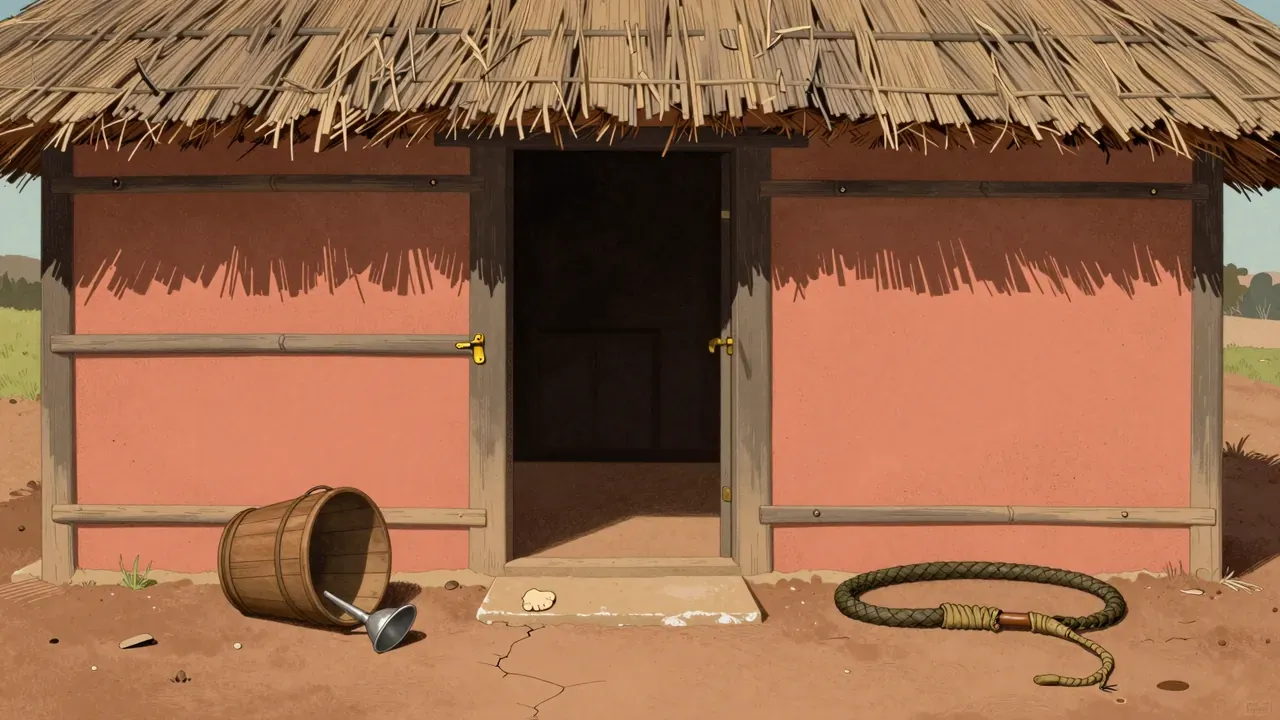
The story follows Edward Parker, a shipwrecked sailor stranded on a remote island ruled by Dr. Moreau, who conducts vivisectional experiments to impose human traits on animals. Karl Struss’ cinematography sustains dread through contrast: deep, unrelieved shadows in the House of Pain, stark silhouettes against jungle foliage, and long takes that let discomfort settle. Charles Laughton’s Moreau moves with precise, reptilian control—his voice low, his gestures economical, his beard and bullwhip functioning as extensions of his will. Kathleen Burke, cast from a nationwide contest, conveys Lota’s fractured consciousness through stillness and sudden flinches; her physicality avoids caricature, anchoring the film’s most disturbing implication—that desire can be surgically implanted, then policed. Bela Lugosi’s Sayer of the Law delivers his chants with liturgical gravity, while Richard Arlen’s Parker remains deliberately thin: a vessel for audience recoil rather than psychological depth. Arthur Johnston’s score is sparse, using dissonant strings and abrupt silences to punctuate moments of revelation or violence. The beast-men, played by wrestlers and stunt performers, move with stiff, jointed menace—their costumes rough-hewn, their speech halting, their presence never fully domesticated.
What lands
What lands most firmly is the film’s oppressive tonal consistency: every frame feels governed by Moreau’s logic, so that even sunlight on Catalina Island carries a forensic chill. Laughton’s performance holds the structure together—not through flamboyance, but through the unnerving clarity of his conviction. His Moreau believes himself righteous, and that belief makes his cruelty legible, not monstrous in the Gothic sense but bureaucratic in its precision. The Law sequences, where beast-men recite prohibitions while trembling under whip-cracks, land with cumulative force because they are staged like religious instruction, not spectacle. Struss’ lighting isolates faces in pools of light, making each confession feel like a coerced self-indictment. The Panther Woman’s final collapse—her body rejecting both her imposed humanity and her enforced desire—is rendered without sentimentality, just a slow, physical unraveling. Even the truncated runtime (70 minutes) works in its favour: there is no digression, no comic relief, no narrative detour to dilute the central premise. The film sustains its thesis—that civilisation is a fragile, violent performance—without wobbling.
What does not
What does not land is the framing device: Parker’s opening and closing narration, delivered with flat urgency, fails to establish emotional stakes or thematic framing. His character functions only as witness, and his reactions—shock, revulsion, flight—are too generic to deepen the film’s moral inquiry. Leila Hyams’ Ruth, introduced late and given little to do beyond embodying conventional virtue, feels grafted on, likely a concession to Production Code anxieties already tightening in late 1932. The beast-men, though physically committed, remain types rather than individuals; their collective identity blurs their suffering into abstraction, weakening the ethical weight of Moreau’s crimes. Some dialogue—particularly the Law chants—veers toward stilted declamation, less incantatory than instructional, robbing them of ritual power. The film’s refusal to visualise the surgical process also works against it: we see the results, but never the act, so the horror stays conceptual rather than embodied. And while the Catalina location work adds texture, the studio interiors—especially the House of Pain—feel stage-bound, their theatricality at odds with the film’s otherwise grounded dread.
The themes that matter
The themes that matter are not those of science run amok, but of sovereignty over the body, the violence of pedagogy, and the fragility of language as a tool of control. Moreau does not merely alter physiology—he imposes syntax, grammar, and taboo, treating speech as another suture to hold his creations together. The Law is not moral instruction but linguistic discipline: ‘Not to go on all fours’ is as vital as ‘Not to eat flesh’. When the beast-men begin to forget, it is not memory failing but language dissolving—syntax collapsing into growls, then silence. This makes the film less about evolution than about coercion disguised as uplift. Colonialism echoes in Moreau’s paternal certainty, his assumption that transformation is benevolent if it conforms to his standard. Sexuality is treated as another site of regulation: Lota’s desire is not hers to express, but a variable Moreau seeks to calibrate. The film’s enduring power lies in how precisely it maps power onto the nervous system—how fear, pain, and repetition rewire instinct, and how easily ‘human’ becomes a title granted, revoked, or withheld.
Who should watch it
This film is for viewers who value atmosphere over exposition, who find unease more compelling than jump scares, and who are prepared to sit with ambiguity rather than seek resolution. It rewards attention to composition, gesture, and pacing—not just what is said, but how long a silence lasts before a whip cracks. It is not for those who require psychological realism in protagonists, who expect narrative closure, or who find slow-burning dread intolerable. Some modern viewers may balk at the racialised undertones in the beast-men’s design and speech patterns, though the film itself offers no commentary on them—it presents them as fact, not critique. Others may find the lack of explicit moral framing frustrating; the film refuses to tell us how to feel about Moreau beyond showing us what he does. A viewer seeking catharsis or redemption will leave unsatisfied. But anyone willing to engage with horror as a mode of ethical inquiry—not just sensation—will find it rigorously sustained.
Is it worth your evening
Yes, it is worth your evening—not as entertainment, but as a compact, unblinking study in power’s architecture. Its seventy minutes pass without slackening, its ideas coiled tight around a single, corrosive question: what remains when you strip away everything that makes us human except the will to command? It demands patience, not least because its pacing assumes an audience accustomed to reading faces and shadows rather than waiting for plot turns. Those who prefer contemporary horror’s emphasis on trauma-as-backstory or survival-as-plot may find it austere. But for anyone interested in how cinema constructs authority—or how horror can function as philosophy in monochrome—it repays close attention. Its restoration history matters: the Criterion edition restores dialogue and scenes censored for decades, confirming that its original impact came from its unflinching logic, not its shocks.