The look of it
La Piscine is a French drama from 1969 that sets out to trace the slow collapse of emotional control among four people confined by heat, proximity and unresolved history. It does not aim for plot propulsion or moral resolution but for sustained atmospheric pressure: the kind built by withheld glances, unspoken histories between actors, and the physical weight of a villa, a pool, and summer light that never softens. Jacques Deray and his co-writers—Jean-Claude Carrière and Alain Page—anchor the film in psychological realism rather than thriller mechanics, treating murder not as climax but as a grimly logical endpoint of accumulated tension. The film’s ambition lies in its restraint: it refuses exposition about past relationships, lets silences accrue meaning, and treats desire and resentment as interchangeable currents beneath polite surfaces. Its setting on the Riviera is not backdrop but condition—luxury as trap, leisure as idleness that exposes character. It works within the conventions of mid-century European art cinema, but with a colder gaze than contemporaries like Antonioni or Resnais: less about alienation from the world, more about the ease with which intimacy curdles into complicity.
The weight of a glance
The story unfolds in measured, almost ritualistic episodes: a scratch, a lash, a swim, a party, a drowning, a cover-up, a silence. Jean-Jacques Tarbès’ cinematography holds the frame steady, favouring medium shots and shallow focus that keep characters physically close but emotionally isolated; he avoids dramatic angles, letting tension emerge from composition and duration instead of movement. Michel Legrand’s score is sparse—piano motifs recur like half-remembered thoughts, never swelling to underscore emotion. Alain Delon plays Jean-Paul with minimal inflection, his stillness reading as calculation rather than vacancy; Romy Schneider’s Marianne moves through scenes with a watchful fatigue, her expressions tightening only when she thinks no one sees. Maurice Ronet’s Harry is all brittle charm and self-sabotage; Jane Birkin’s Penelope is deliberately opaque, her youth a cipher rather than a character arc. Paul Cayatte’s editing sustains rhythm without urgency—cuts land on breaths, not beats—and the production design, including André Courrèges’ swimsuits, treats costume as behavioural shorthand: skin on display, but never vulnerability on offer.
The pace of collapse
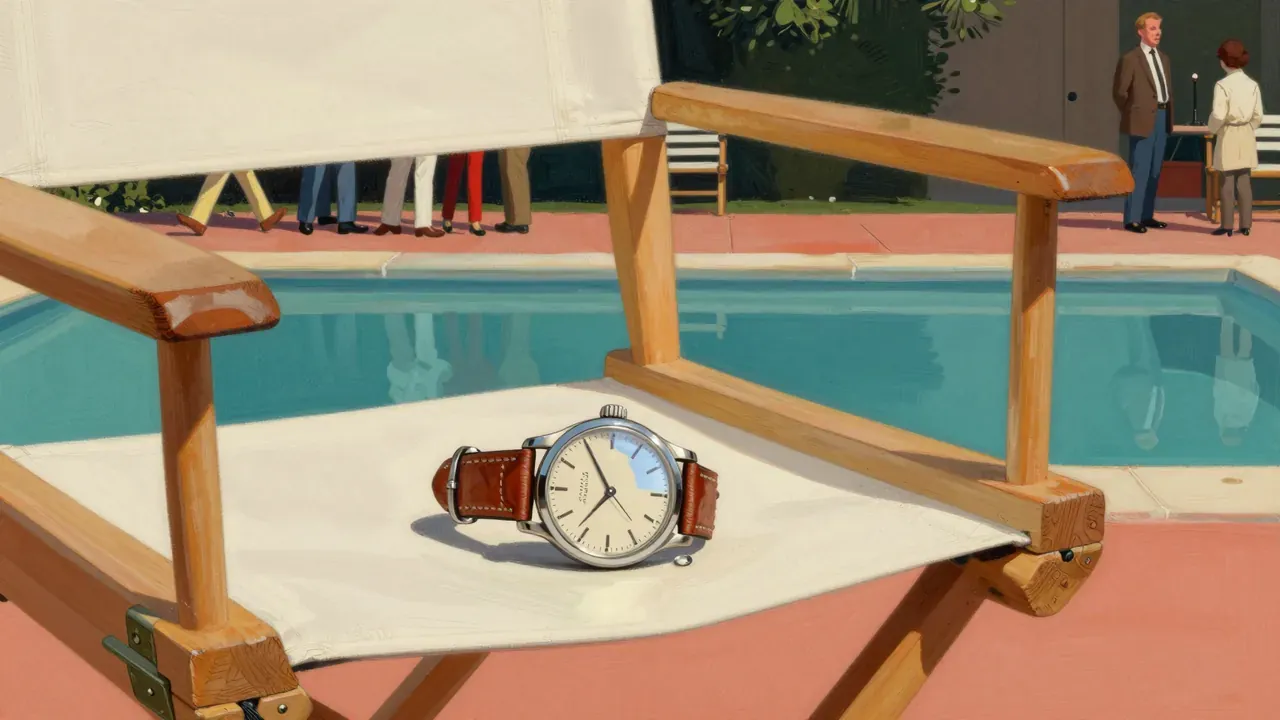
What lands most firmly is the film’s physical texture—the way light pools on wet tile, how sweat glistens on collarbones, how a hand lingers just too long on a bare arm. The swimming pool itself functions as both mirror and morgue: reflective, indifferent, capable of holding life or hiding death. The performances cohere in their shared refusal of catharsis; even the murder feels less like eruption than sedimentary deposit. The ambiguity around Marianne’s final choice—whether her silence is love, fear, resignation or collusion—is sustained without explanation, and the last shot, of two figures embracing while looking out at water they have both used and concealed, lands with quiet force. The film’s pacing, often mistaken for lethargy, in fact enforces the viewer’s participation in the characters’ suspended state: there is no escape from this villa, no cutaway to relief, no music cue to tell you how to feel. That discipline pays off in moments where a glance across a dinner table carries more narrative weight than a monologue would.
The girl by the sea
What does not land is the film’s treatment of Penelope. Though central to the plot’s turning point, her character remains underwritten—not mysterious, but vacant. Her sudden closeness to Jean-Paul lacks grounding, and her departure feels narratively convenient rather than earned. Similarly, Inspector Lévêque’s investigation is reduced to exposition delivered in two brief visits; his suspicion is credible, but his method and motive are left vague, making his eventual withdrawal feel procedural rather than persuasive. The English-language version’s existence, noted in the context, introduces an odd dissonance: though filmed in English for international release, the dialogue retains a stilted, translated quality that undermines the naturalism the film otherwise cultivates. Some viewers may also find the film’s sexual politics dated—not because it depicts power imbalance, but because it treats Marianne’s passivity as inevitable rather than interrogated. The film observes domination without ever questioning its architecture, and that omission sits uneasily alongside its otherwise precise moral scrutiny.
What the water holds
The themes that matter are possession disguised as affection, the illusion of control in relationships built on asymmetry, and the way environment can accelerate decay. The villa is not neutral space but a stage calibrated for confrontation: its open plan forces proximity, its pool invites both recreation and erasure, its isolation removes social consequence. Jealousy here is not reactive but structural—it pre-exists the plot, embedded in the history between Delon and Schneider, Ronet and Schneider, even Delon and Ronet. The film treats memory as a physical presence: every glance at a photograph, every hesitation before a door, every unlit cigarette speaks to what has been buried but not resolved. It also examines the performance of adulthood—how drinking, dressing, hosting and grieving become rituals that mask exhaustion. There is no redemption arc, no revelation that changes behaviour; instead, the film insists that some patterns repeat not because they are inevitable, but because the cost of breaking them is higher than the cost of enduring them.
Who it asks for
This film is for viewers who value atmosphere over exposition, who tolerate ambiguity as a condition rather than a flaw, and who respond to performances that withhold more than they reveal. It suits those familiar with 1960s French cinema’s pacing and syntax, or those willing to adjust to its unhurried rhythms. It is not for viewers who require clear moral positions, narrative closure, or character development that follows cause-and-effect logic. Those who expect psychological realism to include interior monologue, backstory exposition or therapeutic resolution will find it withholding. Nor is it for those who read power dynamics literally: the film presents dominance and submission as ambient conditions, not dramatised conflicts. A viewer who values thematic coherence over plot momentum will find it rich; one who measures drama by incident count will find it inert. Its endurance relies on patience—a quality the film assumes, then rewards.
The embrace at the end
Yes, it is worth your evening—if you approach it as a study in sustained mood rather than a story with destinations. Its 110 minutes unfold with the inevitability of tide turning: no scene feels wasted, no pause unmotivated. The restoration’s re-release success suggests its power lies not in nostalgia but in its unflinching attention to how desire, boredom and resentment occupy the same room. Those who found it ‘gossip-column fodder’ in 1969 missed its formal rigour; those who call it ‘flimsy’ mistake economy for emptiness. It demands nothing beyond attention, and repays it with cumulative precision. A viewer expecting fast cuts, exposition or emotional release will leave dissatisfied—but that is not the film’s failure. It is operating in a different register entirely: one where silence is syntax, and a pool is both setting and subject.