Old crime plots run through new talk
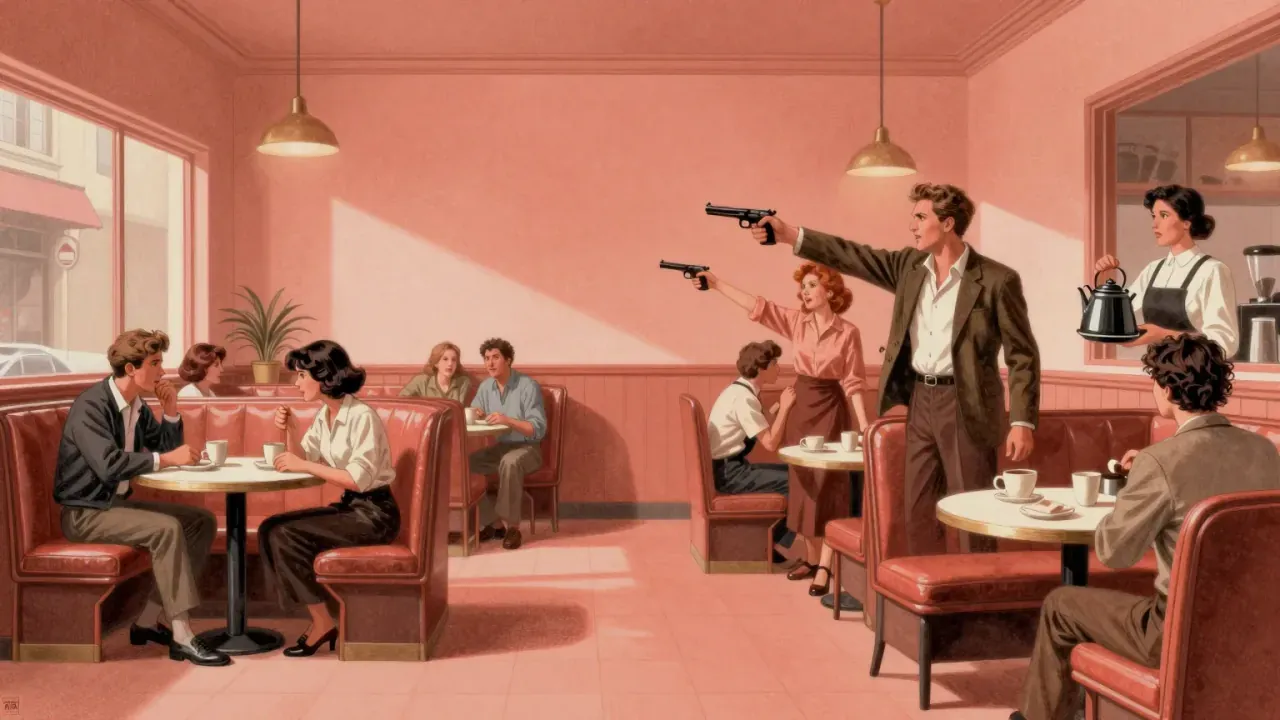
Pulp Fiction is Quentin Tarantino’s 1994 crime film, weaving three stories and a wraparound diner heist through the lower rungs of Los Angeles organised crime: a hitman and a boxer both owing debts to gangster Marsellus Wallace, and a night that turns into an overdose emergency when a mob wife goes out for the evening. Tarantino and Roger Avary built the script from ideas the two had traded since working together at a video store, deliberately taking some of the oldest set-ups in crime fiction and running them through modern, digressive conversation. The chronology is scrambled by design: a character shot dead in one scene turns up alive and joking two scenes later. The intent was less to shock than to see what happens when familiar B-movie plots are populated by people who talk as if they have nowhere else to be.
Three stories, one editing puzzle
Structurally the film interlaces three narratives, involving Vincent Vega and Marsellus Wallace’s wife, a missing gold watch, and a body that needs cleaning up, bookended by a diner robbery shown from different angles at the start and the end. John Travolta and Samuel L. Jackson play hitmen whose job is punctuated by digressions on foot massages and fast food, while Bruce Willis’s boxer Butch is given a detour involving a stolen watch and a pawn shop that turns violent. Andrzej Sekuła’s cinematography favours static, patient framing that lets dialogue run long rather than cutting for emphasis, and Sally Menke’s editing holds the timeline jumps together so the structure reads as a puzzle rather than a confusion. Uma Thurman’s Mia Wallace anchors the film’s most tonally unstable stretch, from dance contest to overdose, without the film settling on how the audience should feel about her.
Where the talk actually works
The dialogue is the engine, and it earns that role: extended exchanges about foot massages, Amsterdam fast food and the etiquette owed to a boss’s wife work as character study disguised as banter, landing because Travolta and Jackson play them completely straight. The adrenaline-shot sequence, drawn from an anecdote in a documentary about a Taxi Driver crew member, is shot and paced for maximum discomfort rather than laughs, and stays genuinely tense despite the film’s overall wit. Jackson’s recitation of scripture before an execution turns a familiar genre beat, the hitman’s monologue, into something that meaningfully complicates his character by the closing scene. The nonlinear structure does real work rather than showing off: it lets a character die and still appear afterwards, and the film uses that trick to earn a note of grace right at the end.
Where the film stalls
The segment involving cleaning up a body in a car, which occupies a significant stretch of the back half, slows the momentum built by the earlier stories, trading incident for one set of characters scrubbing upholstery for the better part of twenty minutes. Some of the racially charged dialogue and slurs, delivered without much interrogation, have not aged as comfortably as the film’s other provocations, and today’s viewers may find the film’s comfort with them harder to read as pure genre pastiche. Rosanna Arquette and Eric Stoltz’s segment as the drug dealer and his girlfriend, while necessary for the plot’s plumbing, is thinly sketched next to the film’s other pairings. And a picture this pleased with its own dialogue occasionally lets a scene run past the point where it is still revealing anything new.
Chance, choice and self-contained worlds
Chance and redemption run under the surface throughout: Vincent’s death is presented as arbitrary, a matter of bad timing rather than moral consequence, while Jules’s decision to walk away from the life is framed as the one instance of a character actually choosing differently. The film treats Los Angeles as a patchwork of self-contained worlds, a boxing gym, a nightclub, a suburban house, a pawn shop basement, each with its own rules the characters must relearn on entry. Pulp fiction as a form, the cheap magazines and paperbacks the title borrows from, is honoured rather than mocked: Tarantino keeps the pleasures of hardboiled plotting, the double-cross, the last-minute rescue, while replacing their clipped prose with dialogue that lingers. Masculinity is tested through composure under threat rather than through violence itself, which is often abrupt and unglamorous when it arrives.
Who the talk is for
This suits viewers who enjoy dialogue-driven scenes that take their time, and anyone curious about a structural experiment that reordered a crime plot without losing clarity, since a rewatch rewards attention to how the timeline fits together. Those who prefer plot to move in a straight line, or who find extended conversational digressions a drag on pacing, will find the film’s rhythms frustrating rather than pleasurable. It is not a film for viewers sensitive to sudden, graphic violence or to racially loaded language delivered without commentary, both of which arrive without warning. Anyone interested in how independent cinema turned into a viable commercial category in the 1990s has particular reason to watch this one, given its outsized financial return against its modest budget.
Whether the runtime pays off
At $8 million to make and $213.9 million taken worldwide, Pulp Fiction is one of the most lopsided successes in modern studio history, and that commercial verdict lines up with the critical one: a Palme d’Or, an Oscar for the screenplay, and aggregate scores in the low nineties that have held up over three decades. The 154-minute runtime is long for a film built this much on talk, but the segmented structure means it never demands two and a half unbroken hours of attention; it can be absorbed in the mental chunks its own storytelling suggests. It rewards a viewer willing to meet its register, amused, unhurried, occasionally cruel, rather than one looking for a straightforward thriller. Measured against what it changed about how crime pictures could sound and how independent films could be financed, an evening spent on it is easily justified.