Three men, a gate, and a story none of them can settle
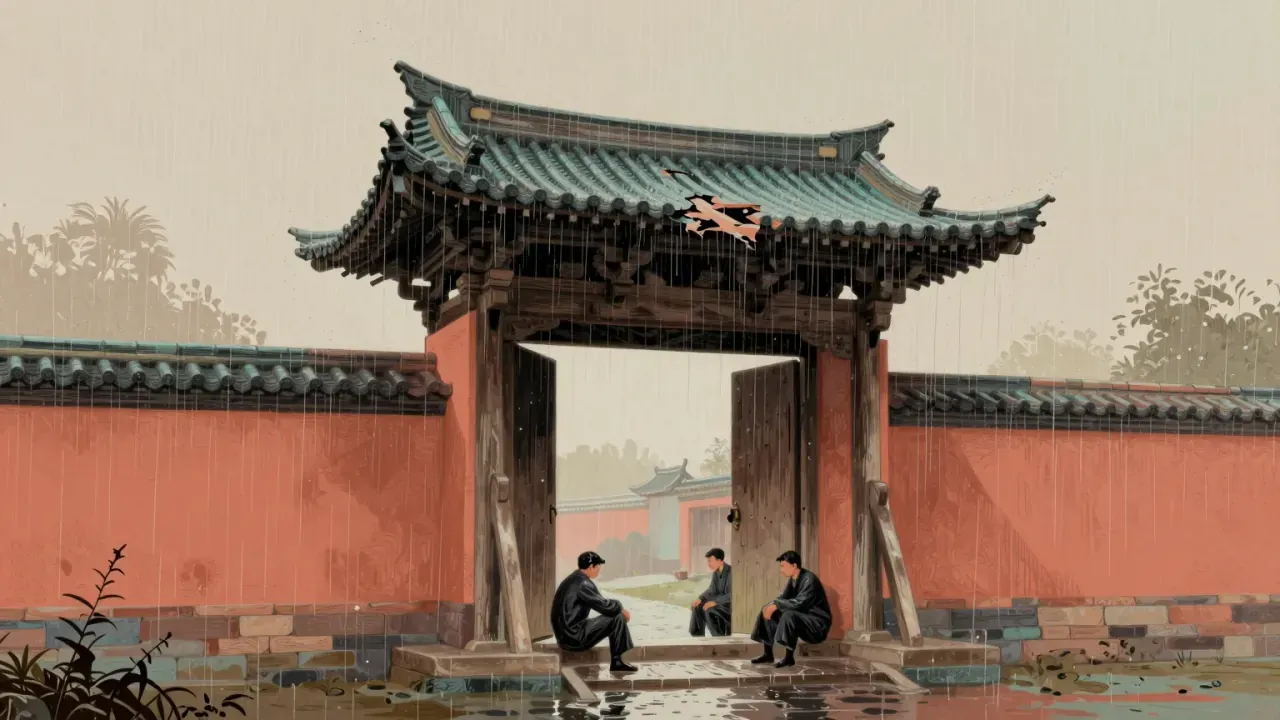
Rashomon opens with a woodcutter and a priest sitting under the crumbling Rashomon gate during a downpour, telling a third man who joins them about a trial they have just witnessed concerning the death of a samurai in a nearby forest. The bulk of the film then replays that trial through four testimonies, from a captured bandit, the samurai’s wife, the dead samurai himself speaking through a medium, and the woodcutter, each describing the same encounter in the forest with different details about who did what and why. Kurosawa is not interested in eventually revealing which account is true so much as in showing that each witness, given the chance to explain themselves, tells a story that happens to leave their own behaviour in the best possible light.
The same killing, four times over
Kazuo Miyagawa’s cinematography includes shots aimed directly into sunlight filtered through forest leaves, a technique that studio convention at the time held would flare or ruin the film, and the resulting dappled, unstable light gives the forest scenes a genuinely disorienting quality that suits the shifting testimony. Toshiro Mifune plays the bandit Tajomaru as loud, animalistic and self-mythologising, while Machiko Kyo, as the wife, adjusts her performance noticeably between versions, meek in one telling and manipulative in another. Fumio Hayasaka’s score borrows the repetitive structure of Ravel’s Boléro for its recurring theme, underlining how the same musical and narrative material returns each time reshaped. Kurosawa’s own editing keeps each version distinct in pace even as the underlying events barely change.
Sunlight shot straight into the lens
The structural trick of showing four accounts of one event without ever cutting to an objective fifth version is handled with total confidence, letting small details, who drew a dagger first, whether the wife fought or consented, shift just enough between tellings to make every version plausible and none of them fully trustworthy. The gate framing device gives the film a second layer of doubt, since even the woodcutter’s supposedly neutral retelling to the priest turns out, by the end, to have left out a detail that implicates him directly. Mifune’s physical performance as the bandit, cackling and sprawling through his own version of events, is the most purely enjoyable piece of acting in the film, and it is deliberately at odds with how restrained he becomes when other witnesses describe him.
A fourth witness who was not entirely honest either
At 88 minutes the film moves quickly, and the compressed pace occasionally leaves each individual testimony feeling more like a demonstration of the structural idea than a fully inhabited scene in its own right, particularly the samurai’s account delivered through a medium, which is the most stylised and least grounded of the four. The framing story at the gate, while thematically necessary, is thinly populated, with the third man serving mainly as a mouthpiece for cynicism the film otherwise complicates elsewhere. Viewers expecting a definitive solution by the end, in the manner of a conventional mystery, will find the film’s refusal to supply one frustrating rather than provocative if they come to it with those expectations.
Self-interest dressed up as memory
The film’s clearest argument is that self-interest shapes memory before memory ever gets to storytelling, so that each witness is not necessarily lying outright but constructing the version of events that lets them live with themselves afterward. Justice, in the form of the trial gathering these testimonies, is shown as structurally incapable of reaching truth when every account serves its speaker’s pride, whether that pride is about courage, fidelity or honour. The closing scene, in which the woodcutter takes in an abandoned infant despite having just been exposed as dishonest himself, offers a small, deliberately modest gesture of decency rather than a resolution to the film’s larger doubt about whether any account of anything can be trusted.
Compact, but not simple
This suits viewers interested in unreliable narration handled with real structural rigour, and it works well as an introduction to Kurosawa or to Japanese cinema more broadly given its short runtime and clear premise. It rewards close attention to small discrepancies between versions rather than passive viewing. It is a slightly frustrating choice for anyone wanting a story that resolves into a clear account of what actually happened, since the film is built specifically to deny that satisfaction. Viewers new to subtitled or older black-and-white cinema will find this one of the more approachable entry points on this list.
A brisk, unsettling ending to sit with
At 88 minutes this is one of the shortest and most efficient films here, with a premise that can be explained in a sentence and an execution that rewards far closer attention than that sentence suggests. Its Golden Lion win at Venice and an honorary Oscar helped establish an international audience for Japanese film at a moment when very little of it reached Western distribution, and the structural device it popularised has since been borrowed, and sometimes flattened, by countless later films and television episodes. Worth an evening on its own terms, not merely as the origin point of a device now used elsewhere.