What it is
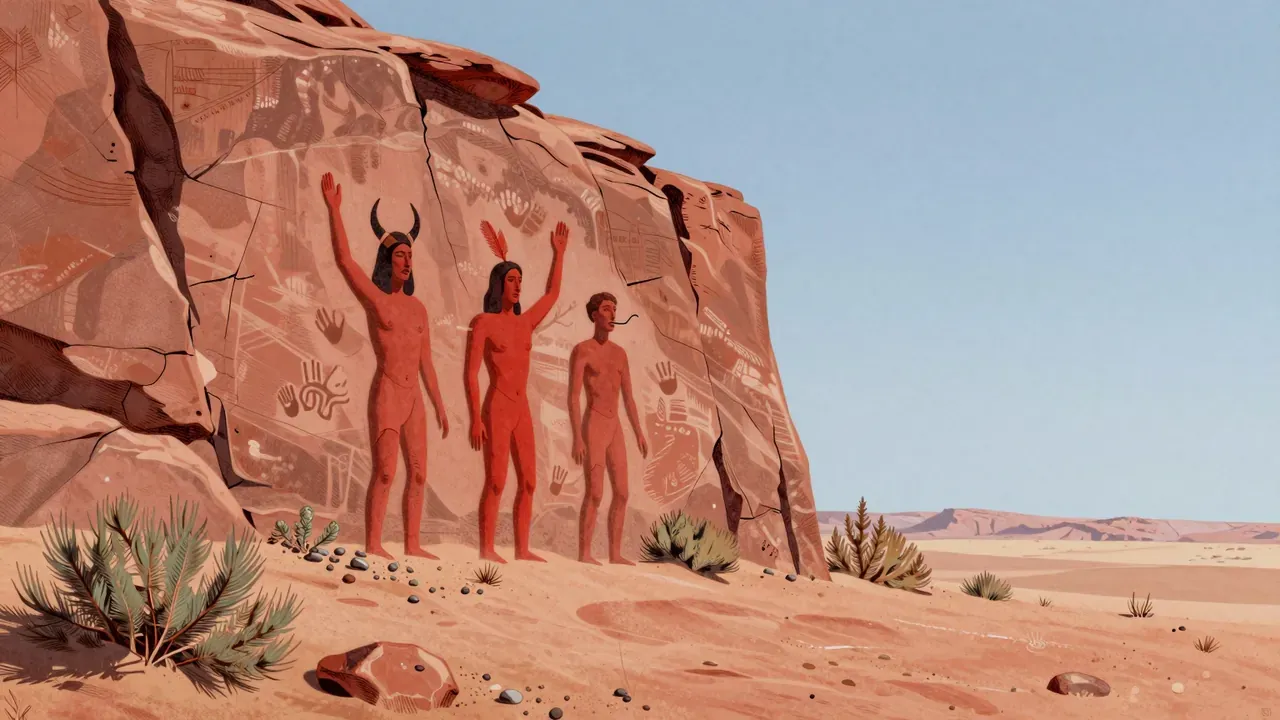
Powaqqatsi is a non-narrative documentary film, the second in Godfrey Reggio’s Qatsi trilogy, released in 1988. It attempts to stage a visual argument about global transition: specifically, the collision between subsistence-based societies and industrial modernity, framed through imagery drawn almost entirely from Africa, Asia, South America and the Middle East. Unlike its predecessor Koyaanisqatsi — which centred on North America and Europe — this film locates its inquiry in what was then termed the ‘Third World’, using sustained, often slow-motion observation to contrast collective labour, ritual, and landscape with incursions of infrastructure, mass movement and mediated imagery. There is no voiceover, no on-screen text, no interviews or exposition. The film relies instead on sequencing, duration, scale and rhythm to propose that industrialisation functions parasitically upon traditional life — a reading embedded in its Hopi-derived title. Its ambition is structural and ethical: to make visible patterns of human effort and displacement without reducing them to illustration or spectacle.
How it moves
The film has no performers in the conventional sense; Cheryl Tiegs appears only as a credited cast member, with no discernible on-screen role. What registers is the physical presence of thousands of uncredited people — miners at Serra Pelada, worshippers in Nepal, children by rivers in West Africa, commuters in Bombay and Cairo — filmed in long takes, often from elevated or fixed positions. Gordon Willis did not shoot this film; Ron Fricke did, and his camera work favours deep focus, steady framing and deliberate pacing, with frequent use of time-lapse and optical printing for layered exposures. Editing is associative rather than linear: chapters such as ‘Mosque and Temple’ or ‘New Cities In Ancient Lands’ group images by texture, motion or symbolic resonance, not geography or chronology. Philip Glass’s score dominates the auditory field — repetitive, cyclical, insistent — and functions less as accompaniment than as a structural counterpoint, binding disparate sequences into a single tonal logic. The absence of dialogue means all meaning accrues through juxtaposition, duration and musical phrasing.
Where it holds
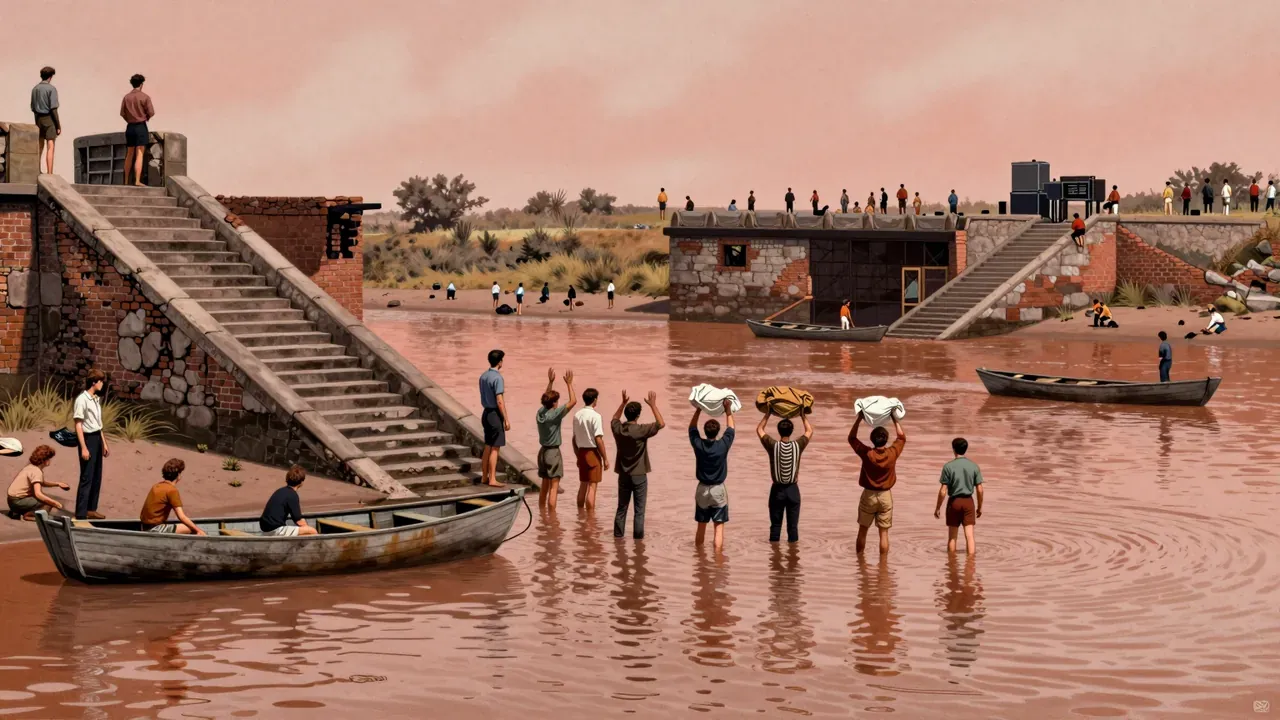
What lands is the sheer physical weight of collective human motion: the ascent of men carrying sacks up the terraced slopes of Serra Pelada, the slow procession across a sun-baked plain in Anthem: Part 3, the rhythmic flow of pedestrians in Delhi or Lagos seen from above. These sequences achieve a kind of gravitas not through explanation but through insistence — repetition, scale and duration combine to produce awe, fatigue and empathy in equal measure. The cross-fade from the dirt carriers to the rotating, multi-exposed head — an allusion to Janus — works precisely because it does not name its reference; it lets the image hold its own ambiguity. Similarly, the final chapter ‘Mr. Suso / From Egypt’ lingers on faces, reflections and call-to-prayer echoes without resolving them into narrative. The film’s strongest moments are those where sound, image and tempo lock into a shared pulse: a boat raising sail timed to a rising string line; waterfalls dissolving into crowds; crows flying over a river synced to a percussive swell. These are not illustrations of ideas but embodied experiences of rhythm and scale.
Where it slips
What does not land is the film’s implied moral hierarchy. Its framing consistently privileges pre-industrial labour and ritual as inherently dignified, while presenting urban density, traffic and advertising — in ‘Video Dream’ and ‘The Unutterable’ — as alienating or dehumanising. This binary flattens complexity: there is no room for agency, negotiation or hybridity in the lives shown. The footage of Serra Pelada, for instance, carries documentary weight, but the film offers no context for why men climb those slopes — whether out of necessity, coercion, hope or choice. Likewise, ‘Video Dream’ treats Western broadcast media as monolithic noise, without acknowledging how those same images circulate within and are repurposed by the very communities the film otherwise portrays with solemn reverence. The critique of ‘First World domination’ remains gestural rather than analytical; it names a condition but avoids tracing cause, consequence or contradiction. The result is a kind of aesthetic paternalism: beautiful, mournful, but ultimately uncurious about the terms of change it laments.
What it thinks about
The themes that matter are transition, scale and reciprocity. Transition appears not as progress or decline but as a state of persistent, uneven becoming — captured in the Janus image, in the recurring motif of ascent and descent, in the shift from village to city, handcraft to machine, silence to broadcast. Scale operates on two levels: the microscopic attention to sweat, dust and breath, and the macroscopic view of crowds, roads and river systems — both treated with equal gravity. Reciprocity is the film’s quietest and most urgent theme: the idea that human life and landscape are not separate domains but interdependent systems, now under strain. This is clearest in sequences where ritual and ecology overlap — a monk by a river, a woman bathing in the Ganges, children playing beside waterfalls — not as picturesque backdrops but as practices rooted in material continuity. The film does not argue for preservation but for recognition: that ways of living embed forms of knowledge about land, time and community that industrial logic tends to erase without accounting for what is lost.
Who it’s for
It is worth watching for viewers who value sustained visual attention, who respond to music-driven structure over verbal exposition, and who are comfortable sitting with ambiguity rather than seeking resolution. It suits those familiar with experimental documentary, with the Qatsi trilogy’s grammar, or with the compositional logic of minimalist music. It is not for viewers who require narrative scaffolding, character development or contextual framing — nor for those expecting critical distance from its subject matter. Some anthropologists and postcolonial scholars have found its gaze ethically thin; others find its formal rigour a necessary corrective to informational overload. A different verdict would follow if the film engaged more directly with voice, history or contradiction — if, for example, it included testimony, archival audio or even on-screen text naming places, dates or economic conditions. As it stands, its power is inseparable from its limitations.
What it asks of you
Yes, it is worth your evening — provided you watch it whole, in darkness, with sound at volume, and without expectation of summary or closure. Its 96 minutes unfold like a single, slow exhalation: demanding patience, rewarding attention, resisting easy interpretation. It works best not as argument but as immersion — a chance to recalibrate perception away from speed and utility toward duration and resonance. Those who find it hollow or pretentious are not wrong; its austerity leaves little room for negotiation. But its images — the layered heads, the gold-dust processions, the river reflections, the muezzin’s call over blurred traffic — lodge in memory not because they explain, but because they persist. It is not a film about the world so much as one that asks you to relearn how to look at it. That recalibration takes time, and it takes space — both of which the film insists upon, and both of which remain rare commodities.