The shape of the journey
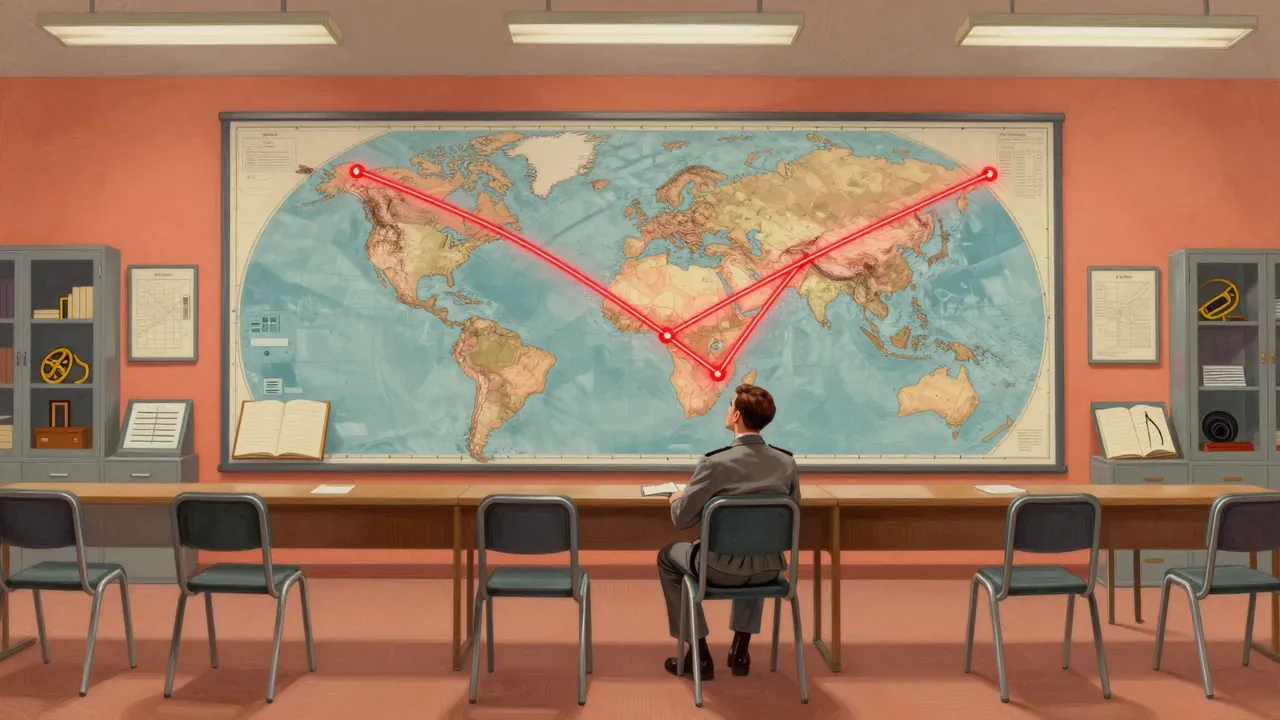
Faces Places is a documentary about two artists making portraits in rural France: Agnès Varda, then eighty-eight, and JR, thirty-three. It sets out to record not just faces but the act of looking — at others, at time, at loss — and to test whether portraiture can hold dignity, memory, and presence across generational and physical distance. The film does not aim for exposé or argument, nor does it seek to map social conditions with statistical rigour; instead, it treats each encounter as a site of mutual recognition, where scale, surface, and visibility become tools for affirmation. Varda’s voiceover names this intention plainly: she wants to see people, and to be seen seeing them. The project’s method — photographing workers, farmers, postwomen, retired miners, then pasting their enlarged images onto barns, factory walls, shipping containers — is both literal and symbolic: it insists on permanence in places marked by decline, and on individuality within communities often rendered invisible by national media. This is not observational documentary. It is collaborative portraiture made visible as process.
The look of it
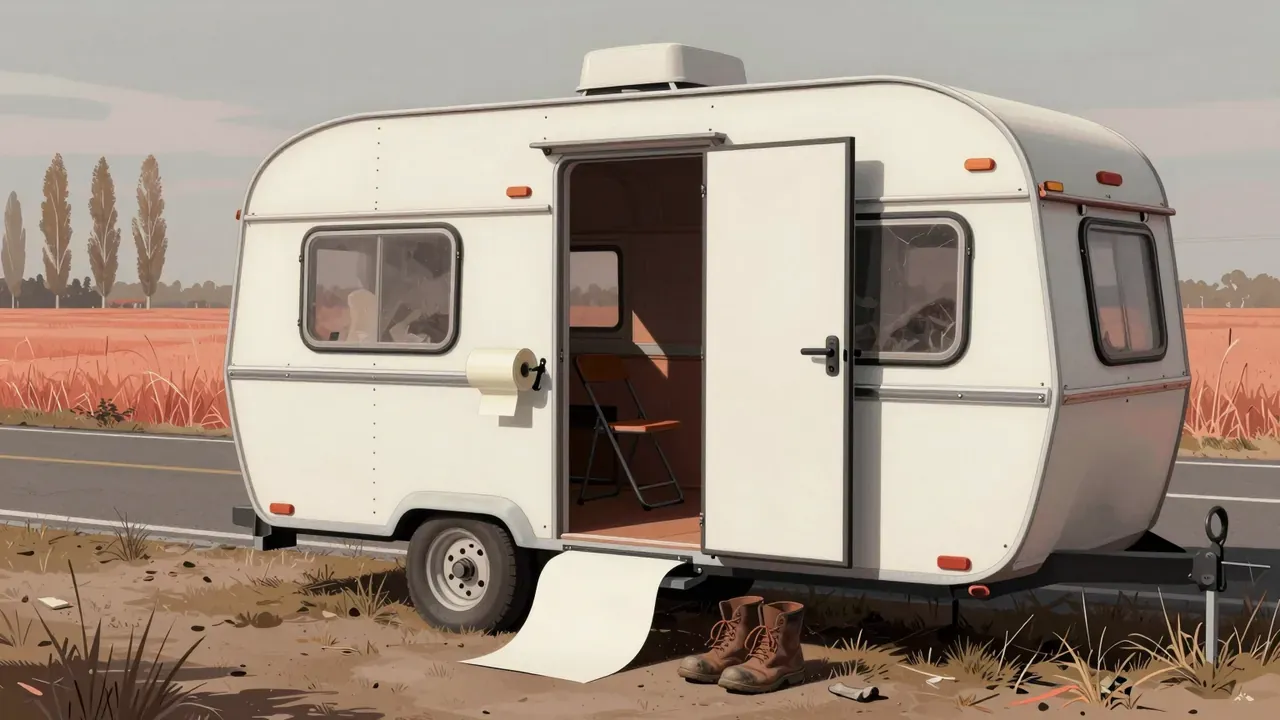
The film unfolds as a road journey through northern and central France, structured around stops rather than narrative arcs. Varda and JR drive, talk, photograph, paste, and reflect. Their performances are unscripted but shaped: Varda speaks directly, often wryly, her voice carrying the weight of decades without strain; JR remains mostly silent behind his sunglasses, his gestures deliberate, his interventions visual rather than verbal. Claire Duguet and Roberto De Angelis shoot in natural light, favouring medium shots and steady compositions that keep focus on hands, eyes, and surfaces — the texture of brick, the grain of skin, the crease of a work jacket. Matthieu Chedid’s score is sparse, acoustic, lightly rhythmic — strings and piano that rise only when needed, never underscoring emotion but marking transitions. Maxime Pozzi-Garcia edits with unhurried continuity: no jump cuts, no rapid montages. Scenes breathe. A shot of a woman’s hands sorting laundry lasts twelve seconds. A long take of JR climbing a ladder to affix a portrait holds until the adhesive dries visibly. The craft serves restraint, not flourish.
What stays with you
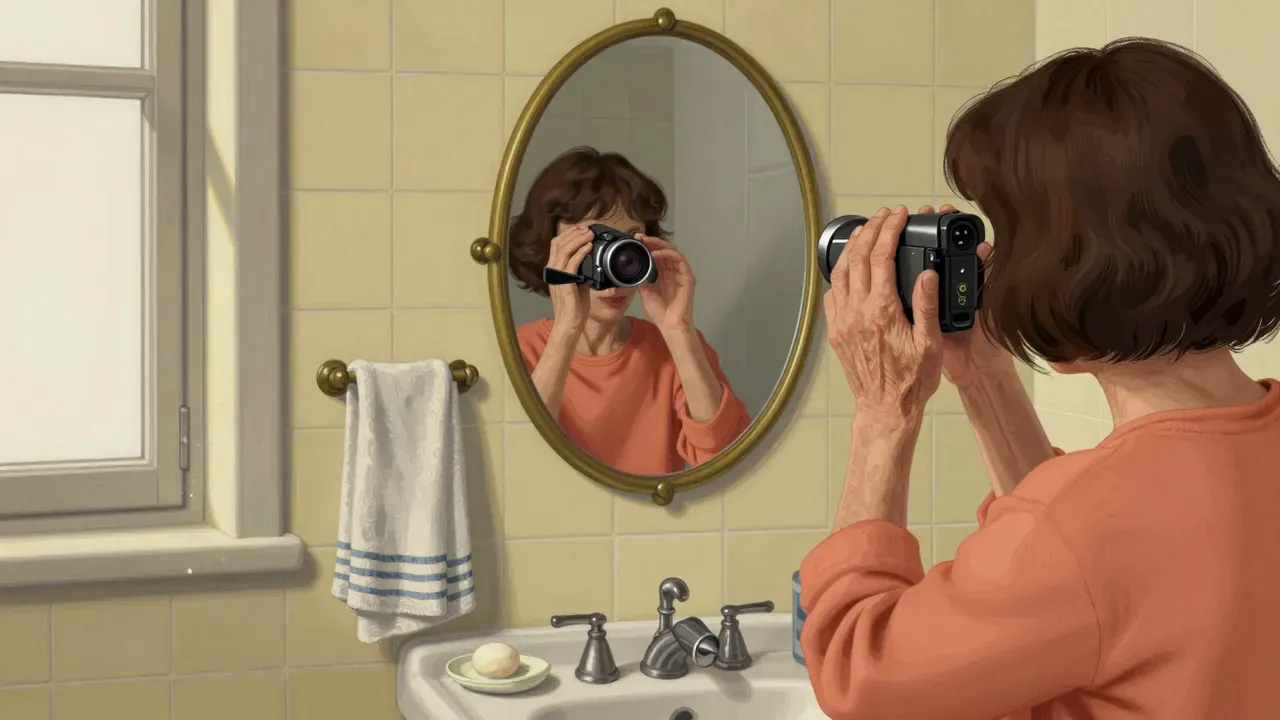
What lands is the quiet accumulation of attention. The film’s power builds not through revelation but repetition: each portrait session follows a similar rhythm — introduction, consent, framing, capture, enlargement, placement — and each variation within that rhythm carries meaning. A miner’s widow stands before her husband’s image pasted on a shuttered pithead; a dairy farmer watches her likeness cover a silo; a group of women factory workers laugh as their faces stretch across a warehouse wall. These moments land because they are grounded in duration and reciprocity. Varda’s frailty is neither hidden nor sentimentalised: she leans on JR’s arm, squints at prints, mishears names, forgets details — and these slips are included without commentary. The film trusts the viewer to register what is at stake: not just art, but care, continuity, and the ethics of representation. When JR removes his sunglasses for Varda near the end, the blurring of his face — caused by her failing vision — becomes the film’s most precise formal statement: sight is partial, memory is fading, but the gesture remains.
Where it stumbles
What does not land is the Godard sequence. Its setup — Varda’s repeated comparisons, the build-up of expectation, the journey to Rolle — gives it structural weight it cannot bear. The refusal feels abrupt, under-contextualised, and tonally dissonant: the rest of the film meets resistance with patience or redirection, but here the door closes with finality, and Varda’s tears arrive without the surrounding scenes’ careful calibration of feeling. The moment risks reducing Godard to a symbol of inaccessible modernism, and Varda to a figure of wounded reverence — a simplification the film otherwise avoids. Similarly, the film’s treatment of JR’s anonymity sits uneasily beside its commitment to visibility: his face stays obscured even as his artistic labour is foregrounded, and the explanation — that he protects his privacy — feels insufficient against the film’s own insistence on exposure as generosity. There is no reckoning with the asymmetry: Varda offers her life, her body, her history; JR offers his work, his back, his silhouette.
What it’s really about
The themes that matter are mortality, scale, and the politics of looking. Varda’s failing eyesight is not metaphor but condition: it shapes every framing decision, every edit, every pause. Her awareness of time’s narrowing is constant, yet never despairing — it sharpens her curiosity. Scale operates on three levels: the physical enlargement of portraits, the geographic smallness of the villages visited, and the historical magnitude of Varda’s career, which the film acknowledges without nostalgia. The politics of looking emerge in who is chosen, how they are framed, and who holds the camera. The subjects are almost all working-class, many elderly, several women who have spent lifetimes unseen by national culture. Their portraits do not aestheticise labour or poverty; they assert presence on their own terms. The film also examines the limits of empathy: JR’s silence, Varda’s blindness, Godard’s door — all suggest that connection is real but never total. What matters is not understanding fully, but showing up, listening, and sticking the image to the wall.
Who it’s for
This film is for viewers who value slowness over exposition, gesture over speech, and collaboration over authorship. It suits those comfortable with ambiguity, who do not require resolution or closure, and who find meaning in accumulated detail rather than plotted revelation. It is not for viewers who expect documentaries to diagnose, explain, or advocate — there is no voiceover analysis of deindustrialisation, no statistics on rural depopulation, no expert interviews. Nor is it for those who need emotional cues amplified by music or editing: the film refuses to tell you how to feel. Someone who found Varda’s earlier works too elliptical, or who finds JR’s public persona opaque, may leave unconvinced. A change in verdict would follow if the film were re-cut to clarify its stance on anonymity — either by naming JR’s reasons more concretely, or by integrating his identity into the visual grammar — but as it stands, the tension remains part of its honesty.
Is it worth your evening
Yes, it is worth your evening: ninety minutes spent watching Faces Places is time spent in the company of two artists who treat attention as an ethical act. It rewards patience, not concentration; it asks for presence, not interpretation. You do not need prior knowledge of Varda’s films or JR’s installations — the film introduces both through action, not biography. What makes it worthwhile is its consistency of tone and purpose: every shot, every edit, every pause serves the same quiet insistence — that people matter, that places hold memory, and that art made with care can be both modest and enduring. Someone who values documentary as witness rather than argument will find it generous. Someone who needs clarity of intent or narrative propulsion may feel adrift. But the film’s strength is not in delivering answers; it is in sustaining a question — how do we see each other, really? — and refusing to look away from the difficulty of the answer.