The shape of the fight
Drunken Master is a Hong Kong action comedy from 1978 that sets out to fuse disciplined martial arts choreography with sustained, character-rooted farce. It does not aim for realism in its kung fu — the ‘Drunken Boxing’ is a theatrical invention, not a documented system — nor does it treat its folklore lightly: Wong Fei-hung and Beggar So are figures drawn from Cantonese oral tradition, here reimagined as archetypes in a moral fable about discipline, humility, and embodied learning. The film’s ambition is structural as much as tonal: it builds its comedy from physical cause-and-effect — a slap leads to a stumble, a stumble triggers a cascade of improvised movement — while anchoring that chaos in a clear pedagogical arc. Yuen Woo-ping and Ng See-yuen do not disguise the studio setting or the stunt rigging; instead, they foreground the labour of training, repetition, and failure. This is not escapism dressed as instruction, but instruction staged as spectacle — a film where every bruise serves narrative logic, and every pratfall tightens the bond between teacher and student. Its project is precise: to make mastery legible, funny, and physically undeniable. (158 words)
The look of it
The story follows Wong Fei-hung’s enforced apprenticeship under Beggar So, moving from arrogance to submission to synthesis — a progression mirrored in Jackie Chan’s performance, which balances cocky physicality with genuine vulnerability in moments of exhaustion and shame. Yuen Siu-tien’s Beggar So is neither caricature nor sage: his drunkenness is tactical, his cruelty calibrated, his silence more instructive than his speeches. Hwang Jang-lee’s Thunderleg functions as pure kinetic counterpoint — all high kicks and unblinking menace — allowing the film’s final fight to pivot on rhythm and adaptation rather than brute force. Cheung Hoi’s cinematography stays close, favouring medium shots and shallow focus that keep limbs, faces, and floor space equally legible. The editing avoids rapid cuts; fights unfold in sustained takes where weight, timing, and recovery matter. Stanley Chow’s score uses folk motifs sparingly, letting ambient noise — clattering pots, shuffling feet, laboured breath — carry much of the film’s texture. The choreography treats each style — Crane, Tiger, Drunken Miss Ho — as a distinct vocabulary, not just visual variety. Every movement has consequence, every fall lands with audible impact. (159 words)
The rhythm of learning
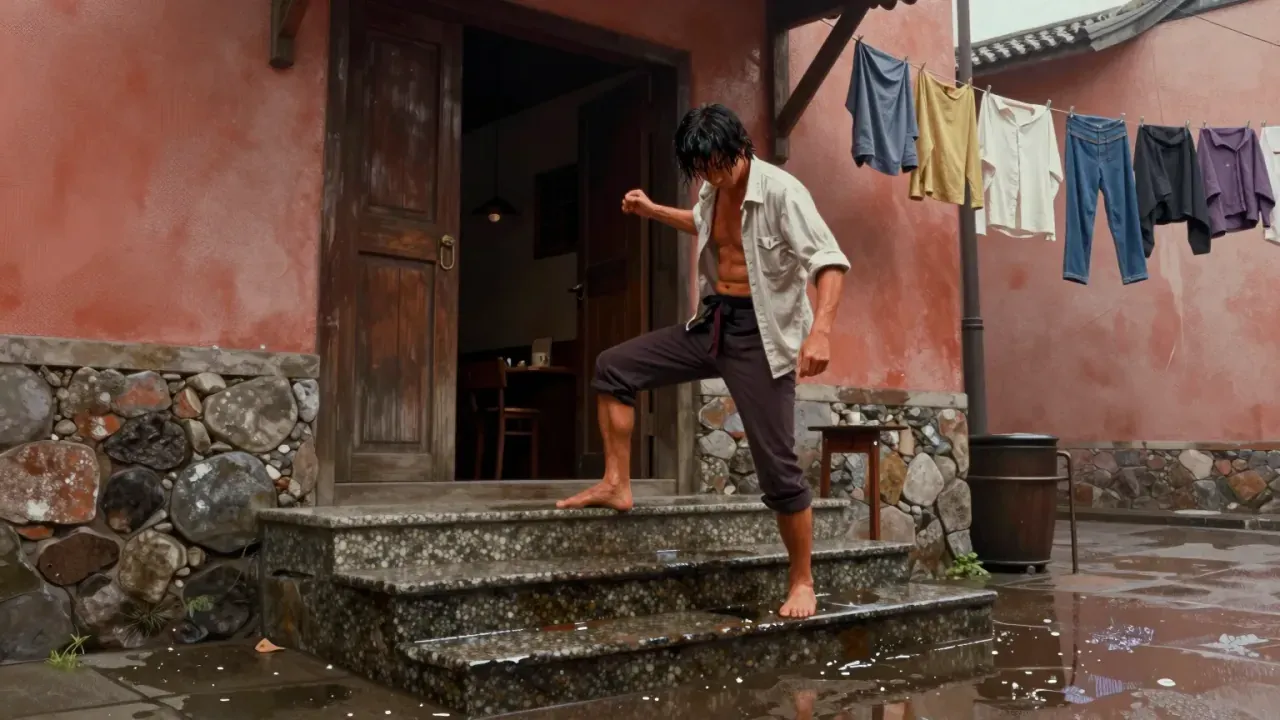
What lands is the integrity of the physical logic. When Wong fails a drill — slipping on wet stone, misjudging a leap, overcommitting to a feint — the failure feels earned, not scripted for laughs. The comedy emerges from his body’s resistance to control, not from gags imposed upon it. The restaurant sequence, where Wong tries to con a meal and discovers the ‘drunkard’ is the owner, works because the escalation is grounded in social embarrassment, not absurdity: his panic is recognisable, his improvisation desperate and clumsy. The training montage avoids montaging time away; instead, it shows repeated attempts, incremental adjustments, sore muscles, and stolen naps — a rare depiction of skill acquisition that honours fatigue. Even the climactic fight holds to this: Wong does not suddenly ‘get good’, but synthesises what he has absorbed, adapting the seven Drunken Immortal styles mid-combat when faced with an unforeseen technique. The film trusts the audience to follow cause and effect without exposition. Its emotional register stays narrow — pride, shame, frustration, dawning respect — but that narrowness gives the shifts real weight. There is no sentimentality, only earned quiet between blows. (156 words)
The edges of the frame
What does not land is the framing of Wong’s early misconduct as mere youthful folly. His harassment of a woman — presented as bravado to impress friends — is softened by revelation that she is his cousin, but the film offers no reckoning beyond his father’s disapproval and subsequent punishment. The narrative treats the incident as comic misidentification, not ethical breach, and the aunt’s thrashing reads as corrective slapstick rather than moral consequence. Similarly, the film’s treatment of class and power remains surface-level: Wong’s father is a respected physician and martial artist, his antagonists are either comic bullies or exoticised villains — Thunderleg’s Korean identity is flattened into a monolithic ‘foreign threat’ defined solely by kicking prowess. The supporting cast, particularly Dean Shek’s professor and Lam Kau’s father, are functional rather than dimensional; their motivations exist only to move Wong from one lesson to the next. The film’s refusal to linger on social context — the late Qing dynasty setting, the colonial pressures on Canton — means its folklore feels decorative rather than anchored. Its moral universe is strictly interpersonal, never political. That choice is coherent, but it limits resonance beyond the immediate arc. (157 words)
The weight of discipline
The themes that matter are pedagogy as transformation, not transmission; humility as physical posture before it is moral stance; and knowledge as something that must be metabolised, not memorised. The film treats mastery not as the acquisition of secrets but as the rewiring of instinct — Wong does not learn ‘Drunken Miss Ho’ as a set routine, but arrives at it through failure, then improvisation, then synthesis. His final victory rests on abandoning imitation for invention, a shift the film signals not with a speech but with a change in footwork and breath. The relationship between Wong and Beggar So avoids the cliché of surrogate fatherhood: So is not nurturing, but exacting; his care is expressed in withheld mercy, in refusing to let Wong rest. The film also treats pain as pedagogical infrastructure — bruises, sprains, and exhaustion are not setbacks but data points, feedback loops in real time. There is no ‘natural talent’ mythologised here; skill is shown as cumulative, iterative, and deeply bodily. Even the folkloric framework — the Eight Immortals, the drunken archetype — serves this: each immortal represents a different state of imbalance that must be mastered before equilibrium can emerge. The film’s philosophy is stoic, not mystical. (155 words)
Who walks away with it
This film is for viewers who value choreographic intelligence over narrative complexity, who find pleasure in watching bodies solve problems in real time, and who accept that comedy can be built from repetition, timing, and consequence rather than setup-punchline structures. It rewards attention to physical detail: how a shoulder drops before a feint, how breath changes mid-kick, how weight shifts during recovery. It is not for those who require psychological realism, sustained emotional arcs, or thematic ambiguity — Wong’s growth is linear, his antagonists symbolic, his world morally uncluttered. Anyone expecting historical fidelity to Qing-era Canton or sociological depth will be disappointed; the film uses its setting as backdrop, not subject. Those who dislike prolonged physical discomfort — the training scenes are deliberately gruelling to watch — may find it exhausting. A viewer who values subtext over text, or irony over sincerity, will likely feel alienated. The film assumes goodwill toward its formal commitments: if you reject its premise that discipline is inherently dramatic, nothing else will convince you. (158 words)
The time it takes
Yes, it is worth your evening — provided you watch it as a demonstration of craft, not a story to be decoded. Its 110 minutes pass with the momentum of a well-structured kata: each sequence has clear intent, internal logic, and cumulative weight. It repays rewatching not for hidden meaning but for missed details — a shift in hand placement, a delayed reaction, a subtle adjustment of stance that foreshadows a later solution. Those who dismiss it as ‘just old kung fu’ mistake its rigour for simplicity. Critics who rate it highly on aggregate platforms do so for its influence and execution, not its depth — and that verdict holds. Anyone who finds modern action films emotionally hollow or choreographically incoherent may find Drunken Master startlingly direct. It does not ask for suspension of disbelief; it asks for attention to belief made physical. To call it ‘light’ is to misunderstand its density. It is demanding in its economy, generous in its clarity, and utterly unsentimental in its vision of what it takes to become someone else. (159 words)