The reason they’re back
My Lucky Stars is a Hong Kong action comedy built around ensemble physical humour and choreographed mayhem, not narrative cohesion or character depth. It aims to sustain momentum through rapid-fire gags, recurring slapstick motifs—especially involving food, mistaken identity, and inept authority—and escalating set-pieces staged in Tokyo’s Fuji-Q Highland amusement park. The film treats plot as scaffolding: a thin pretext for reuniting the ‘Five Lucky Stars’ troupe under new names and looser affiliations than in Winners and Sinners. Sammo Hung directs with a focus on group rhythm over individual arcs; Jackie Chan’s presence is leveraged for star power rather than screen time, his role deliberately deferred until the final act. The film assumes familiarity with the troupe’s shared history—the Peking Opera School lineage, their prior collaborations—and builds its comedy on contrast: trained martial artists playing bumbling civilians, disciplined fighters reduced to scrambling over rollercoaster tracks or hiding inside funhouse mirrors. It is not trying to surprise with story, but to reaffirm a style: communal, tactile, unpretentious, and calibrated for repeat viewings where timing and placement matter more than revelation. (158 words)
The shape of the chase
The story follows a loose chain of coercion and improvisation: a corrupt cop flees to Tokyo, two Hong Kong officers pursue him, one is captured, and the other summons childhood friends—petty crooks and day labourers—to stage a rescue. Their recruitment hinges on media blackmail, a device that lands as absurd rather than cynical, because the film never pretends its characters care about legality. Performances are broad but precise: Sammo Hung anchors the group as Kidstuff, balancing exasperation and competence; Yuen Biao’s Ricky is earnest and physically committed; Eric Tsang and Stanley Fung lean into caricature without flattening it. Arthur Wong’s cinematography keeps wide shots open for choreography, avoids tight close-ups during fights, and uses Fuji-Q Highland’s garish neon and looping architecture to heighten disorientation. Michael Lai and Siu-Lam Tang’s score favours jaunty brass and percussive stings, punctuating gags rather than underscoring emotion. Editing favours continuity of motion over dramatic emphasis—fights unfold in medium-long takes, letting bodies occupy space and collide with weight. There is no attempt at realism, only consistency within its own logic of escalation and return. (159 words)
The weight of a dumpling
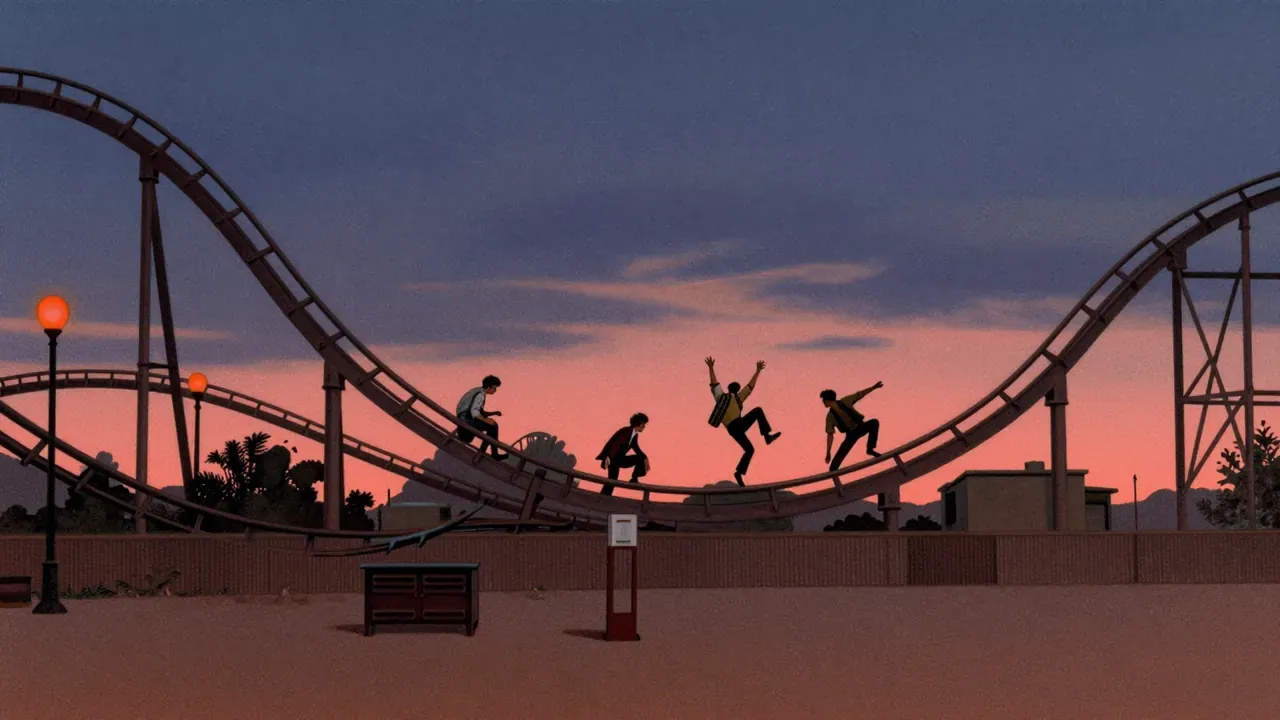
What lands is the group’s chemistry, forged over years of shared training and prior films. Their comic timing relies on asymmetry: Sammo Hung’s grounded control against Eric Tsang’s flustered energy, Richard Ng’s deadpan delivery undercutting Charlie Chin’s faux-American swagger. The amusement park setting works precisely because it is both literal and metaphorical—a place of artifice where rules are suspended, allowing ninjas to drop from popcorn machines and villains to hide behind haunted-house facades. Physical gags land when they follow clear cause and effect: a thrown dumpling leads to a slip, which triggers a domino collapse of scaffolding. The film’s best sequence—the infiltration of the mob’s underground lair via fake money shipment—succeeds because it layers deception, misdirection, and sudden violence without pausing for exposition. Even minor roles register: Lam Ching-ying’s turn as the renegade cop carries a quiet menace that makes his eventual defeat feel earned, not arbitrary. Sibelle Hu’s Swordflower avoids tokenism by refusing to be either damsel or disciplinarian; her presence unsettles the group’s dynamic without resolving it. These elements cohere because the film trusts repetition, variation, and spatial awareness over novelty. (157 words)
The badge and the bluff
What does not land is the framing device of police legitimacy. The Hong Kong Royal Police Force is presented as monolithic and incorruptible, yet its methods—including media fabrication to coerce civilians into service—are treated as harmless farce. This undermines any stakes the plot tries to establish. Jackie Chan’s late entrance feels less like a structural choice and more like contractual compromise; his absence for much of the runtime leaves the central mission emotionally unanchored. The film also falters when it attempts pathos: a brief orphanage flashback adds nothing to character motivation and interrupts rhythm without payoff. Some gags rely on ethnic or regional stereotypes—Charlie Chin’s ‘American Ginseng’ persona, for instance—whose humour depends on audience familiarity with 1980s Hong Kong perceptions of overseas Chinese, making them period-bound and occasionally awkward today. The final reward—a housing unit—is narratively hollow, offering no resolution to the characters’ established rootlessness or petty criminality. The film’s refusal to acknowledge consequence extends to its villains: Paul Chang’s gang chief lacks dimension beyond costume and posture, and Dick Wei’s henchman is purely functional. Without moral or emotional friction, the climax resolves mechanically, not meaningfully. (159 words)
The language they share
The themes that matter are loyalty as habit, not principle, and competence as collective rather than individual. The Lucky Stars do not reunite out of duty or ideology, but because they have no better option—and because their shared language is physical, not verbal. Their skills are real—martial, acrobatic, improvisational—but they are deployed in service of evasion, disguise, and survival, not justice or reform. The film quietly critiques institutional authority: the police supervisor manipulates the press; the yakuza operate beneath public spectacle; even the amusement park is a front for hidden infrastructure. Yet it offers no alternative structure—only the temporary solidarity of the troupe. Class is present but unexamined: the Stars are all working poor or ex-cons, yet their poverty is aestheticised, never interrogated. What persists is a vision of masculinity rooted in mutual reliance, where strength is measured in how well you catch someone falling, not how hard you hit. Nostalgia operates not for childhood, but for a mode of collaboration that predates studio systems, contracts, or hierarchy—rooted instead in the Peking Opera School’s communal discipline. That tradition is the film’s true subject, not crime or Japan. (156 words)
Who this film speaks to
This film is for viewers who value choreographic intelligence over narrative precision, and who recognise physical comedy as a craft requiring rehearsal, trust, and spatial memory. It rewards attention to footwork, reaction timing, and how a gag escalates across three shots rather than one punchline. It is not for those who require psychological consistency, moral clarity, or sustained focus on a single protagonist. Anyone expecting Jackie Chan to carry the film—or seeking coherent world-building, thematic development, or character growth—will find it thin. Fans of Yuen Biao’s stunt work or Lam Ching-ying’s restrained menace will find ample reason to watch, but those put off by mid-1980s Cantonese dubbing, uncredited cameos, or long takes of men rolling down hills will not be converted. A viewer who dislikes ensemble-driven farce or finds repetitive visual motifs tedious would reasonably reject it—not because it fails on its own terms, but because those terms assume a shared cultural grammar of Hong Kong studio comedy that is now niche. Change the expectation from ‘story’ to ‘movement’, and the verdict shifts. (158 words)
Why it holds up
Yes, it is worth your evening—if you approach it as a demonstration of group-based action choreography, not as a plotted narrative. Its ninety-six minutes move briskly, rarely pausing for exposition, and its best sequences—particularly the amusement park finale—sustain tension through geography, not dialogue. You will not leave with new insights about justice or identity, but you may notice how often a character’s hand position changes between shots, or how a thrown object initiates a chain reaction across three bodies. It is worth watching once for its energy, twice for its construction. Those who find its pacing too frantic, its humour too broad, or its politics too light will not warm to it on repeat viewings; the film makes no concessions to slower rhythms or quieter tones. Its value lies in its specificity: a snapshot of a particular troupe, at a particular studio, using a particular set of physical tools. To dismiss it as ‘just comedy’ is to miss how much craft is embedded in what looks like chaos. It earns its time by refusing to waste a single frame on irrelevance. (159 words)