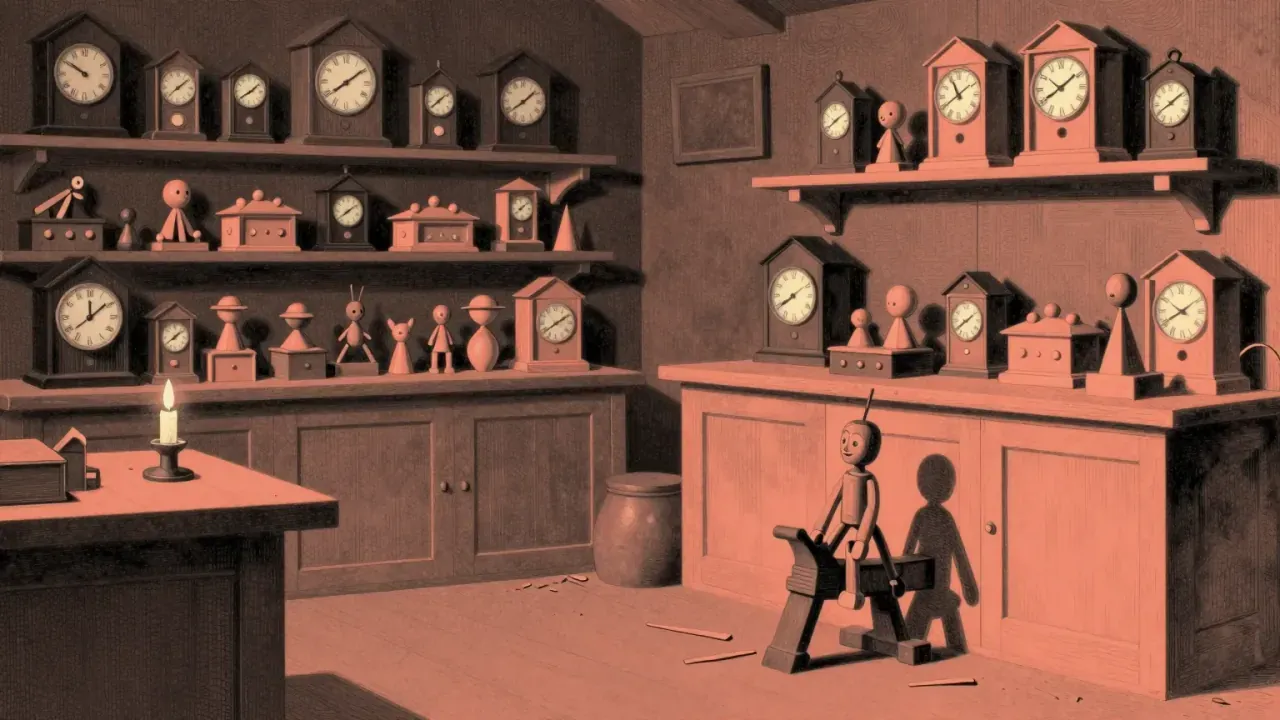
A puppet nobody could like
Pinocchio follows a wooden puppet brought to life by a blue fairy on the condition that he prove himself brave, truthful and unselfish before he can become a real boy, with a cricket named Jiminy assigned to steer him straight. Animator Norman Ferguson brought Carlo Collodi’s novel to Walt Disney’s attention in September 1937, during production on Snow White, and Disney was reportedly so enthusiastic he commissioned an outline almost immediately, only to find it too faithful to a source book whose title character is genuinely unpleasant. The studio spent $2.5 million on the film, intended originally as its third feature after Bambi, but swapped the two productions when Bambi’s animal animation proved too difficult to finish in time.
The cricket who was almost killed off
Getting Pinocchio’s design and personality right took over a year. Early animation by Frank Thomas and Ollie Johnston kept him looking like an actual wooden puppet — pointed nose, bare wooden hands — and Disney halted production, unconvinced anyone could sympathise with a character that rigid. Animator Milt Kahl argued the team should stop thinking of him as a puppet first and a boy second, and an underwater test sequence he produced convinced Disney to redesign the character with a child’s proportions and gloved cartoon hands. Jiminy Cricket underwent an even stranger revision: in the earliest drafts, the talking cricket is a minor character Pinocchio kills with a mallet and who returns as a ghost, before the writers rebuilt him into the puppet’s ongoing conscience.
Water, smoke and lightning as animation problems
The film’s most striking achievement is in its effects animation — rain, underwater currents, smoke, lightning and moving shadow are rendered with a realism the studio hadn’t attempted in Snow White, and the difference is visible in nearly every outdoor sequence. Cliff Edwards, known professionally as Ukulele Ike, voices Jiminy with a warmth that makes the character’s narrating presence bearable across ninety minutes rather than grating, a reasonable risk given this was the first time an animated Disney feature had cast a recognisable celebrity voice. Christian Rub’s Geppetto, modelled visually on Rub’s own face, gives the film its most straightforwardly affecting performance, playing loneliness and hope with more restraint than the plot around him strictly requires.
A morality tale with genuinely frightening detours
Pleasure Island, where wayward boys are transformed into donkeys and sold into forced labour, commits to body-horror imagery well past what the rest of the film’s tone prepares an audience for — a boy’s transformation into a braying, panicked animal is genuinely upsetting rather than cautionary in a comfortable way. That tonal jump is one of the film’s more interesting choices: rather than softening the consequence of Pinocchio’s bad decisions, the animators made it as frightening as anything in the studio’s early output. It sits oddly next to the surrounding morality-tale structure, which otherwise resolves each of Pinocchio’s mistakes fairly gently.
Temptation staged as a series of strangers
Structurally, the film is a series of encounters with adults who each represent a specific temptation — Honest John’s flattery, Stromboli’s exploitation, the Coachman’s traffic in ruined children — and Pinocchio’s arc is less about developing a personality than about learning to recognise manipulation when it’s aimed at him. That makes him a relatively passive protagonist by design: the film’s real interest is in cataloguing the different shapes bad influence can take, from a friendly stranger to an employer to a con man running an entire island. Geppetto’s wish for a son and Jiminy’s assigned role as conscience frame the whole thing as being about guidance — who provides it, who ignores it, and what it costs to need it in the first place.
Who this is for
This suits viewers interested in the technical side of early feature animation, since the water, smoke and lighting work here represents a real jump from what came before it. It also plays well for children old enough to handle a couple of genuinely frightening stretches — Pleasure Island in particular — without being upset by them. It’s a weaker choice for very young or easily frightened children, and modern viewers expecting a more active central character than Pinocchio, who spends much of the film being led rather than choosing, may find him thin as a protagonist even while the world around him stays interesting.
Is it worth the evening
The film won the Academy Award for Best Original Score, the first competitive Oscar given to an animated feature, and now sits at 100% on Rotten Tomatoes and 99 on Metacritic — figures that reflect long-run critical reassessment rather than its original commercial fortunes, since wartime losses of the European and Asian markets meant it was initially a financial disappointment before turning a profit on its 1945 rerelease. What holds up best isn’t the moral scaffolding, which is fairly blunt, but the effects work and the genuine unease of its darker detours. Worth the evening, especially for anyone curious how far Disney’s technical ambitions had already moved in just the three years since Snow White.