The politics of the pocket
Pickup on South Street is a Cold War crime thriller disguised as a New York street-level heist film. It sets out to compress the moral ambiguity of espionage into the cramped, unglamorous world of petty theft and waterfront grift, using the microfilm MacGuffin not as a plot device but as a litmus test for loyalty, self-interest and ideological indifference. Samuel Fuller, writing and directing, treats patriotism as a transactional proposition — one that Skip McCoy refuses to honour until it suits him — and frames the Communist threat not through grand ideology but through the physical menace of Joey’s beatings and the quiet desperation of Candy’s double life. The film avoids courtroom theatrics or bureaucratic procedure; its law enforcement operates in back rooms and subway tunnels, its spies move through pawnshops and flophouses. Fuller’s aim is not to resolve the Cold War but to show how its tensions seep into the nervous system of the city, where a pickpocket’s ethics matter more than a senator’s speeches. It is a deliberately abrasive, low-ceilinged vision of national security as street crime with higher stakes.
The look of it
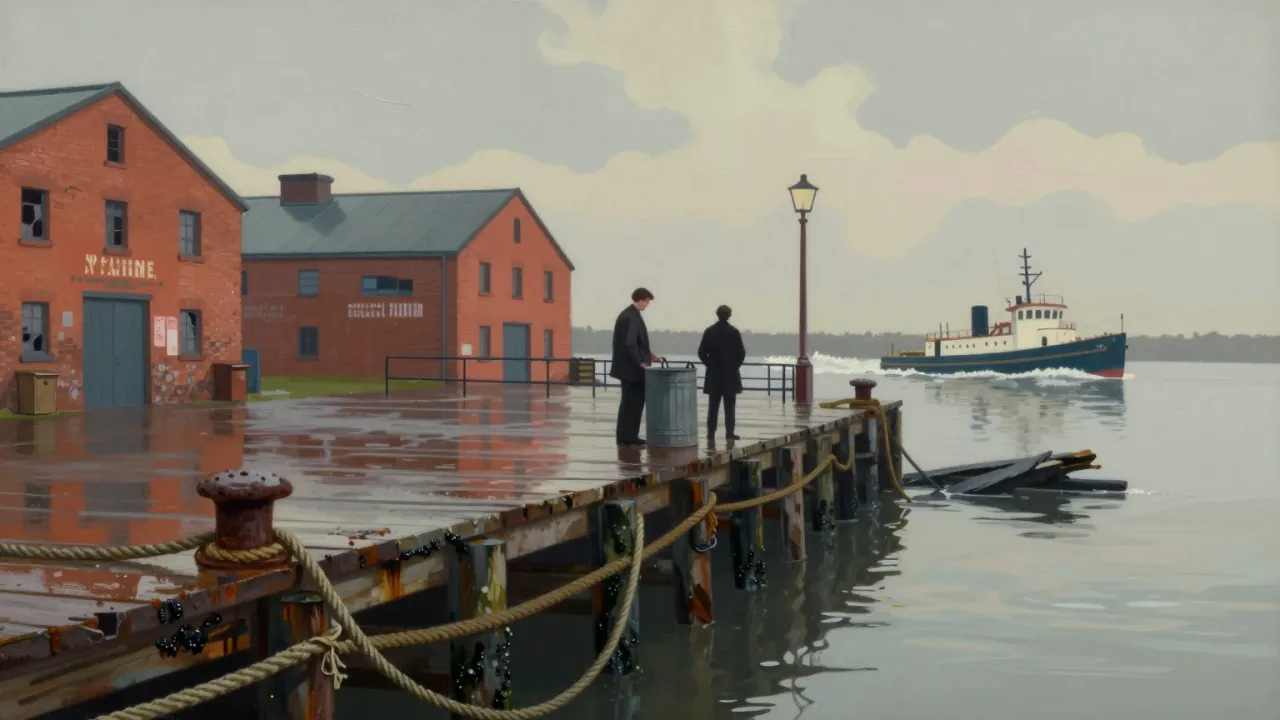
The story moves in tight, unsentimental loops: theft, misdirection, betrayal, violence, reluctant alignment. Richard Widmark plays Skip with a coiled stillness — no swagger, just watchful calculation — and Jean Peters gives Candy a grounded weariness that never tips into victimhood, even when beaten twice. Thelma Ritter’s Moe is the film’s moral hinge: pragmatic, unsentimental, fatally precise in her trade. Joseph MacDonald’s cinematography keeps the light flat and functional — no chiaroscuro flourishes, just the glare of subway fluorescents and the damp sheen of South Street brickwork. Leigh Harline’s score is sparse, mostly absent during dialogue, returning only to underline tension in chase sequences or hospital silences. Nick DeMaggio’s editing sustains momentum without flash: cuts land like punches, not transitions. Fuller’s script avoids exposition, trusting gesture and pause — a glance at a wallet, a hesitation before opening a door — to carry meaning. There are no monologues about freedom or tyranny; the politics live in who gets paid, who gets hit, and who gets buried without a name on the stone.
What sticks
What lands is the film’s refusal to flatter its characters or its audience. Skip’s transformation is neither redemptive nor sentimental: he does not become good, only less indifferent. Candy’s agency is real but bounded — she chooses whom to trust, when to lie, when to strike — and her final act is tactical, not sacrificial. The police are neither noble nor corrupt, just tired professionals negotiating with informants whose price is always higher than expected. Even the villains lack grandeur: Joey is vicious but small-time, his boss unseen until the final exchange, and Zara’s authority is undercut by his inability to control either Skip or Candy. The film’s realism comes from its granularity — the way Moe counts out change, the sound of a flashlight rolling across a floorboard, the exact weight of a stolen wallet in a coat pocket. These details accumulate into a texture that feels lived-in rather than constructed. The ending does not offer resolution but recalibration: love and law remain uneasy allies, not merged identities. That restraint, that refusal to tidy up, is what gives the film its durability.
Where it slips
What does not land is the film’s occasional reliance on shorthand that now reads as reductive. The portrayal of Communist operatives leans on mid-century caricature — their menace is personal, not political, and their ideology is reduced to a motive for violence rather than a system of belief. The racial and class assumptions embedded in the depiction of South Street’s underworld go unexamined: the film presents its milieu as natural, not contested. Candy’s repeated physical abuse, while narratively consequential, risks flattening her into a cipher of endurance rather than deepening her interiority — especially given how little we learn of her past beyond Joey’s influence. The studio-mandated revisions softened some edges but left others jagged: the frisking scene remains awkwardly staged, its tension undercut by choreography that feels rehearsed rather than urgent. And while Widmark’s stillness works, it can also read as vacancy in quieter moments — a choice that serves the character but occasionally stalls the rhythm. These are not flaws in isolation, but accumulations that narrow the film’s emotional bandwidth.
What it’s really about
The themes that matter are loyalty as commerce, patriotism as performance, and information as physical object. The microfilm is never abstract: it is heavy, fragile, concealable, stealable — a thing you can drop, lose, or trade for $25,000. Its value shifts depending on who holds it and what they intend to do with it, not because of its content but because of the power structures it connects. Fuller treats ideology as secondary to survival: Moe sells names, Candy trades affection, Skip trades the film — all are transactions, none are confessions. The film interrogates whether civic duty can be outsourced to people who have no stake in the system — and answers, quietly, that it often is. Class is structural, not symbolic: Skip lives in a shack because he cannot afford rent, not because he rejects society; Candy works as a courier because she has no other options, not because she believes in the cause. There is no utopian alternative offered, only a series of compromised choices made under pressure — choices that feel less like moral failures and more like the ordinary mechanics of living under surveillance, scarcity, and suspicion.
Who it’s for
This film is for viewers who value narrative economy, moral complexity, and performances rooted in behaviour rather than declaration. It rewards attention to gesture, silence, and spatial relationships — the way Skip stands just outside a doorway, or how Moe adjusts her hat before naming a price. It is not for those who require psychological exposition, emotional catharsis, or clear moral signposting. Anyone expecting a conventional romance or a tidy spy thriller will find its rhythms alienating; its pacing assumes familiarity with noir syntax and Cold War shorthand. Those put off by mid-century gender dynamics — particularly the repeated physical punishment of Candy — may find its treatment of violence difficult to reconcile with its otherwise sharp-eyed realism. A viewer who values thematic clarity over ambiguity, or who prefers protagonists with explicit interiority, would likely leave dissatisfied. But for those willing to sit with discomfort and implication, the film offers a sustained, unsparing study of how power circulates in the margins — not through speeches, but through wallets, whispers, and withheld addresses.
Is it worth your time?
Yes, it is worth your evening — not as escapism, but as calibration. Its eighty minutes sharpen perception: how light falls on wet pavement, how a voice drops before a lie, how quickly trust unravels when money changes hands. It repays rewatching not for hidden clues but for accumulated detail — the brand of cigarette Moe smokes, the pattern of cracks in Skip’s floorboards, the exact cadence of Tiger’s sigh when he realises Skip won’t stay reformed. Some will argue it is too bleak, too terse, too dated in its politics — and those criticisms hold weight, particularly regarding its handling of gendered violence. But its formal rigour and ethical precision remain uncommon. Remove the Cold War framing and it becomes a study of informal economies; remove the microfilm and it is still a portrait of people trying to survive each other. Its value lies not in nostalgia but in its refusal to simplify. That makes it demanding, yes — but never wasteful.