A princess’s tasks set against a captain’s war
Pan’s Labyrinth is Guillermo del Toro’s 2006 dark fantasy set in Francoist Spain in 1944, following a young girl named Ofelia who arrives with her pregnant mother at a rural military outpost commanded by her new stepfather, Captain Vidal, a man tasked with eliminating the last republican resistance fighters in the surrounding hills. Written, produced and directed by del Toro, the film treats its underworld mythology as a parable rather than pure escapism, drawing on sources del Toro has cited including Borges, Arthur Machen and Lewis Carroll, and it premiered at Cannes to a 22-minute standing ovation, the longest in the festival’s history at that point.
Twenty years of notebooks and a chief who agreed with no script
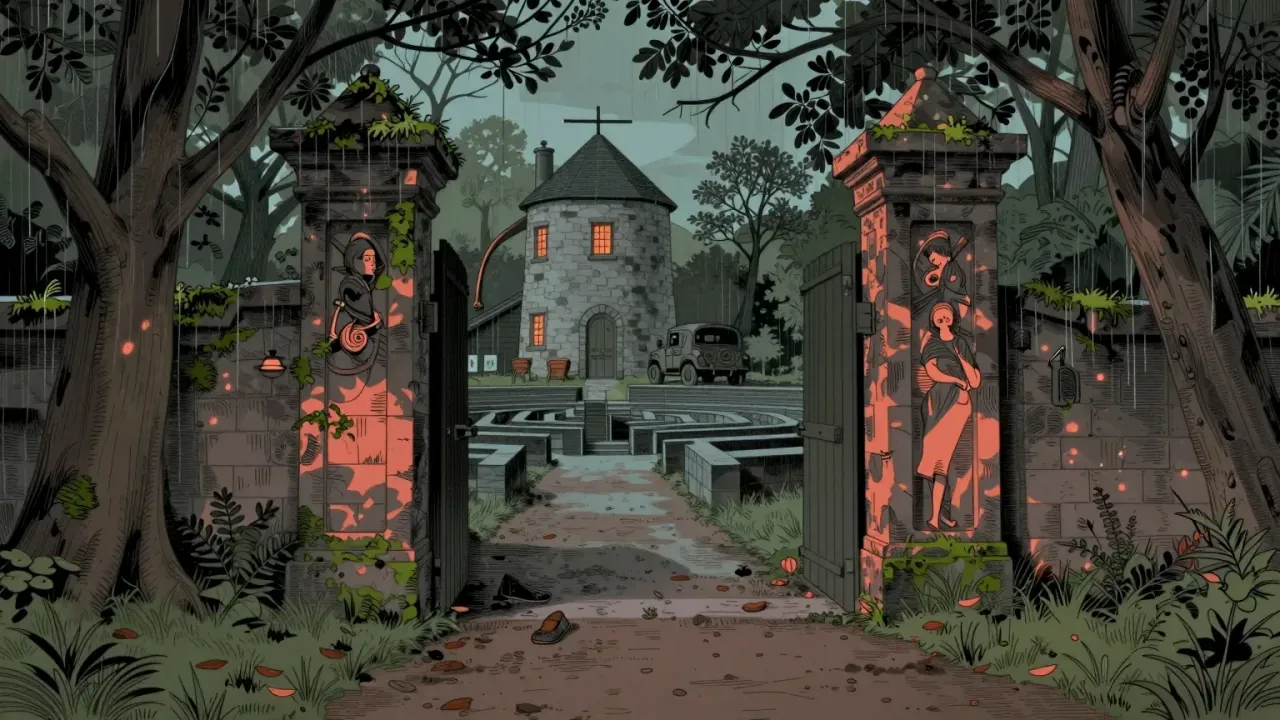
Ofelia discovers an overgrown labyrinth near the outpost and meets a faun who tells her she is the reincarnated princess of an underground kingdom, setting her three trials to prove her identity while, in the household above, Vidal tortures captured prisoners and grows increasingly suspicious of his housekeeper’s ties to the resistance. Cinematographer Guillermo Navarro shot on location in a Spanish pine forest, and del Toro relied heavily on animatronics and prosthetic makeup rather than computer effects, including a faun costume whose ten-pound horns actor Doug Jones had to wear through hours of daily application. The film won Academy Awards for cinematography, makeup and production design.
The Pale Man’s table
What lands most powerfully is the refusal to let either strand of the story comfort the other: the fantasy sequences, especially Ofelia’s encounter with the child-eating Pale Man in a chamber of untouched food, are staged with the same visual seriousness as the historical violence, so that neither reads as safer or more make-believe than the other. Sergi López’s performance as Vidal, precise and unhurried in its cruelty, gives the film’s real-world half a menace that rivals anything in the underworld Ofelia is trying to reach. The practical effects work, built almost entirely from animatronics and prosthetic makeup rather than digital tools, gives every creature a tactile, load-bearing presence on screen that computer generation of the period would not have matched.
A stepfather more frightening than any monster
The film’s deliberate ambiguity about whether Ofelia’s fantasy is real or a child’s imaginative response to trauma is a considered choice, but it leaves some viewers wanting a firmer answer than del Toro is willing to give, even as he has said he personally believes the underworld to be real within the story. The violence, particularly toward and around children, is graphic enough that it will be genuinely difficult for some viewers regardless of the fairy-tale framing around it. Some of the household’s supporting cast, including Ofelia’s ailing mother, exist mainly to advance the plot’s pressure on Ofelia rather than as figures examined in their own right.
Catholic dogma turned inside out
The film uses its fairy-tale structure to examine what it costs a child to retain imagination and disobedience under a regime built on obedience and cruelty, making Ofelia’s small acts of defiance against both the faun’s rules and Vidal’s authority the throughline of the story. Its religious imagery, del Toro has said, is meant as a challenge to Catholic dogma rather than an endorsement of it, most explicitly in a torture scene where a priest’s line is drawn directly from an actual wartime justification for cruelty toward the condemned, a detail that turns a single piece of dialogue into the film’s clearest indictment of institutional complicity.
Who should watch it
This suits viewers who want fantasy that takes its own darkness seriously, admirers of practical effects work over digital spectacle, and anyone drawn to films that hold two realities in tension without ever fully resolving which one is actually true. It is a poor match for anyone seeking fantasy as comfort or escape, since the film’s cruelty is sustained and rarely softened, and it will be a hard sit for anyone who wants advance reassurance that the child at the centre of the story will be kept safe from what surrounds her.
119 minutes that don’t let you look away easily
At 119 minutes, the film moves between its two registers without ever letting the viewer settle into either one, which makes for a demanding but tightly constructed evening. It asks for full attention rather than background viewing, and its combination of craft, moral seriousness and imaginative commitment make that demand worth meeting. Its three Academy Award wins for cinematography, makeup and production design, achieved on a comparatively modest budget, are a fair measure of how much craft was packed into a story that never once feels padded across its two hours.