The look of it
One Wonderful Sunday is a postwar Japanese romance film made in 1947, during the Allied occupation, with an explicit aim to portray ordinary life amid material scarcity and social dislocation. It follows a young couple—Yuzo and Masako—who spend a single Sunday together in ruined Tokyo with only thirty-five yen between them. Akira Kurosawa co-wrote the script with Keinosuke Uekusa, drawing on neorealist impulses seen in Bicycle Thieves and Capra’s humanist melodramas, though without direct access to those films at the time of writing. The film was conceived under constraint: Toho had lost its major stars to Shintoho after labour disputes, so Kurosawa cast unknowns and shot on location using improvised equipment. Its ambition is not spectacle or narrative complexity but fidelity—to economic reality, to emotional vulnerability, to the quiet persistence of hope in conditions that offer little ground for it. It treats romance not as escape but as practice: a daily rehearsal of dignity, imagination, and mutual care. The film’s formal experiments—especially the fourth-wall break at the amphitheatre—are attempts to extend that practice into the auditorium itself. Word count: 158
How it moves
The story unfolds linearly across a single day, structured by dwindling money and accumulating small humiliations: a rejected apartment, a barred cabaret, scalped concert tickets, a café bill misread. Ichirō Sugai appears briefly as a black-market dealer, but the central performances are by Chieko Nakakita and Isao Numazaki—both untested at the time—and their restraint anchors the film’s realism. Asakazu Nakai’s cinematography uses shallow focus and available light, often forcing one figure into clarity while the other softens—a visual echo of economic precarity where attention, like resources, must be rationed. Kurosawa’s editing avoids montage or emphasis; scenes linger just long enough to register exhaustion or tenderness without underlining either. Sound design is deliberately sparse, then abruptly inventive: silence punctuated by imagined symphonic swells, or diegetic street noise giving way to internal monologue. The handheld camera work—concealed in a box, operated amid real crowds—produces grainy, slightly unstable frames that refuse polish. This is not technical limitation disguised as style, but style forged from limitation: every choice reflects the film’s subject, not its author’s signature. Word count: 159
What stays
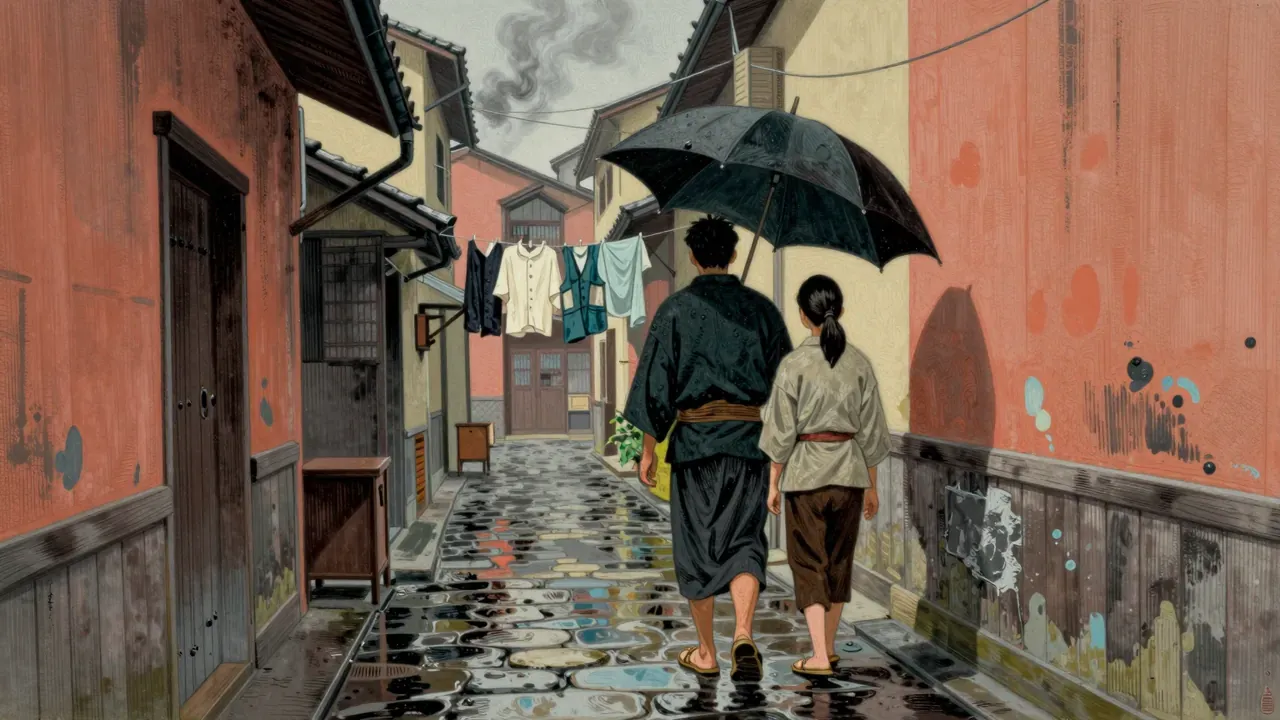
What lands most firmly is the couple’s physical and emotional proximity—the way they lean into each other on swings, share a single umbrella, or pause mid-sentence when rain begins. Their dialogue avoids exposition; instead, meaning accrues through gesture, hesitation, and shared glances. The café scene works because the misunderstanding over café au lait feels lived-in—not comic, not tragic, but quietly humiliating in its banality. The zoo sequence succeeds not for satire but for its gentle refusal of anthropomorphism: the animals are simply there, indifferent, while the couple project only enough to keep talking. Most enduring is the final amphitheatre sequence—not because it ‘succeeds’ musically, but because its failure is built into the premise: Yuzo conducts nothing, Masako pleads for applause that does not come, and yet the embrace that follows is earned precisely because the ritual persists despite absence. That persistence, not triumph, is what resonates. The film’s modesty becomes its authority: it asks for no grand resolution, only recognition. Word count: 157
Where it slips
What does not land is the film’s attempt to dramatise systemic critique through individual encounters—particularly the orphan and the affluent children—which feel inserted rather than integrated, their symbolism too blunt against the rest of the texture. The baseball sequence, meant to show Yuzo’s lingering youth, instead reads as tonally dissonant: its energy clashes with the film’s prevailing hush. The black-market subplot involving Sugai’s character arrives late and departs without consequence, functioning more as set dressing than dramatic pressure. Some of the imagined sequences—especially Masako’s daydream of a furnished apartment—lack the tactile specificity of the real-world scenes, slipping into generic wish-fulfilment. The film’s reliance on Kurosawa’s own later reputation also works against it: viewed today, its neorealist gestures can seem anticipatory rather than urgent, its innovations less radical than historically situated. There is a slight stiffness in Numazaki’s conducting, not from lack of effort—days were spent rehearsing—but from the gap between intention and embodied fluency, which the camera does not soften. Word count: 159
What it’s really about
The themes that matter are not war or occupation as abstractions, but their residue in daily habit: the way money dictates speech, how space is negotiated in crowded ruins, how intimacy is both shelter and friction. Class is rendered not through ideology but through price tags, queue lengths, and whose coat gets left as collateral. The film treats imagination not as escapism but as labour—the couple must actively construct alternatives to their present, whether through role-play in an empty lot or conducting silence. This is shomin-geki stripped to its core: no domestic crises, no generational conflict, just two people trying to hold a future in place long enough to name it. The film’s engagement with sound—its absence, its promise, its manipulation—prefigures Kurosawa’s later preoccupations, but here it serves a social function: the Unfinished Symphony is unfinished not because of artistic failure, but because collective listening has not yet been reassembled. The film’s quietest theme is endurance as rhythm: the weekly Sunday meeting, the repeated promise to meet again, the return to the station platform—these are structures that outlast plot. Word count: 159
Who it’s for
This film is for viewers who value restraint over revelation, who find emotional weight in withheld glances and unspoken reconciliations, and who accept that a romance film need not culminate in union but in continuity. It suits those familiar with postwar Japanese history or neorealist cinema, but does not require that knowledge—it communicates through behaviour, not exposition. It is not for viewers who expect narrative propulsion, clear antagonists, or cathartic release; its pacing assumes patience with ambiguity, its politics operate through omission rather than argument. Those who rely on strong performance tics or expressive close-ups may find Nakakita and Numazaki too muted. Anyone seeking Kurosawa’s later formal confidence—his command of composition, his orchestration of action—will find this comparatively raw. A viewer who values thematic clarity over atmospheric accumulation would likely leave unsatisfied. Word count: 159
Why it lasts
Yes, it is worth your evening—not as entertainment but as calibration. It recalibrates scale: a single day, thirty-five yen, one embrace, one failed symphony. Its value lies in its refusal to inflate significance, in its commitment to the unremarkable as worthy of attention. It rewards attention not with payoff but with alignment: you leave not with answers but with adjusted thresholds for what counts as meaningful. Those who find its pace too slow or its stakes too low would likely prefer Kurosawa’s later work—or any film that treats time as currency to be spent, not held. But if you accept that endurance can be lyrical, and poverty poetic without being aestheticised, then this remains singular. It is not essential viewing for all, but it is indispensable for anyone who believes cinema can model how to live with little, and still insist on beauty. Word count: 159