The title says it
Koyaanisqatsi is a non-narrative documentary film that seeks to render visible the accelerating disjunction between human systems and natural time. It does not argue, explain or persuade in words; instead it assembles visual sequences — urban traffic, desert rock formations, factory assembly lines, cloud movements — and sets them against Philip Glass’s repeating, intensifying score to produce a physiological impression of imbalance. The title, drawn from Hopi, names its aim: life out of balance. But the film avoids editorialising through voiceover or text. There is no narrator, no on-screen identification of locations beyond what the image itself conveys, no chronology, no cause-and-effect logic. Its method is associative, rhythmic, cumulative. It treats the camera not as a witness but as a measuring instrument: one that records duration, scale, velocity, repetition. It asks the viewer to feel the weight of infrastructure, the exhaustion of motion, the silence beneath noise — not by telling, but by holding the eye long enough for perception to shift. This is not exposition. It is calibration.
No story, just structure
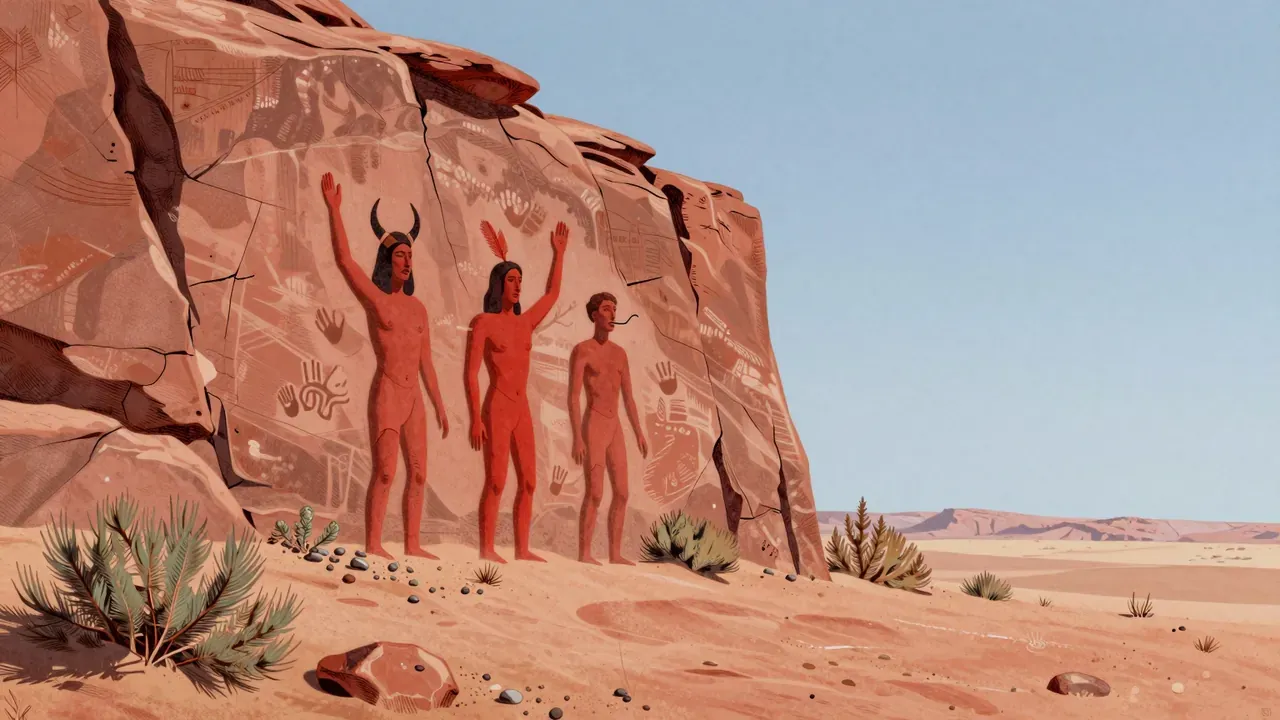
The film works without story, character or performance in any conventional sense. There are no actors, no dialogue, no script beyond the structural outline agreed by Reggio and Fricke. Its craft rests entirely on editing rhythm, photographic control and musical architecture. Ron Fricke’s cinematography uses time-lapse, slow motion, aerial shots and fixed-frame portraiture — all shot on 16 mm and later blown up, often with chemical enhancement to deepen shadow detail. The editing, also by Fricke, arranges footage not by geography or theme but by tempo and tonal contrast: a sequence of clouds dissolves into a freeway, then into crowds, then into circuit boards. Glass’s score — performed live by the Philip Glass Ensemble — is not accompaniment but counterpoint: its ostinatos mirror mechanical repetition, its crescendos map urban density, its silences punctuate collapse. Coppola’s late contribution — the Horseshoe Canyon pictographs bookending the film — adds a temporal frame: ancient human mark-making bookending modern industrial flux. Nothing here is improvised in feeling, though much was discovered in shooting: the Times Square portraits, the New York blackout footage, the Boeing 747 tracking shot — all emerged from responsiveness, not pre-planning.
The rhythm lands first
What lands is the visceral coherence of its central proposition: that speed, scale and repetition have altered human perception so thoroughly that we no longer register their cost. The time-lapse sequences — particularly the Los Angeles freeway shot, built from double-exposed day-and-night takes — do not merely show traffic; they make the viewer’s pulse sync with its cadence, then strain against it. The portrait section, filmed unannounced in Times Square, achieves something rare: anonymity made intimate, individuality flattened by gaze and grain. The cloud sequence, augmented by Louis Schwartzberg’s footage, feels geological rather than meteorological — slow, immense, indifferent. Glass’s ‘The Grid’ builds over twenty-one minutes with such inevitability that its climax feels less like music ending and more like a system peaking, then stalling. Even the opening and closing pictographs — static, weathered, silent — land not as decoration but as punctuation: a reminder of time measured in centuries, not quarterly reports. These moments succeed because they do not illustrate an idea; they instantiate it in duration, texture and resonance.
What it omits matters
What does not land is the film’s implied universality. Though framed as a diagnosis of ‘American civilisation’, its visual language leans heavily on mid-century US infrastructure: the Pruitt–Igoe demolition, LA freeways, Wall Street, the South Bronx blackout — all specific to a particular political economy and moment. Without context, these images risk becoming abstract spectacle rather than critique. The absence of any human voice — no interview, no testimony, no spoken account of displacement or labour — leaves the social dimension underdeveloped. The film shows housing projects collapsing but not who lived there; it shows factories running but not who operates them. Some sequences — notably the extended industrial montage — begin to blur into aestheticised repetition, where the critique of mechanisation starts to mimic the very condition it opposes. And while the Hopi title signals cultural reference, the film makes no effort to engage with Hopi cosmology beyond borrowing the phrase. That gesture remains symbolic, not substantive. A viewer attuned to questions of authorship or representation may find this omission not neutral but evasive.
Time as medium
The themes that matter are not abstract but embodied: time as a contested resource, visibility as a form of power, and scale as a technology of alienation. The film treats infrastructure — roads, grids, skyscrapers — not as neutral tools but as environments that reshape attention, movement and memory. Its repeated focus on verticality (skyscrapers, cliffs, smokestacks) and horizontality (freeways, conveyor belts, cloud layers) maps how human systems organise space to enforce rhythm and hierarchy. The recurring motif of the eye — in the original ACLU campaign, in the Times Square portraits, in the final pictograph — suggests surveillance not only as control but as a mode of being watched into compliance. Technology appears not as invention but as environment: the camera lens, the helicopter, the intervalometer, the synthesiser — all are present not as subjects but as extensions of perception, making visible what the unaided eye cannot hold. Underlying all this is entropy: the slow, inevitable drift toward disorder, whether in crumbling concrete, fading film stock or the dissolving boundary between city and desert.
For whom it waits
It is for viewers who value sustained attention over exposition, who accept that meaning can reside in duration and recurrence, and who are comfortable sitting with ambiguity for eighty-seven minutes. It rewards those familiar with minimalism in music or structuralist film, and those willing to let image and sound generate sensation before sense. It is not for viewers who require narrative scaffolding, causal explanation or moral resolution. Those expecting documentary as advocacy, journalism or historical record will find it withholding. Teachers using it as a primer on urbanism or ecology may need to supplement it heavily — the film offers no data, no dates, no attribution beyond the credits. A viewer who associates ‘documentary’ with argument or evidence may reject its methods outright. What would change the verdict is not better execution but clearer framing: if the film acknowledged its specificity — as a product of 1970s New Mexico activism, 1980s US deindustrialisation, and a particular avant-garde lineage — it would gain precision without losing power.
What it leaves behind
Yes, it is worth your evening — but only if you approach it as an event in time, not a source of information. Its value lies in the recalibration it performs: after Koyaanisqatsi, a bus queue, a flickering streetlight, a scrolling feed may register differently — not as background, but as rhythm, pattern, pressure. It demands nothing more than presence, yet repays close watching with perceptual shifts that linger. Those who dismiss it as ‘just pretty pictures’ miss how precisely its compositions induce unease: the slow zoom into a factory floor, the unnatural smoothness of time-lapse crowds, the way Glass’s brass notes seem to vibrate in the molars. Its endurance comes from refusing utility — it does not solve, instruct or comfort. It measures. And measurement, when done with this rigour and restraint, remains a radical act. Anyone who has ever felt hurried, flattened or unseen by the systems they inhabit may find in it not answers, but recognition — quiet, insistent, and entirely wordless.