What it is trying to do
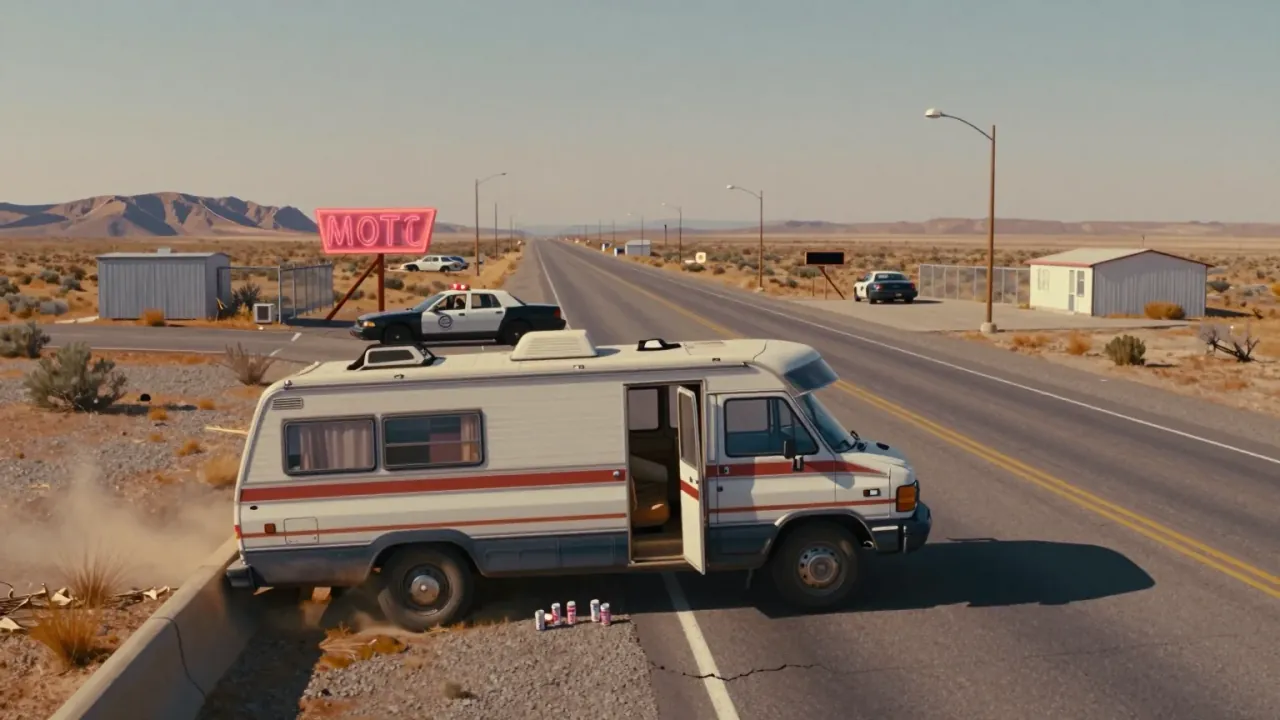
Near Dark is a vampire film that treats the genre as a vehicle for American myth-making rather than supernatural exposition. It sets out to fuse the visual grammar and moral drift of the Western with the bodily horror and social alienation of vampirism, using the open road and sun-baked plains not as backdrop but as structural logic. The film’s ambition lies in its revisionist framing: vampires here are not aristocrats or seducers but itinerant outsiders — a ragged, violent, emotionally stunted family whose mobility mirrors both frontier displacement and post-industrial rootlessness. Their RV is less transport than mobile homestead; their feeding is less ritual than survivalist predation. Kathryn Bigelow and Eric Red do not attempt to explain vampirism as folklore or biology, but to treat it as a condition of estrangement — one that maps onto adolescence, addiction, and the collapse of inherited community. The film refuses gothic grandeur or Victorian dread, opting instead for grease-stained denim, flickering neon, and the hollow thump of a diesel engine at dusk. Its project is not to scare, but to locate the uncanny within the familiar contours of mid-American life.
How it works
The story follows Caleb Colton’s forced initiation into a nomadic vampire clan after being bitten by Mae, then tests his capacity to absorb their rules without surrendering his conscience. Adrian Pasdar plays Caleb with quiet physicality — his reactions are registered in posture and hesitation, not monologue. Jenny Wright’s Mae is both tender and unnerving, her affection inseparable from compulsion. Lance Henriksen’s Jesse Hooker carries authority through stillness and cadence, while Bill Paxton’s Severen is all jagged movement and volatile charm — a performance built on timing, gesture, and controlled dissonance. Adam Greenberg’s cinematography avoids high contrast; he keeps the night scenes dense and grainy, the daylight sequences bleached and unforgiving. Tangerine Dream’s score does not punctuate action but seeps beneath it — low pulses, suspended synths, no melody to latch onto, only atmosphere thickening like heat haze. Howard E. Smith’s editing favours long takes in tight quarters, then sudden ruptures: a bar fight cuts to silence before the fire starts; a chase ends not with impact but with the slow, grinding halt of a jackknifed truck.
What lands
What lands most decisively is the film’s tonal cohesion — the way its genre hybrids settle into something singular rather than pastiche. The Western elements feel earned: the wide shots of empty highways, the emphasis on horsemanship and firearms, the moral ambiguity of the ‘family’ unit, all sit naturally alongside the vampire logic. The horror works because it is tactile — burns blister visibly, blood is sticky and insufficient, sunlight does not vanish victims but cooks them slowly. Performances land where they commit fully to the internal logic: Henriksen’s weary gravitas, Paxton’s grinning menace, Jenette Goldstein’s Diamondback as both lover and lieutenant — none wink at the audience. The RV itself becomes a character: cramped, cluttered, humming with latent threat. Even minor moments — Homer’s childlike fixation on Sarah, the offhand reference to the Great Chicago Fire — accrue weight because they’re delivered without exposition. The film trusts its images: a hand gripping a steering wheel as skin begins to smoke, a silhouette against a burning bar, a jacket pulled over a burning woman’s head. These are not set-pieces but accumulations — each one reinforcing the central idea that monstrosity is a matter of circumstance, not essence.
What does not
What does not land is the resolution. The blood transfusion cure arrives without physiological or thematic groundwork — it is introduced as narrative convenience, not consequence. Caleb’s father, though present, remains functionally inert beyond plot function; his motivations and grief are implied but never dramatised. The final embrace between Caleb and Mae feels emotionally unearned, arriving after a sequence of violence that has already severed their bond beyond repair. The film’s refusal to dwell on Caleb’s trauma — the violation of his body, the loss of autonomy, the guilt over complicity — leaves his arc psychologically thin. Some performances strain under the script’s ellipticality: Joshua John Miller’s Homer is compelling in fragments but lacks development beyond archetype, and Roger Aaron Brown’s lack of screen time prevents his character from registering beyond presence. The film’s commitment to mood over explanation occasionally tips into opacity — Severen’s queer coding, for instance, is suggested through mannerism and proximity but never integrated into the group’s dynamic or Caleb’s response to it. These are not flaws of execution but of calibration: choices made in service of texture that sacrifice clarity where clarity would deepen resonance.
The themes that matter
The themes that matter are kinship as contagion, belonging as coercion, and identity as irreversible rupture. Near Dark treats vampirism not as curse or gift but as irreversible social adoption — a process that demands surrender of self to collective survival. The vampire family is neither loving nor stable; it operates on loyalty enforced by dependency, affection bound to appetite. Caleb’s struggle is not to resist transformation but to retain agency within it — to feed without killing, to stay without submitting. The film interrogates American individualism by placing it inside a structure that demands conformity: the RV is both sanctuary and cage, the open road both freedom and exile. Its treatment of adolescence is unsentimental — growth here is not enlightenment but compromise, not self-discovery but recalibration of boundaries. The Civil War reference anchors Jesse not in history but in historical amnesia: he remembers fighting, not why. The film’s deeper concern is with what persists when institutions fail — not bloodlines or laws, but makeshift allegiances, shared silences, the habit of moving on before dawn.
Who should watch it, and who should not
This film is for viewers who value atmosphere over exposition, who find tension in stillness and dread in daylight, and who respond to genre films that treat their conventions as architecture rather than decoration. It rewards attention to texture — the sound of a match striking in a dark bar, the way dust hangs in a motel room at noon, the rhythm of footsteps on gravel. It is not for those who require clear moral binaries, psychological realism in every beat, or narrative closure that feels earned rather than imposed. Viewers expecting traditional vampire lore or straightforward horror pacing will find its pacing uneven and its stakes diffuse. Those who dislike sustained ambiguity, or who need characters to articulate their inner lives aloud, will leave frustrated. A viewer who values strong craft but finds the ending emotionally unconvincing may still consider it worthwhile — the film’s power resides in its first eighty minutes, not its final ten. Its cult status rests on this imbalance: a near-perfect execution of a vision that stumbles only when it must resolve it.
Is it worth your evening
Yes, it is worth your evening — provided you watch it knowing it is a film of sustained mood and fractured coherence, not a tightly wound thriller or a character study with tidy arcs. Its ninety-four minutes move with the weight of a long drive at night: immersive, hypnotic, occasionally disorienting. You will remember the look of it more than the plot turns, the sound of it more than the dialogue. It repays rewatching not for hidden clues but for shifts in emphasis — how a glance changes meaning on second viewing, how a cut gains significance when you know what follows. Those who dismiss it as ‘style over substance’ miss that its style is its substance: every choice serves the central metaphor of irreversible belonging. It is not for viewers who demand narrative efficiency or emotional catharsis on cue. But if you accept its terms — that horror lives in routine, that family is both shelter and sentence, that the American landscape holds ghosts older than blood — then its rewards are durable, not fleeting.