The intention behind it
The Great Dictator is a 1940 political satire in which Charlie Chaplin — writer, director, producer, composer and star — uses comedy to confront fascism, antisemitism and the cult of personality embodied by Adolf Hitler and Benito Mussolini. It is not a parody of war or diplomacy but of authoritarian spectacle: the rallies, the slogans, the choreographed obedience, the linguistic bluster. Chaplin made it while the United States remained neutral, before American entry into the Second World War, and before public knowledge of the Holocaust. Its aim is moral clarity through ridicule — not to mock suffering, but to expose the absurdity and danger of unchecked power dressed as destiny. It deploys Chaplin’s established screen persona not as refuge but as contrast: the Jewish barber, gentle and disoriented, stands in deliberate opposition to Adenoid Hynkel, the vainglorious dictator whose gestures, speech rhythms and visual iconography are drawn from newsreels and Leni Riefenstahl’s Triumph of the Will. The film attempts something rare for its moment: to name evil while it was still ascending, and to do so in English-language cinema’s first major sound-era satire of totalitarianism. Word count: 158.
The look of it
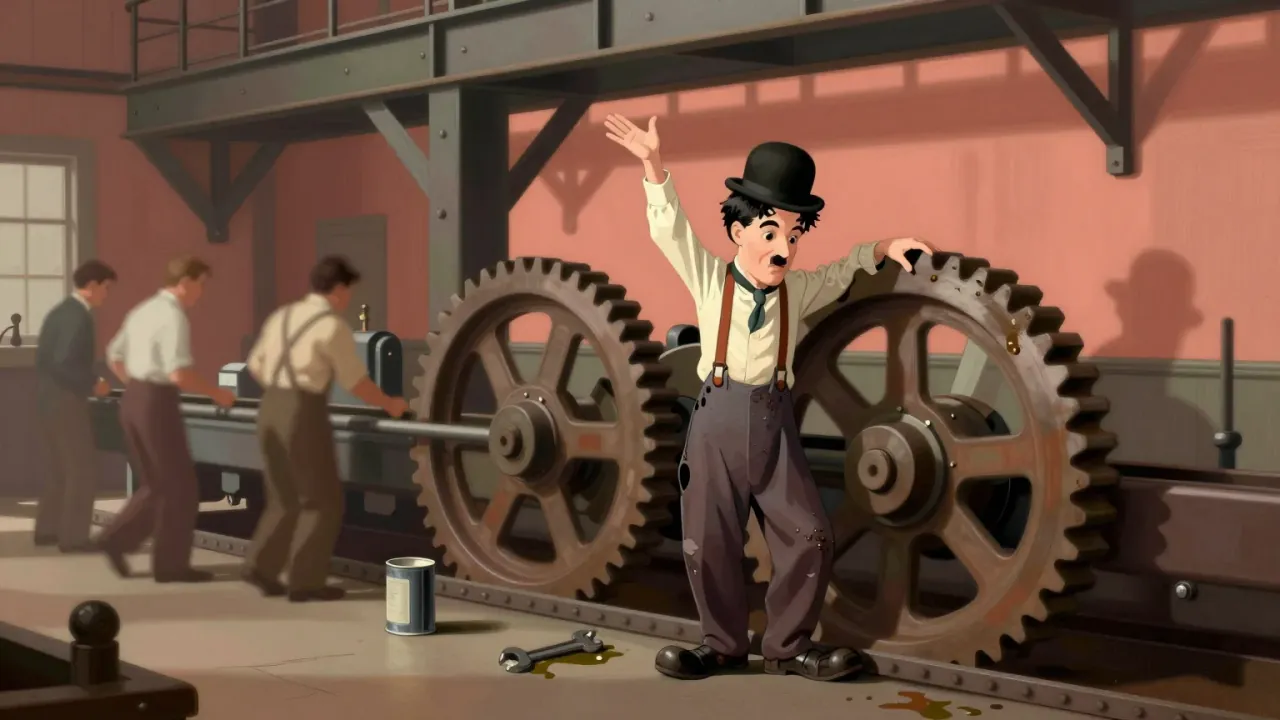
Chaplin plays both Hynkel and the barber, anchoring the film in physical performance: the dictator’s jerky gesticulation, his balloon-dance mimicry of imperial ambition, his tantrums timed to musical punctuation; the barber’s hesitant grace, his quiet dignity amid humiliation. Roland Totheroh and Karl Struss’s cinematography avoids expressionist distortion — instead using deep focus, steady framing and measured tracking shots to let Chaplin’s timing and blocking carry the satire. The editing is classical, unshowy, serving rhythm over shock. Meredith Willson composed the score, though Chaplin dictated key motifs — the Lohengrin prelude during the balloon ballet, Brahms’s Hungarian Dance No. 5 in the barbershop sequence — and oversaw its integration with action. Production design leans on theatrical scale: the Tomainian capital’s monumental architecture, the cramped, crooked streets of the Jewish ghetto, shop signs in Esperanto as quiet ideological counterpoint. The script balances slapstick set-pieces with pointed dialogue, often delivered in faux-German gibberish that parodies rhetorical inflation without relying on translation. Word count: 156.
The moment that holds it together
What lands most firmly is Chaplin’s command of comic timing as political weapon. The balloon dance remains legible not just as whimsy but as precise allegory — inflated authority punctured by gravity, literally and figuratively. The barbershop sequence works because its domestic intimacy contrasts with Hynkel’s grandiose emptiness; the shaving scene’s precision makes the barber’s vulnerability palpable. Jack Oakie’s Benzino Napaloni — a Mussolini caricature — lands through sheer, unapologetic bombast, his rivalry with Hynkel reducing geopolitics to petty ego. The final speech — delivered by the barber mistaken for Hynkel — lands differently today than in 1940: less as surprise revelation, more as culmination of the film’s sustained argument that decency is ordinary, not exceptional. Its language is plain, its cadence unhurried, its appeal rooted in shared human need rather than national or racial identity. That speech endures not because it is eloquent, but because it refuses abstraction: it names hunger, loneliness, work, laughter — things no ideology can credibly claim to own. Word count: 157.
Where it stumbles
What does not land consistently is the film’s structural duality. The barber’s storyline, though tender, lacks the narrative propulsion or thematic weight of Hynkel’s rise — it functions more as ethical anchor than dramatic engine. Some transitions between the two worlds feel abrupt, not symbolic: the shift from battlefield chaos to ghetto quietness relies on mood rather than logic. The supporting Jewish characters — Emma Dunn’s Mrs. Napolini, Bernard Gorcey’s Mr. Jaeckel — are sketched with affection but little interiority; their persecution serves exposition, not development. The satire of bureaucracy — Hynkel’s ministers bickering over ‘Jewish question’ paperwork — feels broad where it might have been sharper, especially given Chaplin’s later reflections that he would not have made the film had he known the full extent of Nazi atrocities. The film’s optimism, while morally necessary, occasionally reads as tonal simplification: fascism is mocked, but its machinery — surveillance, legal erasure, industrialised violence — remains off-screen, implied rather than interrogated. Word count: 159.
What it believes in
The themes that matter are not abstract ideals but material conditions: dignity under erasure, language as coercion, spectacle as substitute for substance. Chaplin treats antisemitism not as irrational prejudice alone, but as a tool of statecraft — visible in the ghetto’s enforced segregation, the sign ‘No Jews Allowed’, the arbitrary arrests. Fascism is shown as performance first, policy second: Hynkel’s speeches are nonsense syllables parsed as profundity by crowds trained to obey tone over meaning. The film insists that power depends on consent manufactured through repetition, ritual and fear of difference — and that resistance begins in small, unheroic acts: a barber refusing to cut a man’s hair until he stops shouting, a woman slipping bread to a starving neighbour, a man choosing kindness when mistaken for a tyrant. It treats democracy not as system but as habit — daily choices to listen, to share, to recognise others’ humanity. These are not period concerns. They persist where leaders mimic Hynkel’s gestures, where language is hollowed out by repetition, where belonging is conditional on conformity. Word count: 158.
Who it speaks to
This film is for viewers who accept that satire requires both rigour and risk — those willing to sit with Chaplin’s uneven pacing, his reliance on physical gesture over psychological nuance, and his mid-century assumptions about gender and community. It rewards attention to composition, timing and historical context, not just plot. It is not for those seeking realism, psychological complexity or narrative symmetry — the barber’s arc resolves too neatly, the romance with Hannah (Paulette Goddard) feels incidental, and the ending’s uplift does not reckon with trauma’s duration. Some modern audiences may find the caricatures reductive, particularly the Jewish characters’ accents and mannerisms, which reflect 1940s studio conventions rather than Chaplin’s intent. Others will argue the film’s moral urgency outweighs its formal limits. A viewer who values historical specificity over allegory, or who expects satire to dissect systems rather than personalities, may leave unsatisfied. Word count: 159.
Why it lasts
Yes, it is worth your evening — not as flawless craft, but as a document of courage in real time. Chaplin made this when neutrality was policy, when mocking Hitler risked boycotts, censorship and diplomatic fallout. Its value lies in its refusal to wait for consensus, its insistence that laughter can be tactical, and its belief that clarity matters more than polish. It is not a film to watch passively; it asks you to notice how power dresses itself in ceremony, how language bends to serve authority, how ordinary people hold space for decency when institutions collapse. Those who expect seamless storytelling or contemporary sensitivity may find it dated. But anyone interested in how art intervenes in crisis — how comedy can name evil before history has settled its name — will find it urgent, awkward, imperfect and necessary. Word count: 159.