A slasher movie on a spaceship
Alien is Ridley Scott’s 1979 science-fiction horror film, built from a script Dan O’Bannon and Ronald Shusett had shopped to studios as a haunted-house story relocated to a working freighter in deep space. The crew of the towing vessel Nostromo, woken from stasis by what they believe is a distress call, investigate a derelict craft on a nearby moon and bring something back with them that was never meant to leave. Produced by Gordon Carroll, David Giler and Walter Hill through their company Brandywine, the film was greenlit by 20th Century Fox on the strength of Star Wars having proved science fiction could be a mainstream draw. Scott’s aim was narrower than spectacle: a small crew, a confined ship, and a creature the audience is shown as little as possible.
How the crew is picked off
The crew, played by Tom Skerritt, Sigourney Weaver, Veronica Cartwright, Harry Dean Stanton, John Hurt, Ian Holm and Yaphet Kotto, are written as workers first, not soldiers or scientists; two of them spend their early scenes arguing about pay grades rather than the mission. That ordinariness is the engine of the horror, since nobody on board is equipped for what they find. H.R. Giger designed the alien and the derelict ship’s interior, giving the creature a biomechanical look built from bone and machine parts rather than the rubber-suited monsters of earlier science fiction. Cinematographer Derek Vanlint shoots almost everything in shadow and steam, and Terry Rawlings’ editing withholds full views of the creature for most of the running time. Jerry Goldsmith’s score alternates between near-silence and sudden orchestral shock, timed to when the camera finally shows something.
What the film shows you, and when
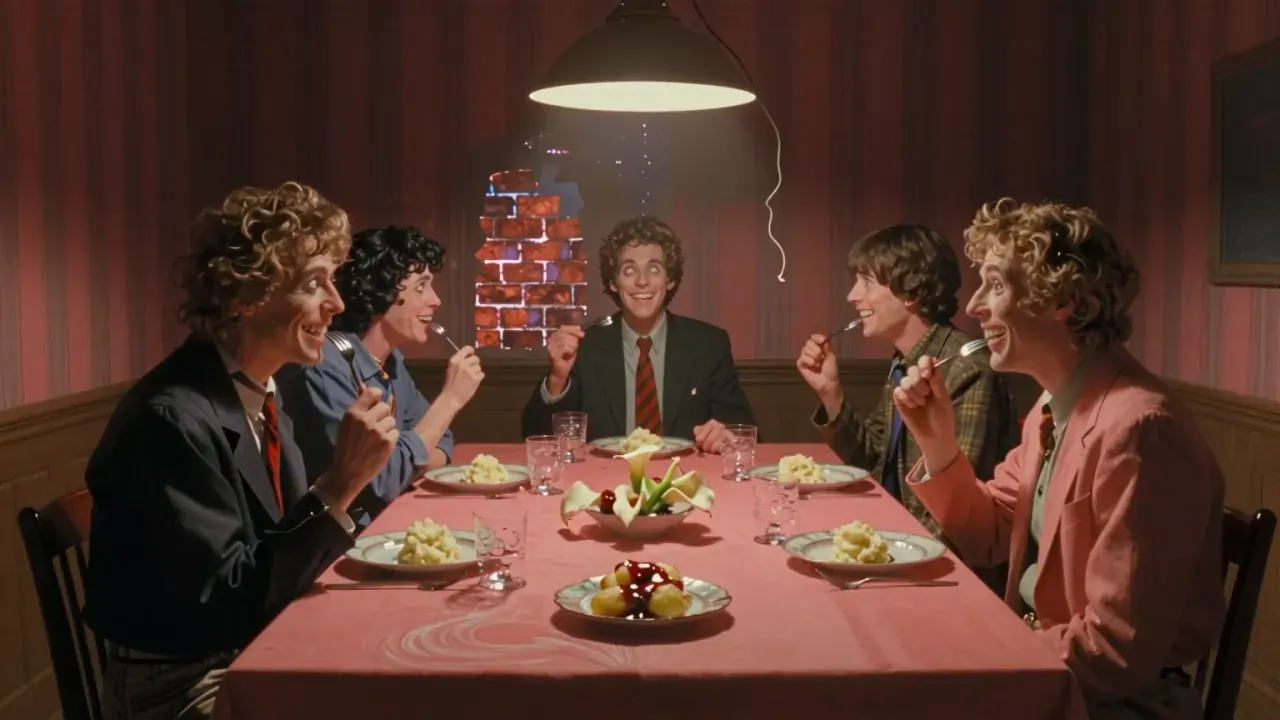
What lands hardest is restraint. The film’s most quoted scene, in which a crew member’s chest is torn open at a dinner table, works because everything before it has trained the audience to expect a jump scare from empty corridors, not from a meal in a lit room. Ian Holm’s performance as the science officer Ash, and the reveal of what he actually is, still catches first-time viewers off guard decades on. Weaver’s Ripley, who spends the film’s first half as a mid-ranking officer rather than an obvious hero, becomes the only crew member whose judgement is consistently right, a fact the film reveals gradually rather than announcing. The Visual Effects Oscar it won was for exactly this kind of unglamorous, tactile design work.
The parts that don’t scare anymore
What doesn’t land as cleanly now is the pace of the opening third, which spends real time on ship logistics and crew banter before the plot proper begins, a choice that rewards patience but will test anyone expecting a horror film to start with horror. Some of the supporting characters, particularly Parker and Brett, exist mainly to be picked off rather than to register as people, a structural habit the genre had not yet worked past. And the practical effects that still hold up in close, dim shots occasionally show their age in the wider or better-lit ones, a hazard of an eleven-million-dollar budget stretched over a spaceship’s worth of sets.
Class, survival and the reveal of Ripley
Alien’s crew dynamic is class-inflected in a way later franchise entries dropped: Parker and Brett’s demand for a bigger cut of the bonus money is treated as a legitimate grievance, not comic relief, and it is the corporation’s willingness to sacrifice the crew for the creature’s commercial value, encoded in the ship’s own computer, that turns the company into a secondary threat. The film’s other lasting contribution is Ripley herself, a female lead who survives not through fighting prowess but through following procedure when everyone else panics or improvises badly, a model the genre had rarely offered before and one the sequels would build an entire character arc from.
Who should watch it
This is for anyone who wants to see where the modern monster movie’s grammar was set: the slow reveal, the confined setting, the crew that thins out one at a time. It rewards viewers willing to sit through a long, quiet setup for a small number of intensely staged scares rather than a constant run of them. Fans of practical creature effects will find Giger’s design still unnerving in a way computer-generated monsters rarely manage. It is not for anyone needing frequent jolts to stay engaged, or for viewers who find several lit-corridor minutes between incidents a chore rather than a build. Younger viewers used to the found-footage or jump-scare pacing of recent horror may find its first act especially slow going.
An evening well spent
Alien returned 106.3 million dollars on an 11 million dollar budget, a result that looks modest next to its own sequels but was extraordinary at the time, and it has aged into consensus classic status: preserved by the Library of Congress, still cited by directors working in horror and science fiction alike. Reviews on release were mixed rather than immediately rapturous, which makes its reputation now a case of a film outlasting its own opening weekend. Watched today it remains tense rather than dated, mostly because so much of its power comes from what it withholds rather than from effects a modern audience has already seen surpassed elsewhere. Worth the evening, particularly in the dark.