The threshold
Cave of Forgotten Dreams is a documentary about the Chauvet Cave in southern France, where paintings made around 32,000 years ago survive in near-pristine condition. Werner Herzog does not treat the cave as an archaeological site to be explained, but as a threshold — a place where time collapses and human intention becomes tactile. The film attempts something rare for non-fiction: not to instruct about prehistory, but to evoke its presence. It seeks proximity, not distance; resonance, not summary. Herzog’s narration avoids chronology or taxonomy. Instead, he lingers on the way light catches a bison’s shoulder carved into rock, or how a handprint fits the curve of a wall bulge. The film’s ambition is phenomenological: to make the viewer feel the weight of deep time not as abstraction but as atmosphere — damp air, narrow walkways, the silence between breaths. It asks whether these images were made to be seen, or to be felt — and whether seeing and feeling were ever separate acts for their makers. (158 words)
The look of it
The film unfolds across three interwoven registers: footage shot inside the cave, interviews with archaeologists Dominique Baffier and Jean Clottes, and exterior shots of the Pont d’Arc landscape. Herzog appears on camera only briefly; his voice carries the film, measured and uninflected, avoiding rhetorical emphasis. Peter Zeitlinger’s 3D cinematography is the central craft decision — not as spectacle, but as necessity. The cameras, battery-powered and heatless, move slowly along a two-foot-wide walkway, capturing contours the painters used: a ridge becomes a horse’s spine, a depression a beast’s flank. Ernst Reijseger’s cello-and-didgeridoo score avoids period pastiche; it pulses with low frequencies that mimic subterranean resonance. Joe Bini’s editing sustains duration without monotony, holding shots long enough for the eye to adjust to dimness and depth. There are no re-enactments, no CGI reconstructions — only what the cave yields, under strict access conditions. The 3D is not layered; it is structural, built into the framing and movement. (159 words)
The weight of stillness
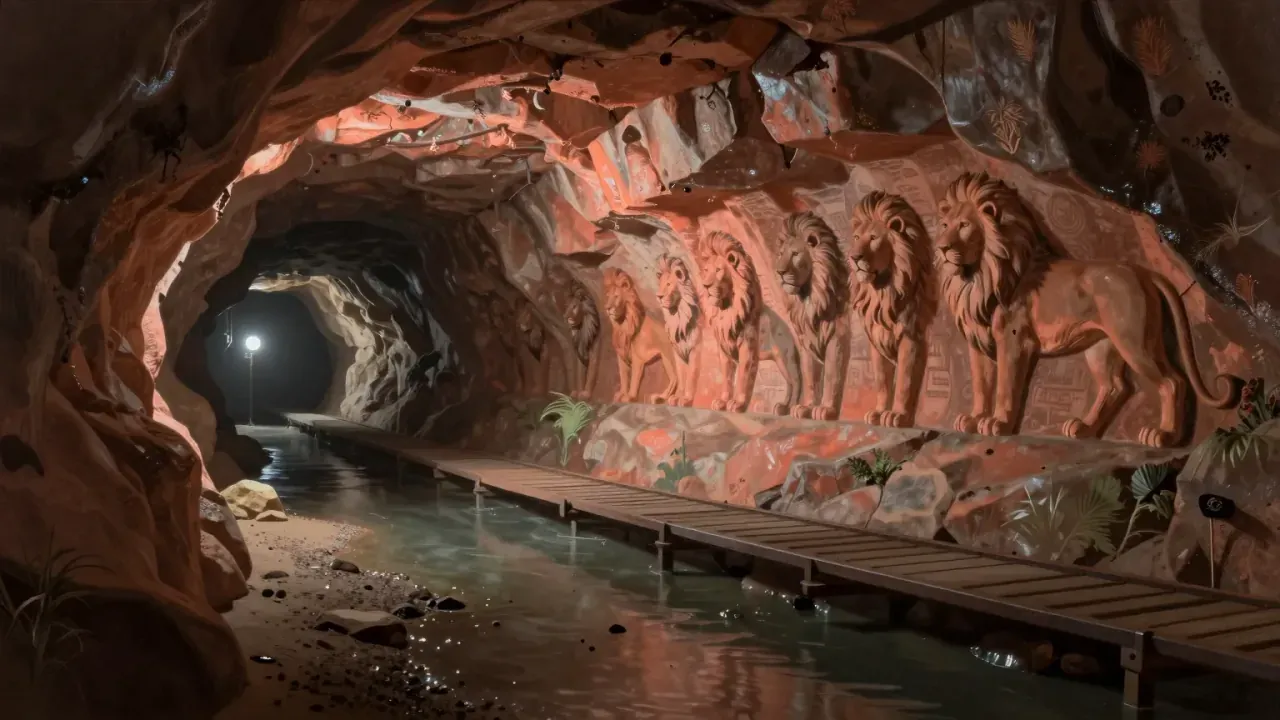
What lands most firmly is the physicality of the cave itself — not as backdrop, but as co-author. The 3D rendering makes palpable how the artists worked with the stone: a bulge becomes a bison’s haunch; a fissure, a rhinoceros’s horn. Herzog’s restraint in narration allows those relationships to speak without translation. The interviews avoid academic jargon; Baffier and Clottes speak plainly about carbon dating, microbial growth, radon levels — facts that ground wonder in material reality. The contrast between the cave’s stillness and the crew’s logistical fragility — four people, four hours per day, suits changed at the entrance — adds quiet tension. Even the technical limitations become expressive: the narrow walkway forces composition that mirrors the painters’ own constraints. The film’s pacing, unhurried and deliberate, matches the scale of its subject. It refuses to rush the viewer through millennia, and that refusal is its strongest argument. The final sequence — a slow pan across a panel of lions — holds without commentary, trusting the image to carry its own gravity. (157 words)
The edge of knowing
What does not land is Herzog’s speculative detour into the ‘dream life’ of the cave’s earliest inhabitants — a brief, unsupported musing on Neanderthal consciousness that sits uneasily beside the film’s otherwise grounded approach. His comparison of a cave bear skull to a ‘ballet dancer’ feels like a stray metaphor, not an insight. The 3D, while essential to the cave’s topography, occasionally falters in exterior shots: daylight scenes at Pont d’Arc lack the same spatial urgency, and the format feels ornamental there. The film also sidesteps questions of cultural ownership and colonial framing — the French state’s control over access, the absence of local or Indigenous voices in the narrative, the fact that the cave was named after a modern discoverer rather than any ancestral lineage. These omissions are not flaws in execution, but absences in scope: the film chooses intimacy over context, and that choice leaves some ethical dimensions unexamined. A viewer attuned to repatriation debates or museum ethics may find the reverence uncritical. (156 words)
The cost of closeness
The themes that matter are deep time, intention, and preservation as paradox. The cave survives because it was sealed for 20,000 years — its art preserved by abandonment. Access now is possible only through restriction: suits, radon limits, walkways, battery power. Preservation demands distance; understanding demands proximity — and the film lives in that contradiction. Another theme is the continuity of gesture: the handprint on the wall, the charcoal line, the modern filmmaker’s hand adjusting a light — all separated by thirty-two millennia, yet sharing the same motor impulse. Herzog returns repeatedly to the idea that these are not ‘first attempts’, but accomplished works — implying a lost tradition, not a beginning. The film treats the cave not as origin point, but as a surviving fragment of something older and more widespread. That shifts the question from ‘where did art begin?’ to ‘what did it mean to make something that lasts longer than memory?’ The answer, the film suggests, lies less in symbolism than in tactility — in how a surface meets a hand, how light meets a curve. (159 words)
Who stands here
This film is for viewers who value slowness as a mode of attention, not just a pace; for those who find awe in geological patience rather than dramatic revelation. It suits people comfortable with silence, with ambiguity, with images that withhold explanation. It will frustrate anyone expecting exposition, chronological clarity, or a thesis-driven argument. Those who require context — political, linguistic, or ethnographic — will find the film too narrow in focus. Viewers seeking critique of heritage management, or analysis of how such sites are framed for Western audiences, will leave with questions unanswered. The film assumes a baseline curiosity about human origins, but does not educate toward it — it presumes interest, then deepens it sensorially. Its ideal viewer is not a student needing facts, but a person willing to stand still in front of a wall and ask what it means to leave a mark that outlives language. Anyone who finds 90 minutes of muted light and hushed voice taxing will not endure it. (159 words)
The other side
Yes, it is worth your evening — provided you arrive prepared for its terms: no urgency, no resolution, no summary. It rewards attention, not consumption. Its value lies in how it recalibrates perception — making the viewer notice how light falls, how surfaces hold shape, how silence accumulates. Someone who watches primarily for narrative payoff or emotional catharsis will likely find it thin. But for those who have ever paused before a centuries-old fresco or traced a Roman inscription with a fingertip, the film articulates an unspoken kinship across time. Its power is cumulative, not climactic. A different verdict would follow if the film tried to do more — explain radiocarbon dating, map migration routes, name competing theories — but it does not. To wish for those things is to misread its purpose. It is not a textbook. It is a threshold. And thresholds are meant to be crossed slowly. (158 words)