The look of it
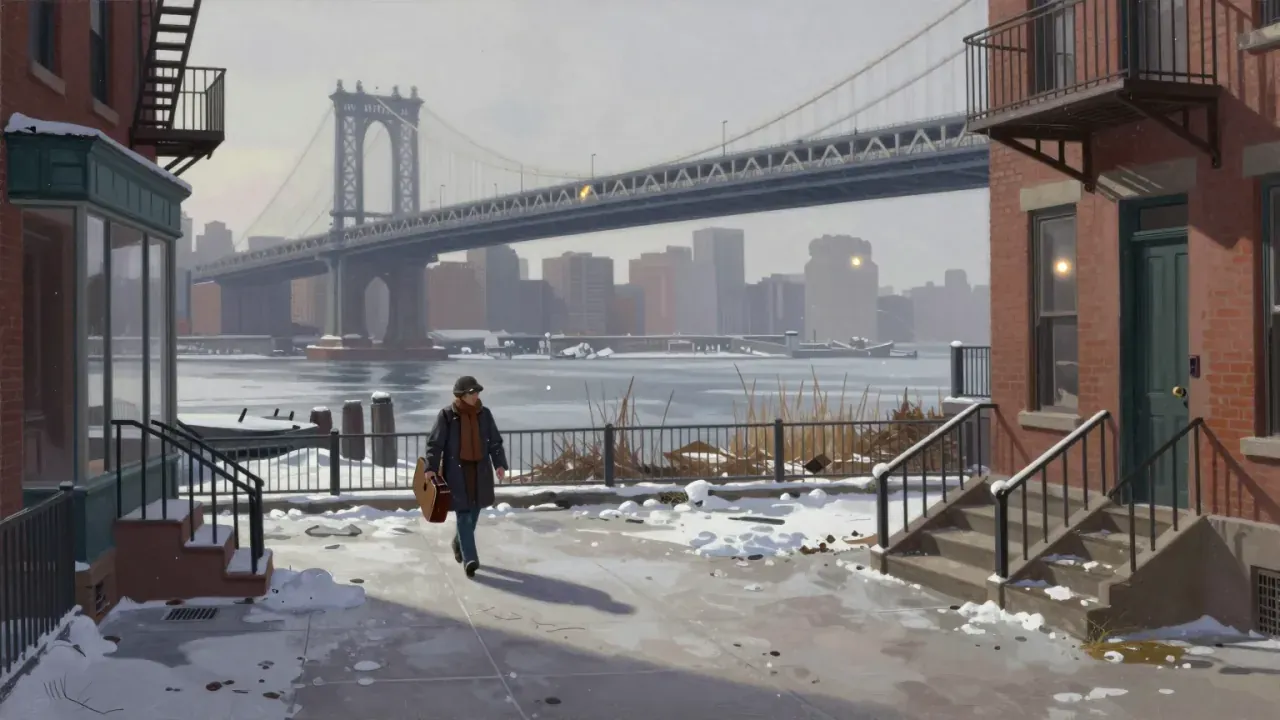
Inside Llewyn Davis is a tightly wound period drama set over one wintry week in early 1961, following a folk singer who cannot hold a job, a relationship, or even a cat. It does not aim to document the Greenwich Village scene, nor to offer uplift or redemption; instead, it constructs a self-contained moral and aesthetic universe where artistic sincerity is inseparable from self-sabotage, and where failure recurs with the quiet inevitability of a verse-chorus structure. The Coens treat the folk revival not as cultural history but as mythic terrain — a landscape of doorways, subways, and basement rooms where character is revealed through gesture, silence, and the unvarnished act of singing. The film’s ambition lies in its refusal to soften its protagonist or flatter its audience: Llewyn is neither tragic hero nor comic foil, but a man whose integrity is indistinguishable from his inability to bend. It seeks no explanation for his condition, only precise observation of its rhythm and weight.
The shape of the week
The story moves in looping, almost ritualistic patterns: Llewyn plays a set, sleeps on a couch, argues, loses a cat, boards a bus, sings again. Oscar Isaac performs every song live, his voice raw and unadorned, anchoring the film in physical presence rather than technique. Carey Mulligan’s Jean is terse and weary, John Goodman’s Roland Turner a grotesque counterpoint of jazz-inflected contempt, Garrett Hedlund’s Johnny five words deep in laconic cool. Bruno Delbonnel’s cinematography renders New York in muted greys and ochres, the interiors lit as if by a single bulb behind a curtain. The Coens’ editing avoids emphasis or punctuation — cuts land without fanfare, holding on faces just long enough to register exhaustion, not insight. T Bone Burnett’s music supervision ensures every note feels sourced, not scored: no underscore, no emotional cue, only songs that exist in the world of the film, sung by people who must earn their keep in it. The craft is restrained, cumulative, unshowy — each decision serving the film’s central proposition: that art made without concession is also art made without shelter.
What returns
What lands is the film’s tonal precision: its ability to sustain a mood of rueful clarity without tipping into sentiment or satire. The recurring motif of the runaway cat — passive, indifferent, impossible to control — works not as metaphor but as structural principle: Llewyn’s life, like the animal’s path, resists narrative resolution. The performances land because they withhold interpretation; Isaac never asks for sympathy, Mulligan never offers absolution, Goodman never winks. The music lands because it is diegetic and functional — songs are tools, weapons, alibis — and because the arrangements (mostly acoustic, mostly unvarnished) refuse the polish of retrospective nostalgia. The winter light lands: it is not atmospheric but procedural, shaping how characters move, speak, and disappear from frame. Even the humour lands with the dryness of a dropped chord — never broad, never timed for laughter, always emerging from the gap between what Llewyn believes he deserves and what the world permits him to keep.
What stays closed
What does not land is any sustained sense of consequence beyond the immediate week. The film’s refusal to explain Llewyn’s past — why he dropped out of school, why he alienates everyone, why he clings to a dead partner’s memory — risks flattening him into archetype rather than character. Some viewers find the emotional withholding too absolute, the repetitions too insistent, the lack of forward motion mistaken for stagnation rather than design. The supporting roles, though sharply drawn, remain deliberately opaque: Jean’s bitterness, Jim’s success, Roland’s cruelty — none are rooted in exposition, and those who expect psychological scaffolding may feel adrift. The cats, while technically accomplished, occasionally strain credulity not as animals but as narrative devices — their autonomy becomes a formal conceit that, for some, overshadows their function as silent witnesses. And the ending, which circles back to the opening moment, lands with intellectual satisfaction but leaves little room for earned change — a choice that reads as conviction to some, evasion to others.
The weight of staying put
The themes that matter are failure as condition rather than event, artistic labour as daily endurance rather than heroic breakthrough, and the quiet violence of being chronically unmoored. Class surfaces not in dialogue but in texture: the worn tweed, the cracked leather of a guitar case, the difference between sleeping on a floor and sleeping on a sofa. Time is treated non-linearly not for show but to reflect how memory and regret loop — Llewyn hears his own voice on a record he did not approve, sees his reflection in subway glass as if confronting a stranger he has known too long. The film treats folk music not as heritage but as practice: communal, imperfect, passed hand to hand, vulnerable to mishearing and misplacement. Its deepest theme is the cost of refusing compromise — not as moral stance, but as physiological fact. Llewyn’s body bears the toll: his hands are chapped, his voice frays, his posture closes in. The film suggests that integrity, when divorced from strategy or luck, becomes indistinguishable from inertia — and that both are forms of survival.
Who it meets halfway
This film is for viewers who value precision over propulsion, who find resonance in repetition, and who do not require narrative closure to feel emotionally satisfied. It suits those accustomed to the Coens’ syntax — their use of genre as container rather than compass — and those attuned to musical performance as character revelation. It is not for viewers who rely on plot momentum, empathetic identification, or redemptive arcs; those who need clear motivation, psychological exposition, or tonal warmth will find it withholding. Fans of biopics or music documentaries may mistake its restraint for detachment. Those who associate folk music with communal hope rather than individual struggle may feel its vision is unduly bleak. A viewer who values craftsmanship over catharsis, or who finds beauty in unresolved tension, will respond differently than one who measures films by how much they ‘move’ them — literally or emotionally. Change the ending, add a flashback, soften Llewyn’s edges: the verdict shifts.
What it gives back
It is worth your evening if you accept that a film can be rigorous without being difficult, melancholy without being oppressive, and deeply musical without being a concert film. Its 105 minutes pass with the quiet insistence of a well-tuned guitar — no wasted notes, no false harmonies. It rewards attention not with revelation but with recalibration: after watching, minor irritations feel smaller, small kindnesses larger, and the act of singing — alone, badly, repeatedly — feels more consequential than it did before. It is not an easy watch, but it is an honest one — and honesty, here, is not blunt but layered, like varnish on old wood. Those who expect entertainment to soothe or affirm may leave unsettled; those who trust that art can hold space for discomfort without resolving it will find it quietly generous. It asks for nothing but time, and repays that time with density, not diversion. To call it ‘worth it’ is not to praise its accessibility, but to acknowledge its rare consistency of purpose and execution.