A Nikkatsu Noir
I Am Waiting is a 1957 Japanese drama film produced by Nikkatsu as part of its early noir-inflected output, aiming to recalibrate domestic genre expectations in response to American and French imports. It does not replicate Hollywood structure or moral framing but adapts noir’s visual grammar and fatalism to local conditions: postwar disillusionment, economic precarity, and the lingering stigma of personal failure in a society still measuring men by physical and professional success. The film attempts something modest but precise — to hold two damaged people in close proximity while their pasts press in from all sides, using the restaurant as both refuge and trap. Its ambition lies not in plot complexity but in sustained mood and psychological compression: every scene tightens the knot between memory, desire and consequence. It works within strict formal limits — single-location interiors, rain-slicked night exteriors, dialogue that rarely explains — trusting atmosphere and gesture over exposition. This is not a film about solving a crime but about surviving the aftermath of one, even when the crime has no name.
The Weight of Silence
The story follows Jōji Shimaki, a disgraced former boxer, and Saeko, a singer whose voice has failed under illness and coercion, as they shelter together in a Tokyo restaurant while evading gangsters and internal shame. Yūjirō Ishihara carries the film with minimal inflection: his performance is less acting than withholding — a posture of exhaustion that reads as dignity under pressure. Mie Kitahara matches him in restraint, her vulnerability never sentimentalised. Koreyoshi Kurahara directs with tight framing and deliberate pacing; Masaru Sato’s score uses muted brass and sparse piano to underscore tension without melodrama. Shintarō Ishihara’s script avoids monologues and backstories, revealing character through refusal — what Jōji won’t say about his brother, what Saeko won’t sing in front of customers. The lighting, though uncredited in the fact sheet, consistently favours shadow over clarity, particularly in the restaurant’s back rooms and stairwells, reinforcing entrapment as both physical and existential. Every cut feels considered, every silence weighted.
What Lands Without Words
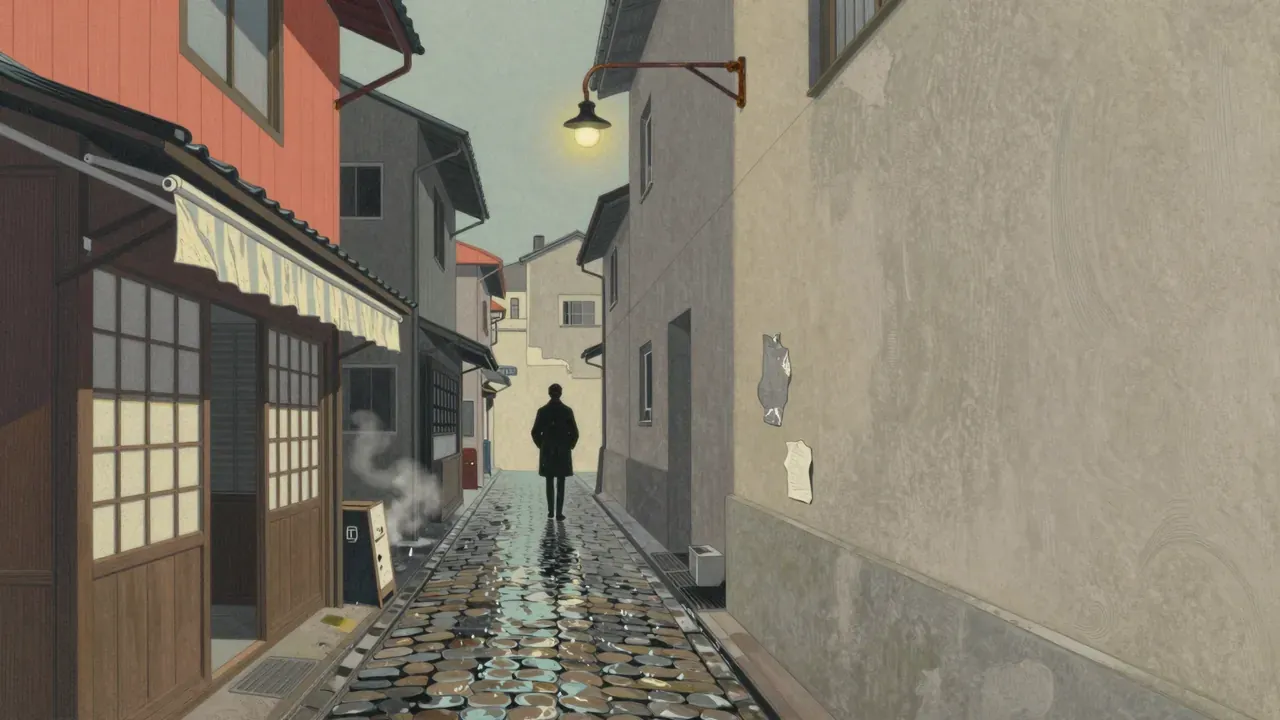
What lands is the cumulative weight of small, unspoken choices: Jōji turning away from a fight he could win, Saeko refusing to open a letter she knows will bring bad news, the way both characters pause before stepping into the street at night. The film’s emotional register stays low but never flat — it builds through accumulation rather than climax. The restaurant itself becomes legible as a character: its cramped kitchen, flickering neon sign, and narrow alley entrance all function as narrative pressure points. Ishihara’s physical presence grounds the film; his boxing past is visible in his stance and the way he holds his hands, even when idle. The sense of a city just beyond frame — traffic noise, distant sirens, the murmur of unseen patrons — gives texture without exposition. There is no false uplift, no redemption arc, yet the film avoids nihilism by anchoring its despair in specificity: a missed train, a broken watch, a half-packed suitcase. These details do not explain but confirm — they make the characters’ resignation feel earned, not imposed.
Where the Thread Snaps
What does not land is the late revelation about Jōji’s brother. Though pivotal to the plot, it arrives without sufficient groundwork — the earlier references to Brazil are too vague, the brother’s absence too lightly sketched, for the betrayal to carry full emotional force. The gangster antagonists remain functional rather than felt: Shibata (older) and Uchiyama operate as types, their menace delivered through costume and posture rather than motive or contradiction. The film’s resistance to exposition works against itself here — where ambiguity serves the leads’ interiority, it leaves the opposition hollow. A subplot involving the police detective never coheres; his appearances feel like structural placeholders rather than narrative necessity. The final confrontation lacks spatial logic — its geography is unclear, its stakes diffuse — and the resolution leans on gesture over consequence. None of this breaks the film, but it dilutes the precision elsewhere. A viewer expecting tight cause-and-effect plotting will find gaps; the film assumes patience with implication, and some implications remain unanchored.
I Am Waiting
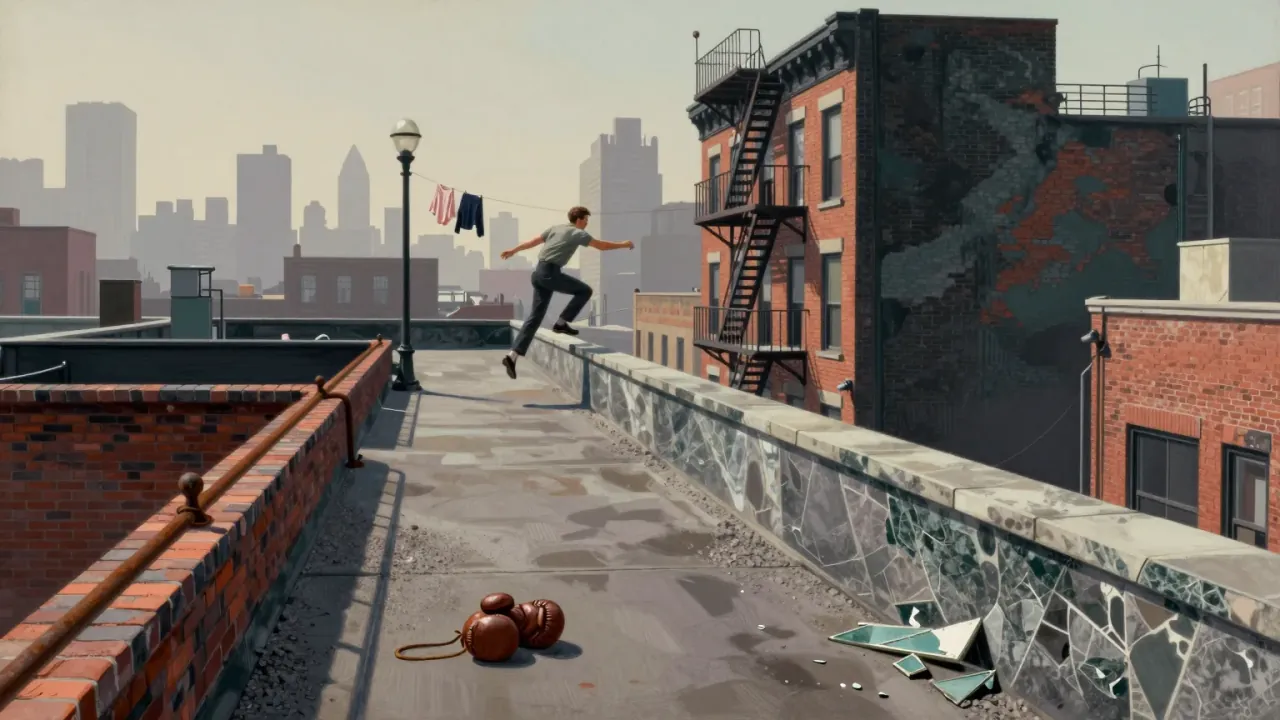
The themes that matter are failure as identity, waiting as agency, and escape as myth. Jōji is defined not by what he did in the ring but by what was taken from him — his disqualification, his brother’s absence, his inability to speak plainly. Saeko’s voice loss is literal and symbolic: she cannot sing, cannot plead, cannot be heard except through Jōji’s silence on her behalf. The title is not passive — ‘I am waiting’ is an assertion, however fragile, of continuity in the face of erasure. The film treats dreams — Brazil, love, quiet work — not as goals but as temporary shelters, structures built to hold off collapse for just a little longer. Class is present but unspoken: the restaurant is neither glamorous nor destitute, a middle ground where survival requires constant negotiation. There is no critique of the system, only its quiet operation — the gangsters do not need ideology, only leverage; the police do not need conviction, only procedure. The film’s moral centre is not justice but endurance, and its clearest statement is that some people keep moving not because they believe in arrival, but because stopping would mean admitting the road ends.
Who It Is For
This film is for viewers who value mood over momentum, who follow characters through hesitation rather than action, and who trust a director to withhold rather than explain. It suits those familiar with mid-century Japanese studio filmmaking — particularly Nikkatsu’s 1950s output — or with noir’s emphasis on urban isolation and compromised choices. It is not for viewers who require clear antagonists, narrative payoffs, or psychological exposition; those seeking catharsis or closure will find the film withholding to the point of austerity. Someone who values strong plotting over sustained tone — or who expects romance to resolve rather than persist in uncertainty — will leave unsatisfied. A viewer who prefers performances that declare emotion rather than contain it may misread Ishihara’s stillness as vacancy. The film asks for attention to what is withheld, and that demand is not neutral: it presumes a certain familiarity with cinematic economy, and without it, the film can feel inert rather than intentional.
Worth Your Evening
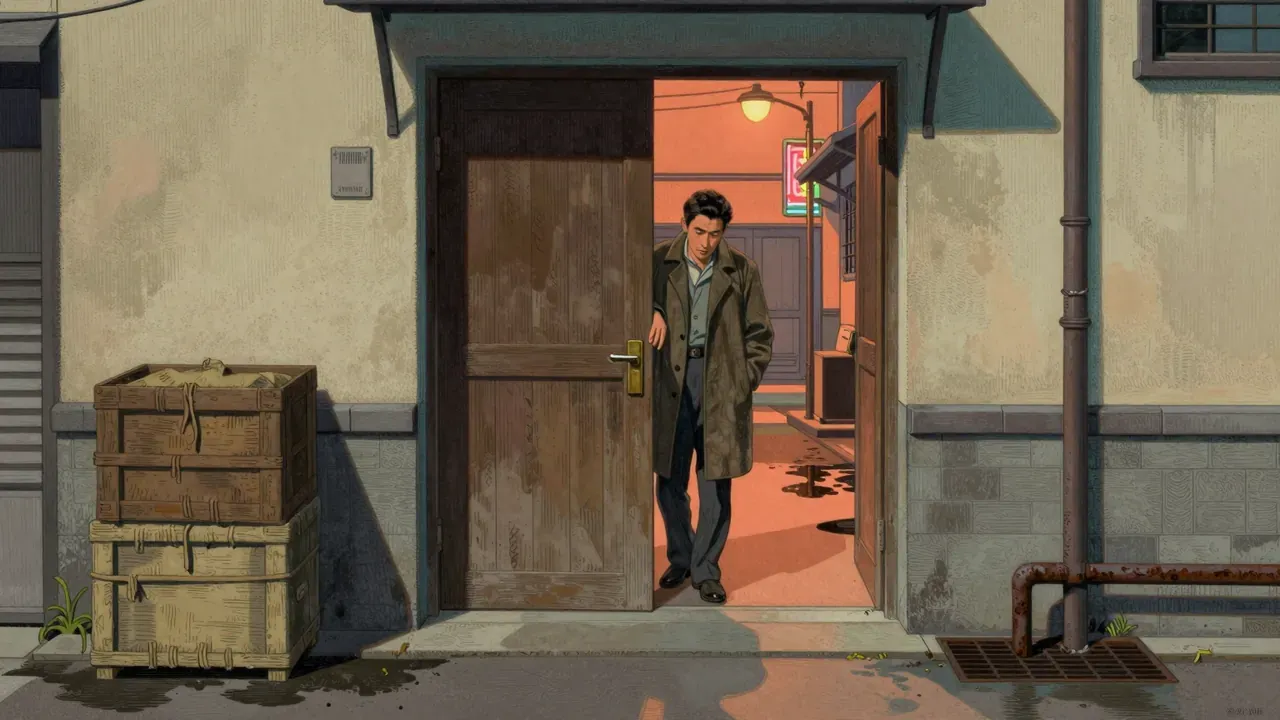
Yes, it is worth your evening — provided you watch it as a study in restraint, not as a puzzle to solve. Its ninety-one minutes unfold without hurry, building tension through repetition and restriction rather than escalation. The rewards are cumulative: a particular glance held too long, a door left ajar in the rain, the way light falls across a tabletop at 3 a.m. Those who approach it expecting narrative propulsion will find it slow; those who attend to its textures — the grain of the film stock, the cadence of its silences, the weight of its pauses — will find it quietly insistent. It does not ask for investment in outcome but in presence. A viewer who values craftsmanship over convenience, who finds resonance in unresolved endings, and who accepts that some films measure time not in events but in breaths, will find it worthwhile. Those who require clarity, closure or comfort will not. Nothing changes that verdict — not restoration, not subtitles, not context — because the film’s design is its argument.