The pulse of it
The Warped Ones is a 1960 Japanese drama film that sets out to portray disaffected youth not as misunderstood rebels but as volatile, amoral forces shaped by urban neglect and cultural rupture. It does not seek redemption, explanation or even consistent motivation for its characters — instead it presents them as symptoms: Akira’s rage, Masaru’s restless ambition, Yuki’s transactional pragmatism, Fumiko’s sudden vulnerability. The film attempts no sociological diagnosis, but insists on the physicality of their condition — cramped tenements, sun-bleached beaches, jazz clubs pulsing with unresolved tension. Its aim is stylistic and behavioural fidelity: to mirror the jagged rhythms of post-war Tokyo youth through editing, sound and movement rather than exposition or moral framing. It rejects the studio polish Nikkatsu typically applied to youth films, opting instead for a raw, almost documentary immediacy — though never pretending to realism. The film treats its characters as phenomena, not persons; their actions are less choices than eruptions. This is not a critique of delinquency so much as an anatomical study of its nervous system.
The grammar of it
The story moves in short, violent arcs: arrest, release, theft, rape, pregnancy, betrayal, abortion. There are no subplots, no digressions — only escalation and recurrence. Tamio Kawachi plays Akira with a physical vocabulary of snarls, lunges and abrupt stillness; Eiji Gō’s Masaru is all nervous energy and scat-sung bravado; Yuko Chishiro’s Yuki shifts between detachment and calculation without affectation. Nobuo Yamada’s script avoids psychology, giving characters lines that function more like percussion than dialogue. Toshiro Mayuzumi’s jazz score does not accompany action but drives it — brass stabs punctuate cuts, basslines accelerate chases, silence arrives only before violence. Yoshi Mamiya’s cinematography alternates between tight, static frames and handheld surges; Akira Suzuki’s editing uses freeze-frames not for emphasis but interruption, jump cuts not for irony but disorientation. The camera lingers on sweat, cigarette smoke, wet sand, car tyres spinning — textures over narrative. Every craft decision serves the same principle: to deny the viewer stable ground, both visually and morally.
The rhythm of it
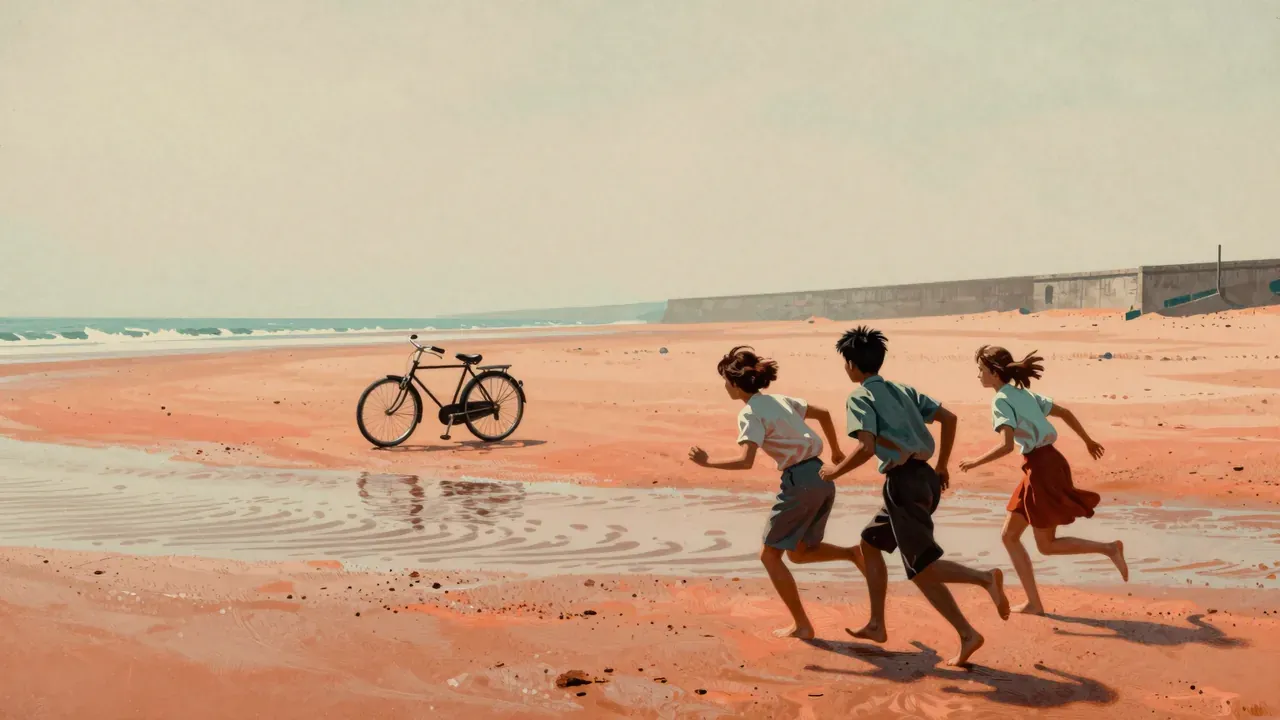
What lands most decisively is the film’s rhythmic coherence — the way music, editing and performance lock into a single nervous frequency. The beach sequence works not because it is narratively necessary but because its chaos feels inevitable: the ocean’s indifference, the characters’ animal exertion, the camera’s refusal to look away. The abortion clinic confrontation lands precisely because it offers no catharsis — only a flat, almost bureaucratic exchange of biological facts that undercuts every prior claim to passion or consequence. The film’s refusal to judge its characters also lands, not as neutrality but as structural honesty: Akira is neither hero nor villain, but a force whose logic is internal and untranslatable. The jazz score remains inseparable from the film’s impact — not background but architecture. Even now, the soundtrack’s urgency feels less like period flavour and more like a persistent physiological response. The film’s brevity (75 minutes) aids its effect: there is no time for reflection, only immersion and recoil. Its power lies in sustained tonal consistency, not isolated moments of brilliance.
The cost of it
What does not land is any sustained emotional engagement with the characters beyond their surface volatility. Their motivations remain opaque not by design but by omission — the script gives no history, no interiority, no contradiction beyond what the plot demands. Akira’s fleeting moment with Gil, the Black jazz musician, gestures toward race and marginality but stops at gesture; it is not developed, contextualised or revisited. The film’s socio-political framing remains implied rather than argued: we see sterile tenements and hear references to unemployment, but the link between environment and behaviour stays associative, not causal. Nor does the film sustain its own stylistic logic in every sequence — some scenes revert to conventional coverage, diluting the earlier intensity. The rape scene, while central to the film’s thesis, risks collapsing into sensationalism without clearer authorial distance or formal counterpoint. And though the film critiques moral hypocrisy, it offers no alternative framework — its nihilism is absolute, which may read as exhaustion rather than rigour to some viewers.
The air of it
The themes that matter are not youth rebellion or jazz culture per se, but the erosion of coherent subjectivity under late-modern conditions: how identity fractures when institutions — family, education, law, even language — fail to provide stable reference points. The film treats crime not as transgression but as default behaviour in a landscape stripped of viable models. Jazz functions here not as metaphor but as sonic analogue: improvisation without harmony, rhythm without resolution. The recurring motifs — gas cocks, water, explosions, pregnancy — are not symbols but pressure valves: repeated attempts to rupture a suffocating status quo. Class appears not as economic category but as sensory deprivation: the characters move through spaces drained of warmth, colour or texture. Their hedonism is not pleasure-seeking but anaesthesia — sex, theft and noise as ways to confirm bodily presence in a world that refuses to acknowledge them. The film’s political thrust is quiet but insistent: these are not warped individuals, but the logical output of warped structures. Their amorality is systemic, not personal.
The demand of it
This film is for viewers who value formal audacity over narrative comfort, who respond to cinema as sensory event rather than storytelling vehicle. It suits those familiar with 1960s Japanese New Wave conventions or with avant-garde jazz’s structural logic — people who find coherence in disjunction. It is not for viewers seeking psychological depth, moral resolution or character continuity. Those who require clear cause-and-effect, empathetic protagonists or thematic clarity will find it alienating. Some critics have called it ‘dangerous’; others call it hollow — the difference hinges on whether one values provocation as substance or as tactic. A viewer who finds Godard’s Breathless emotionally distant or Ray’s Rebel Without a Cause sentimental may find this more direct. But anyone needing ethical anchorage, even implicit, will leave unsettled without satisfaction. Its value is not in what it says about youth, but in how relentlessly it enacts their dislocation.
The measure of it
Yes, it is worth your evening — provided you approach it as a concentrated aesthetic object, not a story to be followed. Its 75 minutes pass with the velocity of its own editing, leaving little room for fatigue. The film rewards attention to texture, rhythm and restraint: what is withheld matters as much as what is shown. It is not ‘enjoyable’ in any conventional sense, but it is unmistakably alive — a rare thing in cinema of any era. Those who dismiss it as juvenilia or exploitation misunderstand its discipline: every jarring cut, every screeching trumpet, every blank stare is calibrated. It would not gain from being longer, kinder or clearer. To wish for those things is to misread its purpose. Its endurance lies not in universality but in specificity — a precise, unblinking record of a particular cultural voltage at a particular moment. That precision makes it worth watching, even if it leaves you breathless in the wrong way.