The look of it
I, Daniel Blake is a British drama film that sets out to depict the lived reality of welfare claimants under the UK’s post-2010 austerity reforms. It does not frame itself as allegory or satire but as direct social observation: its aim is to make visible the bureaucratic violence embedded in automated assessments, mandatory online applications, and punitive sanctions. Ken Loach and Paul Laverty base the film on interviews with people who had navigated the Department for Work and Pensions system, and the script adheres closely to documented procedures — the Work Capability Assessment, the appeal process, the conditions attached to Jobseeker’s Allowance. The film refuses abstraction; it names forms, offices, protocols, and consequences. Its political intent is neither concealed nor softened: it treats the welfare state not as a neutral administrative apparatus but as an active agent in the erosion of dignity, health, and community. This is not a film about ‘one man’s struggle’ in the literary sense, but about how policy becomes physiological fact — heart attacks, hunger, isolation — when applied without regard for human contingency. It asks the audience to witness, not empathise from a distance.
The way it moves
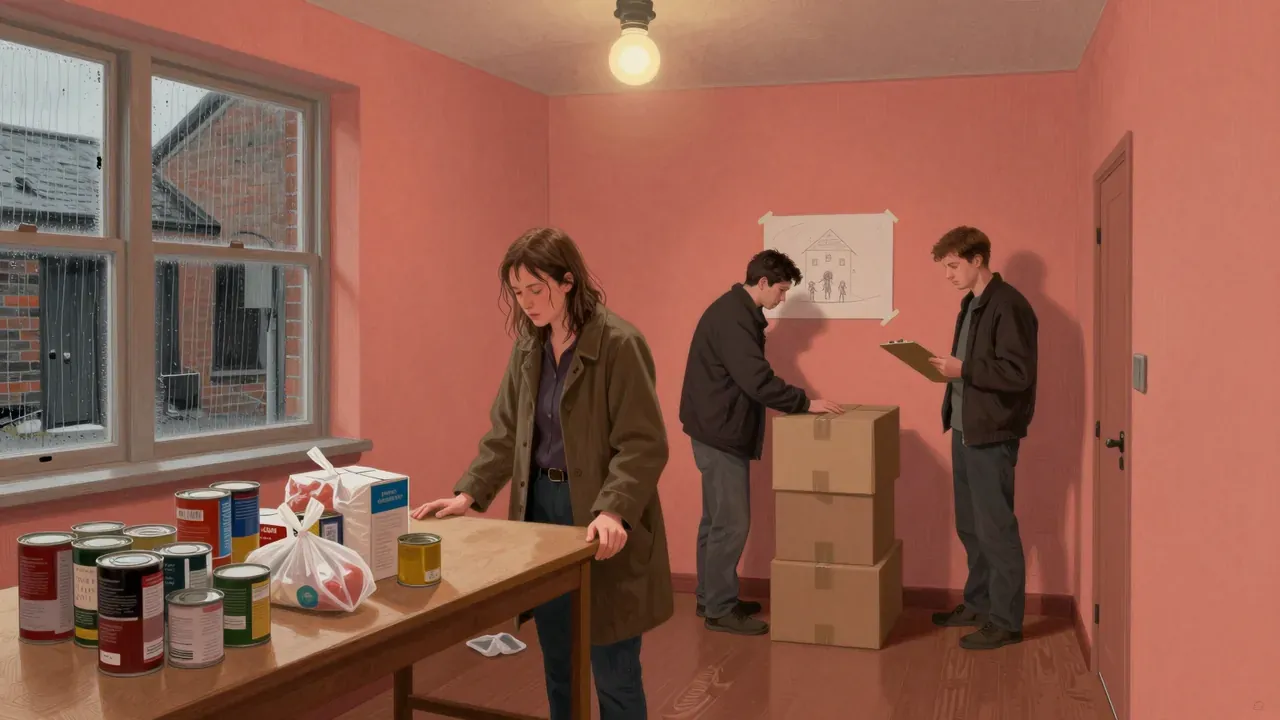
The story follows Daniel Blake, a Newcastle joiner recovering from a heart attack, as he contests a decision declaring him fit for work. His path crosses with Katie Morgan, a single mother newly arrived in the city after eviction and homelessness. Their relationship develops through small, unceremonious acts: mending furniture, sharing meals, teaching children to draw. Dave Johns plays Daniel with a quiet, weathered precision — his pauses carry the weight of exhaustion, not performance. Hayley Squires’ Katie is less contained: her breakdown at the food bank is rendered without music or cutaways, sustained in a single take that trusts the actor’s physical control and the camera’s restraint. Robbie Ryan’s cinematography avoids flourish: handheld shots stay close but never intrusive; interiors are lit with the flat, low-wattage realism of municipal buildings and rented rooms. Jonathan Morris’s editing sustains rhythm through accumulation rather than contrast — scenes of waiting, typing, queuing, repeating — building pressure by refusing release. George Fenton’s score is sparse, used only in transitional moments, never to cue emotion. The craft serves the subject without embellishment or apology.
What sticks
What lands is the cumulative effect of procedural detail made visceral. The film makes the reader feel the friction of bureaucracy not as abstraction but as physical impediment: the tremor in Daniel’s hand as he tries to type an appeal form, the heatless chill of a council flat, the way a Jobcentre interview room smells of disinfectant and stale air. The scene in the food bank works because it refuses dramatisation — Katie’s silence before her collapse, the other volunteers’ averted glances, the slow realisation that no one intervenes because intervention is outside their remit. Similarly, Daniel’s spray-painted protest is not heroic but desperate, and the bystanders’ murmured support feels earned, not scripted. The film’s moral force comes from its refusal to isolate injustice: it shows how sanctioning one person destabilises a family, how a missed appointment triggers a cascade of rent arrears, childcare gaps, and nutritional collapse. These are not plot points but causal chains, drawn from testimony, and they land because they are anchored in behaviour, not exposition.
Where it slips
What does not land is the film’s occasional reliance on schematic contrast — particularly in the portrayal of DWP staff, who appear either uniformly indifferent or quietly complicit, with no variation in tone, motive, or personal history. While the script cites pressure from above, the individuals enforcing policy remain functionally undifferentiated, which flattens the system’s complexity and risks reinforcing the very caricature it seeks to dismantle. The subplot involving Katie’s coerced entry into sex work arrives abruptly, with insufficient groundwork in her prior choices or constraints — it reads less as inevitable consequence and more as narrative intensifier. Likewise, Daniel’s final heart attack occurs off-screen in a toilet cubicle, then cuts to Katie reading his unfinished speech at his public health funeral: the transition sacrifices emotional logic for symbolic closure. The film’s commitment to realism occasionally falters when it subordinates character logic to thematic emphasis, especially in its closing stretch, where grief is framed more as indictment than interior experience.
What it’s really about
The themes that matter are not poverty as condition but poverty as process — the slow, documented attrition of agency, time, and bodily integrity under administrative demand. It treats work not as vocation or identity but as a lever pulled by remote actors to enforce compliance. The film interrogates literacy not as education but as gatekeeping: digital illiteracy is treated as disqualification, not disability. It insists on the materiality of care — how heating a room, repairing a chair, or carving a toy constitutes resistance when formal support has withdrawn. Class is not signalled through accent or costume but through access: to broadband, to transport, to legal advice, to doctors who return calls. The film’s most persistent theme is the erasure of personhood by systems that reduce human beings to data points — NI numbers, tick-box outcomes, algorithmic risk scores — and its quiet insistence that dignity resides not in self-sufficiency but in mutual obligation, however fragile. That obligation is shown not in speeches but in shared tea, in borrowed tools, in a child delivering soup.
Who it’s for
This film is for viewers who want to understand how contemporary welfare policy operates on the body and the clock, not just the balance sheet. It is for those willing to sit with discomfort without catharsis, and for anyone who has ever filled in a government form while unwell, under-resourced, or without internet access. It is not for viewers who require narrative resolution, psychological exposition, or moral ambiguity in institutional portrayals — the film offers none of these. Those who believe welfare systems are fundamentally benevolent or that individual resilience can override structural constraint will find its perspective unremitting. It also assumes familiarity with UK-specific institutions: Jobcentres, ESA, food banks as emergency infrastructure — international audiences may need contextual scaffolding. A viewer who expects character arcs to resolve or who finds sustained realism emotionally draining may leave unsettled rather than informed. Its value lies in fidelity, not accessibility, and that fidelity excludes compromise.
Is it worth your time
Yes, it is worth your evening — not as entertainment but as calibrated exposure. Its 100 minutes do not pass lightly; they accumulate like unpaid bills. You will not forget the sound of a keyboard being tapped by someone who has never used one before, or the silence after a security guard offers Katie work she cannot refuse. It earns its gravity not through spectacle but through adherence: to documented procedure, to observed behaviour, to the rhythms of waiting and repetition that define life under sanction. Some will argue it is too didactic, too narrow in its focus, too unwilling to grant complexity to its antagonists — and those criticisms are valid, if secondary to its purpose. What would change the verdict is not better craft but a different aim: this film was never meant to persuade the unconvinced, but to name what is happening, in plain language, to people who have no platform. That makes it difficult, necessary, and, in its own terms, successful.