What it is trying to do
Eating Raoul is a low-budget American black comedy that uses murder as a narrative engine for satire—not of violence, but of aspiration, propriety, and the moral compromises baked into small-business ambition. It sets out to be deliberately unglamorous: no stylistic flourishes, no psychological exposition, no redemption arc. Paul Bartel and Richard Blackburn’s script treats killing as routine labour, like restocking wine or changing bed sheets. The film’s tone is flat, its pacing unhurried, its visual grammar functional—Gary Thieltges’ cinematography keeps interiors lit like a dentist’s waiting room, not a thriller’s lair. It does not aim for shock through gore or suspense, but through the sheer banality of its protagonists’ logic: if swingers are disposable, and money is scarce, then disposal becomes accounting. Its project is structural, not visceral: to expose how easily moral lines dissolve when framed as practical constraints. It is not parodying horror or crime genres so much as using their scaffolding to hang a dry, deadpan critique of middle-class striving in Reagan-era Los Angeles.
How it works
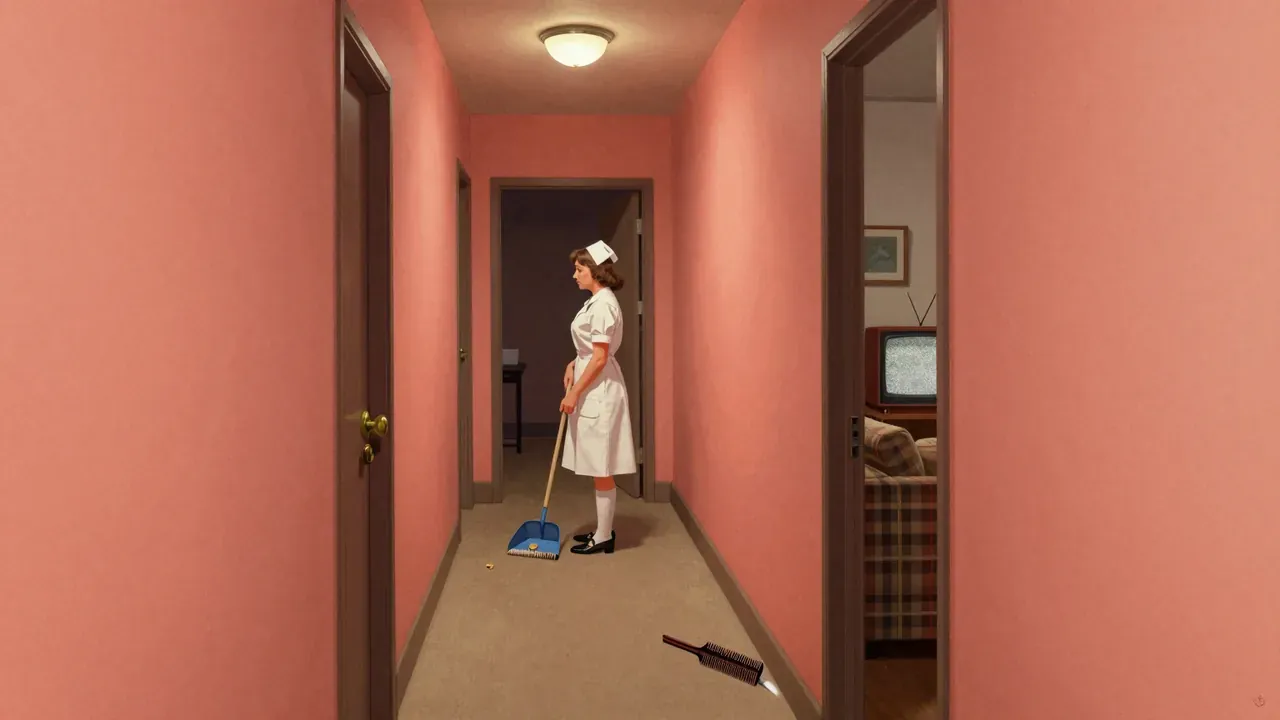
The story follows Paul and Mary Bland—a prudish, twin-bedded couple—who kill affluent swingers to fund their restaurant. Their method is repetitive, almost bureaucratic: lure, mislead, strike, dispose. Performances are calibrated to understate: Bartel plays Paul with clipped diction and suppressed panic; Woronov’s Mary delivers lines about necrophagy and infidelity with the same affectless precision she uses to check a patient’s pulse. Robert Beltran’s Raoul is the only character with physical swagger, yet even he is undercut by his own incompetence—his criminality is half-baked, his seduction tactics transparent. Thieltges’ camera stays at medium distance, avoiding close-ups that might invite empathy or dread. Editing is unobtrusive; sound design avoids stings or score swells—music appears only diegetically, like a radio playing faintly in the background. The film’s craft serves its thesis: this is not chaos, but system. Even the trash compactor, the electric heater, the rattail comb—they are tools, not symbols. Nothing is heightened. Everything is accounted for.
What lands
What lands is the consistency of its tone and the rigour of its premise. The Blands’ refusal to be flustered—even when cooking Raoul—carries the film’s dark humour without needing punchlines. Scenes work because they follow internal logic: Mary’s discomfort with the frying pan as cookware, Paul’s irritation at having to buy groceries mid-murder, Doris the Dominatrix’s bureaucratic impersonations—all land because they extend the film’s central joke: that evil, here, is administrative. The casting reinforces this: Buck Henry as a sleazy investor, Ed Begley Jr. as a smarmy swinger, Hamilton Camp as a clueless landlord—each performance is precise, never broad. The film’s most effective moments are quiet ones: Mary folding laundry while a corpse lies in the next room, Paul adjusting his glasses before swinging the pan, the long pause after Raoul’s body hits the compactor. These are not gags; they are beats of lived-in absurdity. The film earns its laughs not by escalating, but by refusing to break stride.
What does not
What does not land is the final act’s shift toward farcical escalation. The hot tub massacre—Paul hurling an electric heater into nude bathers—breaks the film’s established rhythm of muted cause-and-effect. It introduces slapstick where the rest relies on procedural irony, and it arrives without the same grounding in character logic. Similarly, Raoul’s sudden turn from comic foil to sexual threat feels less like development than narrative convenience; his motives blur, his agency shrinks, and the affair with Mary gains emotional weight the script otherwise denies to intimacy. The film’s early restraint makes these later turns feel unearned, not anarchic. Some viewers may also find the flatness mistaken for emptiness: there is no subtext about trauma, no critique of gender roles beyond surface-level prudishness, no reckoning with consequence beyond logistical inconvenience. That is deliberate—but it leaves little room for resonance beyond the immediate joke, and no foothold for reflection once the credits roll.
The themes that matter
The themes that matter are not sex or death, but the quiet violence of aspiration and the banality of moral compromise. The Blands do not kill for pleasure or ideology, but because their dream—a modest, family-run restaurant—requires capital they cannot access through legitimate channels. Their prudishness is not hypocrisy, but insulation: it lets them frame each murder as a transaction, not a transgression. The film treats class as infrastructure: the wine shop, the hospital, the apartment building, the Hollywood Press—all are systems that exclude or exploit, and the Blands respond not with protest, but with parallel exploitation. Swingers are not villains, but symptoms: affluent, careless, interchangeable. Raoul is not a monster, but a fellow opportunist whose methods simply overlap theirs. The film’s real subject is the erosion of boundaries when survival and success become indistinguishable—and how easily ‘normal’ people build new moral architectures, one corpse at a time, without ever raising their voice.
Who should watch it, and who should not
This film is for viewers who value tonal discipline over emotional payoff, who find humour in repetition and irony in understatement, and who are comfortable with satire that refuses catharsis. It suits fans of early John Waters, early Jim Jarmusch, or the flatline wit of Joe Orton—people who prefer a raised eyebrow to a belly laugh. It is not for those who need narrative momentum, psychological depth, or thematic resolution. Viewers expecting horror will find no dread; those seeking romance will find no chemistry beyond transactional flirtation; those hoping for social commentary with clear targets may find the film too diffuse, too committed to its own logic to point fingers. A viewer who values moral ambiguity as atmosphere rather than puzzle will stay engaged; one who reads irony as evasion may leave cold. Its appeal narrows with familiarity—the more you expect from cinema, the less Eating Raoul gives back, unless you meet it on its own terms: as a dry, precise, slightly sour appetiser, not a main course.
Is it worth your evening
Yes, it is worth your evening—if you approach it as a tightly wound clockwork joke, not a story with stakes. At 83 minutes, it moves briskly without rushing, and its repetitions accumulate meaning rather than fatigue. It rewards attention to detail: the way Mary’s nurse’s uniform stays immaculate, the exact brand of wine Paul stocks, the bureaucratic language Doris uses to fake immigration paperwork. Those who dislike it tend to cite its emotional austerity or its refusal to judge its protagonists—critics like Roger Ebert found it clever but inert, missing the ‘transcendent breach of taste’ that might have elevated it. But that breach is precisely what the film avoids: its power lies in its refusal to sensationalise. If you value films that trust their audience to sit with discomfort without explanation, this holds up. It does not deepen on repeat viewings, but it does not fray either—it remains exactly what it is: a small, sharp, unsentimental blade.