The shape of the family
Monsoon Wedding is a domestic ensemble film set over four days in Delhi, tracking the preparations for a Punjabi Hindu wedding. It aims to hold together contradictory impulses: the ritual gravity of intergenerational obligation and the lightness of romantic comedy; the claustrophobia of family scrutiny and the exuberance of collective celebration; the unspoken weight of trauma and the insistence on communal joy. It does not seek to resolve these tensions but to stage them in proximity — letting a qawwali play over a confession, placing a maid’s quiet dignity beside a billionaire’s entitled charm, framing a child’s fear within a flurry of marigolds and drumbeats. The film treats tradition not as fixed code but as contested, adaptable practice — one that absorbs English, Christianity, Texas, and trauma without fracturing. Its ambition is structural as much as thematic: to build a world dense enough to contain contradiction, yet coherent enough to feel lived-in. It asks whether love, repair, and belonging can coexist with silence, complicity, and inherited harm — not as abstractions, but as choices made in real time, under monsoon clouds. (158 words)
The look of it
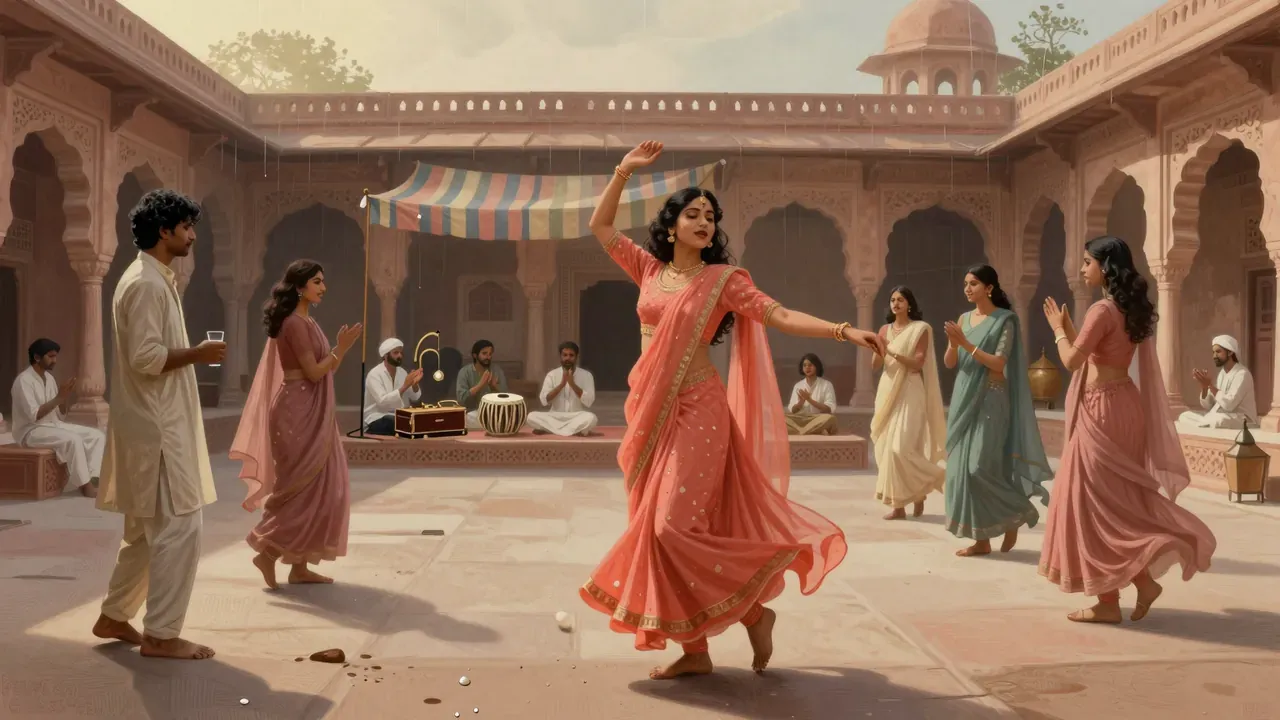
The story moves through overlapping arcs — Aditi’s reluctant engagement, Ria’s suppressed testimony, Dubey’s courtship of Alice, Varun’s quiet resistance to gendered expectation — all anchored by Lalit’s mounting financial and moral strain. Sabrina Dhawan’s script gives each character functional agency: no one exists solely to reflect Aditi’s dilemma. Naseeruddin Shah grounds Lalit in weary decency; Shefali Shah’s Aditi balances pragmatism and vulnerability without slipping into archness; Vasundhara Das’s Alice speaks little but registers every shift in power with her posture and gaze. Declan Quinn’s cinematography avoids stylisation: he keeps interiors sun-bleached and shallow-focus, lets handheld shots wobble only when emotion spills over, and frames group scenes so bodies occupy space without hierarchy. Mychael Danna’s score weaves Indian instrumentation with Western harmony but never swells to underscore feeling — it breathes alongside the characters. The editing, by Vibha Singh, sustains rhythm without rushing: pauses land because they’re earned, not inserted. (159 words)
Where the weight falls
What lands is the film’s refusal to isolate pain from pleasure. Ria’s accusation against Tej arrives mid-festivity, not in a hushed corridor or flashback, but amid dancing cousins and clinking glasses — and the film holds both realities without diluting either. The reconciliation between Lalit and Ria works because it is neither total nor tidy: he does not disown his sister, but he does expel Tej, and the cost of that choice is visible in his face, not just his words. Dubey and Alice’s parallel wedding feels earned because their bond grows through shared labour — setting up tents, calming guests — not scripted declarations. Even the monsoon’s arrival is neither metaphor nor miracle: it is mud, soaked saris, and laughter as people scramble for cover. The film trusts its audience to register nuance — that Hemant’s forgiveness of Aditi is not passive acceptance but active recalibration; that Pimmi’s anxiety about Varun’s dancing stems from love and limitation in equal measure; that Tej’s wealth shields him not because the film excuses him, but because the system does. These are not revelations but recognitions. (157 words)
The loose ends
What does not land is the resolution of Ayesha and Rahul’s subplot: their mutual attraction is established early, yet their late-night dance feels tacked on, emotionally unearned, and visually disconnected from the rest of the sequence — lit too brightly, scored too sweetly, cut too fast. The film also struggles with Tej’s wife’s disbelief in Ria’s testimony: it reads less as cultural complexity and more as narrative convenience, flattening her into a foil rather than giving her interiority or motive beyond loyalty. Similarly, the depiction of Vikram — Aditi’s married boss — remains sketchy: his presence raises questions about workplace power and consent that the film acknowledges only in passing, then drops. There is also a slight tonal imbalance in the final hour: the shift from confrontation to celebration happens rapidly, relying on music and montage rather than sustained emotional logic. Some viewers may find the ending’s warmth insufficiently tempered — not because it is false, but because the film has shown how deeply harm lodges in family tissue, and the stitching feels, at moments, too neat. (156 words)
What gets passed down
The themes that matter are inheritance and accountability — not as abstract ideals but as daily practices. The film treats Partition not as historical backdrop but as living debt: Tej’s wealth compensates for loss, Lalit’s shame over borrowing echoes generational scarcity, Ria’s trauma is compounded by the family’s need to preserve unity. It interrogates what ‘family’ obliges: protection, silence, erasure, or truth-telling. It asks whether modernity resides in English fluency or in the courage to name abuse; whether tradition lives in ritual or in the willingness to revise it. Class is embedded in gesture — Tej’s casual command of servants, Dubey’s deference masking resentment, Alice’s instinct to vanish when accused. Religion appears not in doctrine but in rhythm: the ghazal’s ache, the qawwali’s surrender, the Christian hymn hummed by a maid who knows her place but not her worth. Love here is not singular but plural — filial, erotic, platonic, dutiful — and none is granted primacy. The monsoon is not symbol but condition: it disrupts plans, exposes foundations, and forces adaptation. (159 words)
Who it is for
This film is for viewers who value ensemble storytelling where no character is purely functional, who accept that moral clarity often arrives in fragments, and who do not require catharsis to feel satisfied. It suits those accustomed to films where silence carries weight and where cultural specificity deepens rather than narrows universality. It is not for those who expect plot propulsion over texture, who need villains clearly marked or resolutions fully sealed, or who find emotional ambiguity exhausting rather than truthful. Some may resist its refusal to moralise Tej’s wife or to dramatise Vikram’s consequences — those objections would be valid, but they stem from different priorities: this film values behavioural realism over narrative tidiness. A viewer who demands tighter cause-and-effect or stronger psychological exposition would find it diffuse. What would change the verdict? A longer runtime allowing deeper development of secondary arcs — particularly Ria’s aftermath and Pimmi’s internal conflict — would strengthen its claim to full emotional coherence. (158 words)
Is it worth your evening?
Yes, it is worth your evening — not as escapism but as immersion. Its 114 minutes pass with the uneven rhythm of real life: long stretches of chatter punctuated by sudden stillness, bursts of music followed by quiet exhaustion. It earns its joy precisely because it does not avoid discomfort — the wedding feels earned, not imposed. Those who watch for craft will notice how Quinn frames three generations in a single shot without hierarchy; those who watch for character will track how Alice’s hands move from folded to open across the film; those who watch for theme will see how money, memory, and marriage are braided together. It is not flawless — the Ayesha-Rahul thread falters, the finale leans gentle — but its generosity of attention, its refusal to reduce India to exoticism or trauma, and its belief in repair as ongoing work make it durable. It repays rewatching not for hidden clues but for accumulated detail. (159 words)