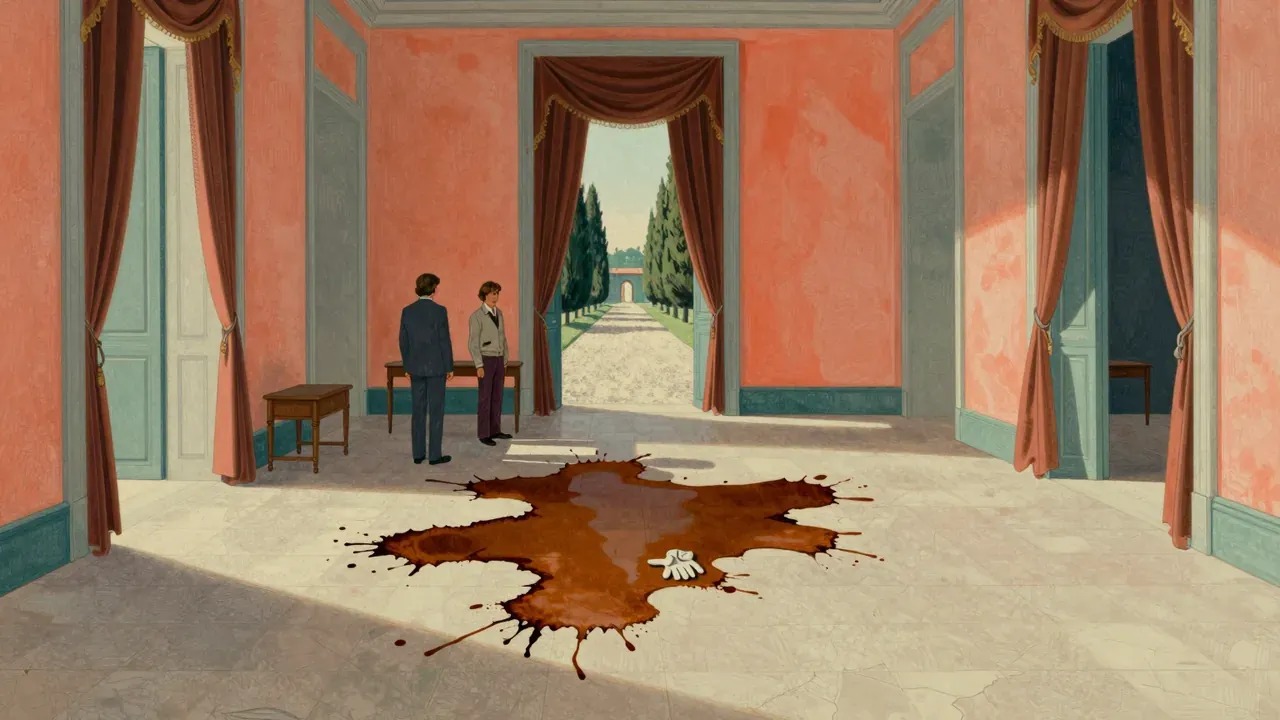
A ghost story set in 1939
The Devil’s Backbone is a Spanish gothic horror film set in the final months of the Spanish Civil War, using the conventions of the ghost story to anchor a political and moral reckoning. It does not treat the war as backdrop but as atmosphere: dust, silence, deferred violence, the weight of unspoken loyalties. Its central device — a boy haunted by another boy’s ghost — is neither metaphor nor ornament; it is structural. The orphanage is both refuge and trap, its walls holding Republican idealism, personal betrayal, and the physical residue of conflict: an unexploded bomb in the courtyard, gold buried beneath floorboards, a doctor’s jars of preserved fetuses labelled ‘Limbo water’. Guillermo del Toro co-wrote the script with David Muñoz and Antonio Trashorras over many years, refining it from earlier versions set in Mexico and featuring different supernatural logic. What emerges is not a genre exercise but a tightly wound historical fable, where the supernatural is inseparable from the social — where haunting begins not with death, but with concealment, complicity, and withheld care. It aims for quiet dread, not shock; for sorrow that lingers, not scares that fade.
The look of it
The film works through restraint: in performance, in framing, in pacing. Fernando Tielve, in his debut, plays Carlos with minimal inflection and steady gaze — a child who observes more than he interprets, whose innocence is procedural rather than sentimental. Eduardo Noriega’s Jacinto moves with contained menace, his violence deferred until it erupts without warning. Marisa Paredes and Federico Luppi ground the adult world in weary dignity, their Republican commitment worn like threadbare cloth. Guillermo Navarro’s cinematography avoids flourish: interiors are lit with practical sources, shadows pooled and deep, daylight thin and brittle. The ghost of Santi — rendered by DDT Studios — appears only in glimpses: a pale face at a doorway, a smear of blood on temple, eyes fixed but unblinking. Javier Navarrete’s score uses sparse piano motifs and low strings, never swelling, never underlining. Luis de la Madrid’s editing holds shots just past comfort, letting silences accrue weight. There is no jump scare, no musical sting on revelation. Even the fire sequence unfolds with grim inevitability, its chaos measured, its consequences shown in aftermath rather than action.
What haunts you
What lands is the moral architecture of the orphanage — how power circulates among adults and children, how ideology fractures under pressure, how grief becomes visible only when it takes shape. The ghost is credible because his presence follows logic: he appears where memory pools — near the cistern, in the kitchen, beside the inert bomb — and his silence feels less spectral than accusatory. The children’s shift from fear to agency is earned: Jaime’s confession, Carlos’s quiet decision to lead, the makeshift weapons forged not from heroism but necessity. The film’s most resonant image is not Santi’s bleeding head but Casares’ monogrammed handkerchief left behind after his ghost unlocks a door — a small, human trace in a place defined by erasure. The ending does not offer catharsis but continuity: the surviving children walk away, not unscarred, but unbroken. Casares’ ghost watches, not as guardian, but as witness. This refusal of resolution — of tidy justice or spiritual release — gives the film its gravity. It treats childhood not as vulnerability alone, but as a site of moral perception sharpened by absence.
Where the frame slips
What does not land is the framing device of the adult narrator, whose voiceover opens and closes the film. It adds little beyond exposition already embedded in image and dialogue, and its tone — reflective, distanced — sits uneasily beside the immediacy of the orphanage’s world. The character of Conchita, though played with quiet resolve by Irene Visedo, remains underwritten: her relationship with Jacinto serves plot function but lacks interior texture, and her death feels abrupt rather than inevitable. A few transitions between scenes rely on ellipsis that borders on opacity — particularly the shift from Casares’ confrontation with Jacinto to the fire, which omits the psychological pivot that would make Jacinto’s escalation feel less like narrative convenience and more like collapse. The political context, while present in dialogue and setting, is never interrogated beyond loyalty and betrayal; Francoist forces remain off-screen abstractions, and the Republican cause is presented as humane but unexamined. These are omissions of depth, not flaws of execution — the film remains coherent and controlled, but certain seams show under scrutiny.
What it’s really about
The themes that matter are inheritance and accountability: what is passed down not as gift but as burden — trauma, ideology, violence, silence. Jacinto is not a monster but a product: abused as a child in this same orphanage, now replicating the harm he absorbed. The gold is not wealth but weight — a symbol of collective hope turned toxic when hoarded, then weaponised. The ghost is not vengeance made flesh but memory made visible: Santi does not attack, he waits, and his demand — ‘bring him to me’ — is not for blood but for recognition. The film treats time as non-linear: the bomb in the courtyard is both relic and threat; the war is ending but its effects are just beginning. Childhood is framed not as innocence lost but as perception clarified — Carlos sees what others ignore, not because he is special, but because he has not yet learned to look away. The orphanage itself is the central theme: a microstate built on care and concealment, where every locked door, every hidden key, every whispered rumour reflects a larger structure of power and omission.
Who it’s for
This is for viewers who value atmosphere over action, implication over explanation, and moral ambiguity over moral certainty. It suits those accustomed to slow-burn Spanish-language cinema, to films where silence carries narrative weight and where ghosts speak in glances, not speeches. It is not for viewers who require clear antagonists, rapid pacing, or explicit exposition — those who expect horror to startle rather than settle will find it withholding. Fans of del Toro’s later work may be surprised by its austerity: there are no elaborate creatures, no baroque sets, no mythic scaffolding. Those who dislike period pieces anchored in real historical trauma — especially those sensitive to depictions of child endangerment or institutional failure — should approach with caution. The film’s power depends on sustained attention to mood and subtext; it repays patience but offers no shortcuts. Anyone expecting a conventional ghost story or wartime thriller will misread its intentions entirely.
Is it worth your evening
Yes, it is worth your evening — provided you watch it without distraction, in a room where the light can dim and the sound can settle. Its 106 minutes unfold with the rhythm of breath held and released, and its rewards are cumulative, not immediate. It asks for nothing more than presence, and returns quiet resonance: the sense of having witnessed something true about how people hold on, break down, and remember. Those who prefer plot-driven narratives or visceral thrills will likely find it too subdued. But for anyone willing to sit with its stillness — to notice how a shadow falls across a wall, how a child’s hand hesitates before touching a doorknob — it delivers a rare kind of emotional precision. Its value lies not in spectacle but in fidelity: to history, to psychology, to the unspoken grammar of loss. It earns its quiet, and keeps it.