The shape of the silence
Cure is a Japanese psychological horror film that treats hypnosis not as spectacle but as contagion — a quiet, reversible erosion of volition. It does not aim to startle with shocks or jump-scares, nor to build dread through atmosphere alone. Instead, it works by subtraction: stripping motive from murder, memory from identity, and certainty from perception. Kiyoshi Kurosawa’s script frames the detective Takabe not as an investigator but as a subject — someone whose professional rigour collapses under the weight of unanswerable questions, not because he fails to solve the case, but because the case dissolves the premise of solution. The film’s ambition is structural as much as thematic: to make the viewer feel the same disorientation as its characters, not through confusion in editing or narrative, but through deliberate pacing, withheld exposition, and the steady accumulation of unexplained repetitions — the X, the flame, the whisper, the cylinder. It is horror as epistemological fatigue.
The look of it
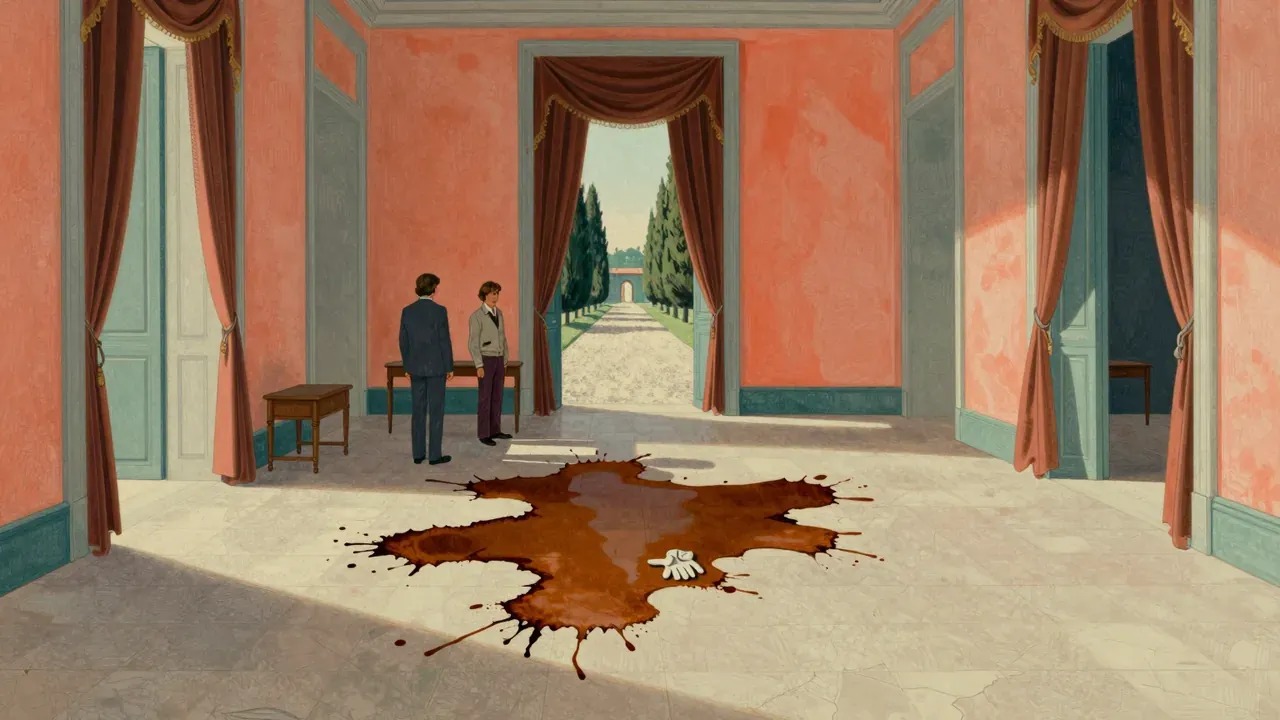
The story unfolds in measured, almost bureaucratic increments: each murder is reported, each confession recorded, each suspect traced back to Mamiya with clinical detachment. Kōji Yakusho plays Takabe with minimal inflection — his exhaustion registers in posture, not monologue; his unraveling appears in pauses longer than necessary, in glances held a beat too long. Tokushō Kikumura’s cinematography avoids expressionist distortion: interiors are lit evenly, often flatly, with little contrast; exteriors are washed in grey daylight or dim fluorescent office light. Gary Ashiya’s score is sparse — mostly low drones and isolated piano tones, never underscoring emotion but occupying silence like a physical presence. Kan Suzuki’s editing sustains duration without emphasis: scenes end when their functional purpose ends, not when tension peaks. There are no flashbacks, no voiceover, no cutaways to subjective vision — even Takabe’s hallucinations are filmed with the same neutral framing as reality. The craft insists on ambiguity by refusing to tip its hand.
What sticks
What lands is the cumulative pressure of the unsaid. The X carved into flesh is not a symbol waiting for decoding but a recurring fact — repeated enough times, it stops signifying and begins infecting the viewer’s attention, like a tic or a mantra. The film’s restraint makes small deviations feel seismic: a waitress pausing mid-step, a flicker of recognition in Mamiya’s eyes when Takabe shouts, the sudden, unbroken silence after a gunshot. These moments land not because they are loud or violent, but because they rupture the film’s own self-imposed grammar of stillness and repetition. The horror is not in what happens, but in how little it takes to destabilise a person’s sense of agency — demonstrated not only in the killers, but in Takabe, Sakuma, and eventually the audience. The film trusts its rhythm over revelation, and that trust pays off in sustained unease rather than fleeting fright.
What slips away
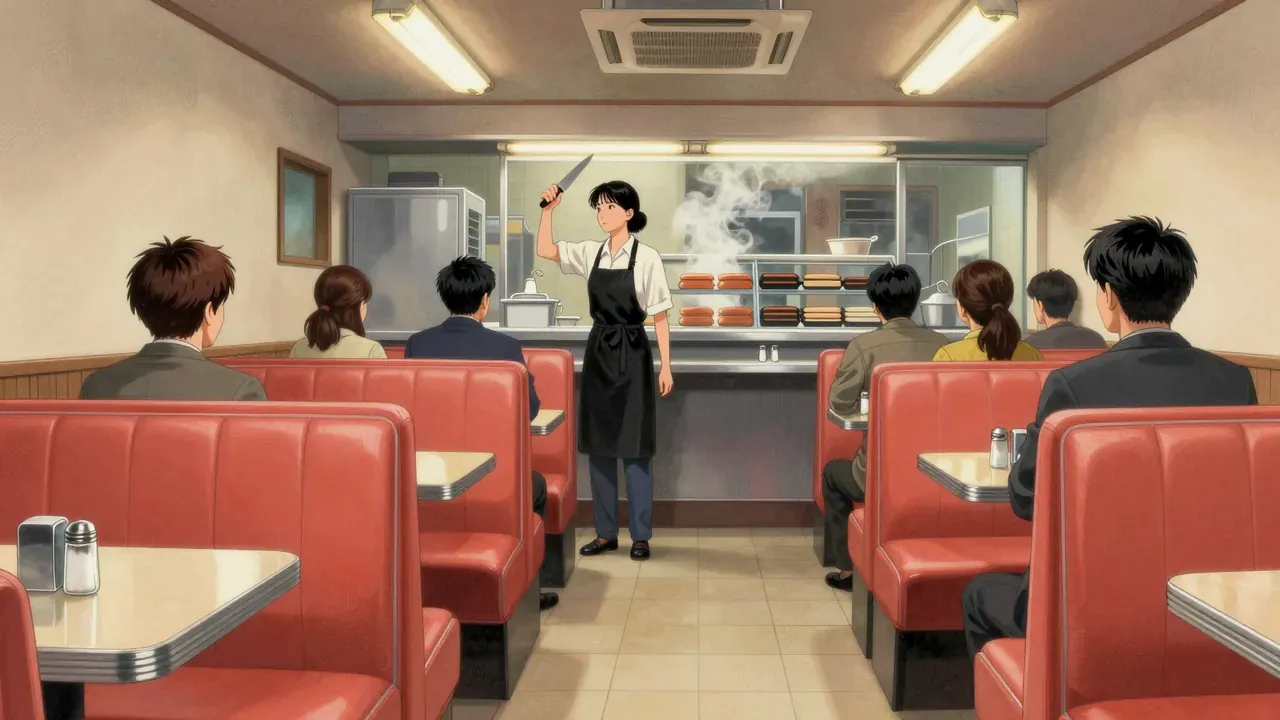
What does not land is any attempt to locate moral or causal closure. The Bakuro cylinder, the mesmerism literature, the Tokyo subway attack’s influence on the title — these remain contextual footnotes, not narrative engines. The film offers no origin story for Mamiya, no explanation for why Takabe is vulnerable, and no resolution beyond recursive collapse. Some viewers will read this as rigour; others as evasion. The final restaurant scene — the waitress drawing a knife — functions not as climax but as coda, and its power depends entirely on whether the viewer has already accepted the film’s central proposition: that suggestion is ambient, irreversible, and untraceable. Without that acceptance, the ending feels abrupt, even arbitrary. The film refuses to distinguish between psychological realism and metaphysical contagion, and that refusal, while intellectually consistent, leaves no ground for emotional catharsis or narrative satisfaction.
What it’s really about
The themes that matter are memory as infrastructure, suggestion as social technology, and the fragility of the self when stripped of narrative coherence. Cure treats amnesia not as pathology but as default condition — Mamiya’s memory loss mirrors Takabe’s eroded sense of purpose, Fumie’s dissociation, Sakuma’s breakdown. The film asks what remains when motive, identity, and continuity are removed: not emptiness, but susceptibility. Its critique of late-1990s Japan is implicit but precise — the police bureaucracy, the mental health system, the urban anonymity — all function not as backdrop but as vectors for transmission. The X is not a mark of violence but of inscription: a signifier imposed from outside, replicable, scalable, legible only in retrospect. This is horror rooted not in the supernatural, but in the mechanics of influence — how easily a gesture, a sound, or a question can bypass reason and lodge directly in behaviour.
Who it’s for
This film is for viewers who find unease more durable than fear, and who value precision of tone over plot momentum. It suits those accustomed to slow cinema, to films where silence carries weight and repetition signals intention. It is not for viewers who require clarity of cause, emotional payoff, or character arcs — Takabe does not ‘solve’ anything, and his arc is one of diminishing returns. Those who expect horror to deliver catharsis through confrontation or revelation will leave frustrated. The film’s pace and opacity are not stylistic affectations but structural necessities; shortening a scene or clarifying a motive would break its logic. A viewer who prefers psychological thrillers with tight causality — say, Se7en or Shutter Island — would likely find Cure inert. But for those who respond to mood as meaning, it is essential viewing.
Why it holds
Yes, it is worth your evening — provided you watch it undistracted, in one sitting, and without expectation of resolution. Its 107 minutes pass slowly not because they drag, but because they resist acceleration: every frame serves the accumulation of doubt. The film rewards attention not with answers, but with recalibration — a shift in how you register gesture, tone, and silence. It is not ‘entertaining’ in the conventional sense, nor is it designed to be. Those who dislike it tend to cite its austerity or its refusal to explain itself — fair objections, but objections to its method, not its failure. Change the pacing, add exposition, clarify Mamiya’s motives, and Cure becomes a different, lesser film. Its value lies precisely in its unwavering commitment to ambiguity as both form and content.