The look of it
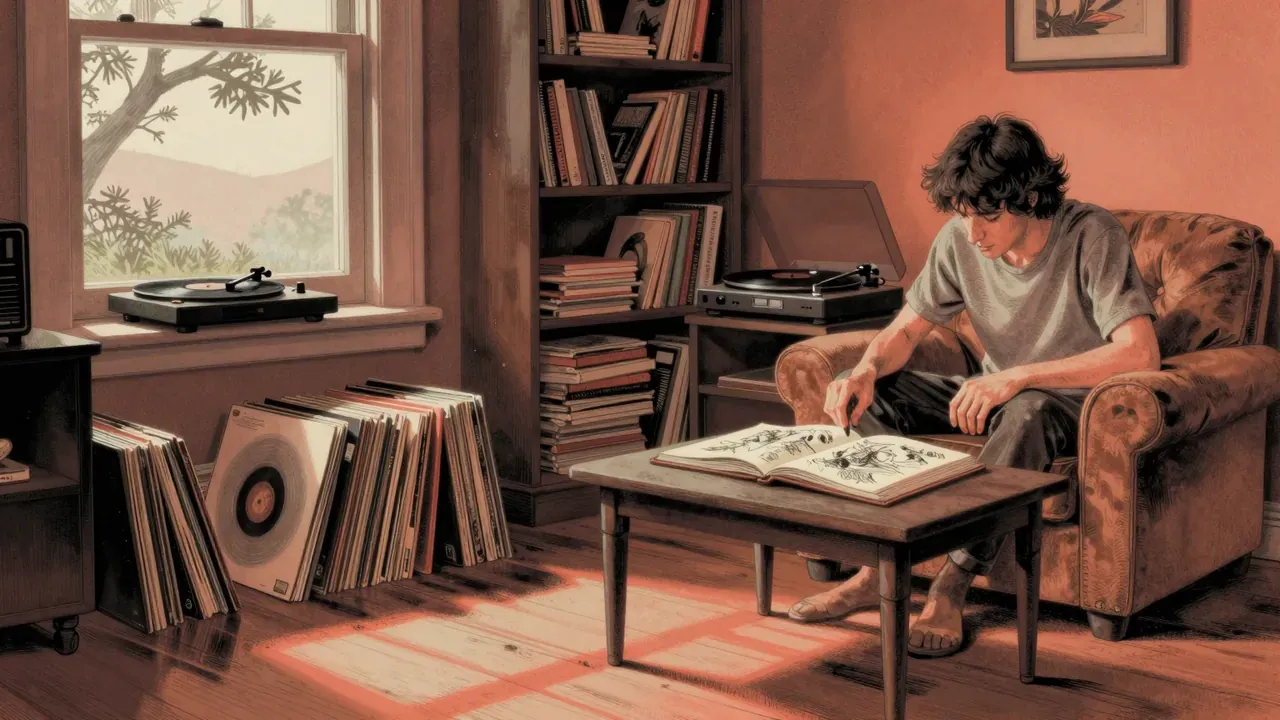
Crumb is a documentary portrait of cartoonist Robert Crumb, made over nine years by Terry Zwigoff, who also produced it. It does not aim to survey Crumb’s influence on underground comix or catalogue his output; instead, it uses his life and work as a lens to examine inherited trauma, artistic compulsion, and the instability of family bonds. The film gives extended time to Crumb’s two brothers — Charles, who stopped drawing and took psychiatric medication, and Maxon, who lives in isolation with epilepsy and ascetic discipline — treating their lives not as footnotes but as parallel expressions of the same upbringing. It includes interviews with contemporaries and critics, but avoids voiceover explanation or chronological framing. Its method is cumulative: long takes, unedited dialogue, repeated motifs — record players, sketchbooks, family photographs — that accrue psychological weight without commentary. The film’s ambition is structural as much as thematic: to hold three damaged lives in sustained, unflinching proximity, and let their differences and repetitions speak for themselves. It refuses resolution, biography, or advocacy. It simply watches.
The way it moves
The film works through duration, restraint, and editorial discipline. Maryse Alberti’s cinematography stays close but never intrusive: static medium shots in cramped rooms, slow pans across Crumb’s sketchbook pages, fixed frames on Maxon’s hotel room wall. Victor Livingston’s editing avoids cross-cutting between past and present; instead, it lets scenes breathe — a ten-minute conversation between Robert and Beatrice Crumb unfolds in near real time, with no inserts or reaction shots. There are no re-enactments, no archival montages, no illustrative graphics. Performances are not performed: Robert sketches while talking; Charles stares into middle distance before answering; Maxon recites scripture while folding laundry. Even the soundtrack — early blues and ragtime, mostly newly recorded — functions as ambient texture rather than emotional cue. The film’s craft lies in what it omits: no score swells, no titles explain, no narrator interprets. Its authority comes from accumulation — the weight of hours spent in the same rooms, with the same people, listening to the same silences. It trusts the viewer to notice repetition, contradiction, and gesture without guidance.
The shape of the family
What lands is the sheer, unvarnished coherence of its subjects’ inner worlds. Robert Crumb’s cynicism reads not as affectation but as hard-won calibration — a defence against sentimentality he associates with American consumerism and false uplift. Charles’s withdrawal feels less like resignation than a different kind of vigilance, his medication a necessary tether. Maxon’s asceticism registers not as pathology but as a consistent, if extreme, logic applied to desire and consequence. The film makes their positions legible without endorsing them, and without reducing them to symptoms. The recurring motif of Crumb’s 78-rpm records — handled with reverence, packed with care, mourned when moved — becomes a quiet anchor: a tangible, finite thing he can control amid chaos he cannot. The interviews with ex-partners and peers land because they are neither vindictive nor apologetic; they simply add layers of contradiction — Dana’s matter-of-fact recollection of abandonment, Aline’s wry tolerance of Robert’s misanthropy, Trina Robbins’s measured critique of his imagery. Nothing is smoothed over, and nothing is left unexamined.
The line it does not cross
What does not land is the film’s implicit claim to neutrality in its framing of consent and vulnerability. Though Zwigoff filmed Charles and Maxon only with their agreement, the film offers no context for how that consent was obtained, nor any reflection on whether either man possessed the capacity to weigh the consequences of exposure. Charles’s suicide, noted in an end title, arrives without preparation or follow-up — a fact dropped, not processed. The film’s refusal to interpret leaves this omission feeling less like rigour and more like evasion. Similarly, its treatment of Crumb’s depictions of women and Black people rests entirely on others’ testimony — critics, ex-partners — without inviting Crumb to articulate his own position beyond vague defensiveness. That silence reads not as fairness but as avoidance. The film’s moral gravity depends on its observational stance, yet it never questions the ethics of observing these particular men at these particular stages of fragility. It assumes the camera’s presence is benign, even when the subjects appear barely able to sustain it. Some viewers will find that assumption untenable.
The work beneath the work
The themes that matter are inheritance, compulsion, and the porous boundary between creativity and survival. The film treats art-making not as self-expression but as reflex — something the Crumb brothers do because they cannot stop, whether drawing, collecting, meditating, or hoarding. Their father’s authoritarianism recurs not as anecdote but as grammar: the way Charles forces childhood comics onto his brothers, the way Robert repeats phrases his mother used, the way Maxon’s seizures map arousal onto physical collapse. Trauma is not dramatised but embedded in habit — in Robert’s meticulous record storage, Charles’s flattened affect, Maxon’s ritualised poverty. The film also interrogates the myth of the solitary artist: Robert’s work is inseparable from his family’s disintegration, just as Maxon’s drawings emerge from the same nervous system that produces seizures. There is no ‘outside’ to the damage; it is the medium. Even the film’s structure — looping back to the same rooms, the same arguments, the same records — enacts this idea: that some patterns cannot be broken, only witnessed.
Who it holds
It is for viewers who accept that understanding another person may require sitting with discomfort longer than feels natural, and who trust that duration can be argumentative. It suits those familiar with documentary traditions that resist exposition — films like Salesman or Harlan County USA — and who value ethical ambiguity over didactic clarity. It is not for viewers who need narrative propulsion, moral resolution, or explanatory scaffolding. Those who expect documentaries to advocate, diagnose, or conclude will find it withholding. Those unsettled by prolonged exposure to mental distress — particularly untreated or under-treated psychosis — may find Charles’s scenes difficult without contextual framing the film pointedly declines to offer. It is also not for viewers who require explicit engagement with power dynamics in representation; the film’s silence on its own positionality is deliberate, but not neutral. Anyone expecting a primer on underground comix or a celebration of Crumb’s legacy will leave unmoored. This is not a film about achievement. It is about persistence — and persistence is not always admirable.
The time it asks for
Yes, it is worth your evening, provided you watch it whole and without interruption. Its 119 minutes accumulate meaning slowly, and its impact depends on immersion in its rhythms — the scratch of pencil, the hum of a record player, the pauses between sentences. Skipping ahead or watching in fragments breaks its logic. Those who find it unrewarding often do so because they expect documentary to clarify rather than compound; the film deepens uncertainty, and that is its point. Critics who rated it highly — Siskel, Ebert, Guthmann — all stressed its cumulative force, not its immediacy. Anyone who values formal rigour, psychological honesty, and the weight of unspoken history will find it resonant. Those who prefer analysis over observation, or who need closure, will not. Its value lies not in what it says, but in how relentlessly it looks — and how long it asks you to look back.