The moment it was
When We Were Kings is a documentary about the 1974 ‘Rumble in the Jungle’ boxing match between Muhammad Ali and George Foreman in Kinshasa, Zaire. It does not aim to reconstruct the event as live reportage but to situate it — through archival footage, news clips, stills, and interviews conducted two decades later — within its political, cultural, and personal contexts. The film treats the fight as a hinge: between Ali’s exile from boxing after refusing the Vietnam draft and his return; between Cold War patronage and postcolonial spectacle; between American celebrity and African self-assertion. Leon Gast filmed on location in 1974 but spent twenty-two years editing and securing financing before release. The film’s ambition is neither forensic nor chronological, but atmospheric and interpretive: to show how a sporting contest became a moment of global resonance, layered with contradiction, charisma, and consequence. It foregrounds Ali not as athlete alone but as symbol, strategist, and speaker — one whose words in Zaire carried weight beyond the ring. (158 words)
How it was cut
The film works by juxtaposition: grainy 16mm footage of Ali dancing in the streets of Kinshasa against stilted press conferences with Foreman; James Brown’s sweat-drenched Zaire 74 performance beside Norman Mailer’s measured 1990s reflections; Don King’s deal-making alongside Mobutu Sese Seko’s state machinery. Maryse Alberti’s cinematography is not present in the original footage — that was shot by multiple cameramen including Albert Maysles — but her contribution lies in the 1990s interview segments, where she keeps lighting flat and framing tight, letting the speakers’ faces carry the weight. Leon Gast edits with rhythmic patience: long pauses, unbroken takes, minimal voiceover. The music — drawn from the festival and newly recorded — underscores mood without dictating it. There are no re-enactments, no animated diagrams, no talking-head experts outside the named interviewees. The craft is restrained, functional, anchored in what was captured and who was willing to speak. It trusts the material’s density rather than amplifying it. (159 words)
The man in the frame
What lands is Ali’s presence — not just his physicality in the ring or his wit at the mic, but the consistency of his posture across time. His speeches in Zaire, his private conversations with Malick Bowens, his banter with locals: all cohere into a portrait of agency, calculation, and moral clarity. The contrast between Ali’s ease among Congolese crowds and Foreman’s visible discomfort is not editorialised but shown, and it holds. The footage of the fight itself lands with visceral precision — particularly the eighth round, where Ali’s exhaustion and Foreman’s sudden collapse feel earned, not inevitable. The interviews with Mailer and Plimpton do not merely contextualise; they model how intelligent observers grappled with the event’s ambiguity in real time. Spike Lee’s later commentary adds generational perspective without overriding the earlier voices. The film avoids hagiography by showing Ali’s contradictions — his confidence bordering on arrogance, his idealism shadowed by pragmatism — and that honesty makes the triumph feel human, not mythic. (157 words)
The place it happened
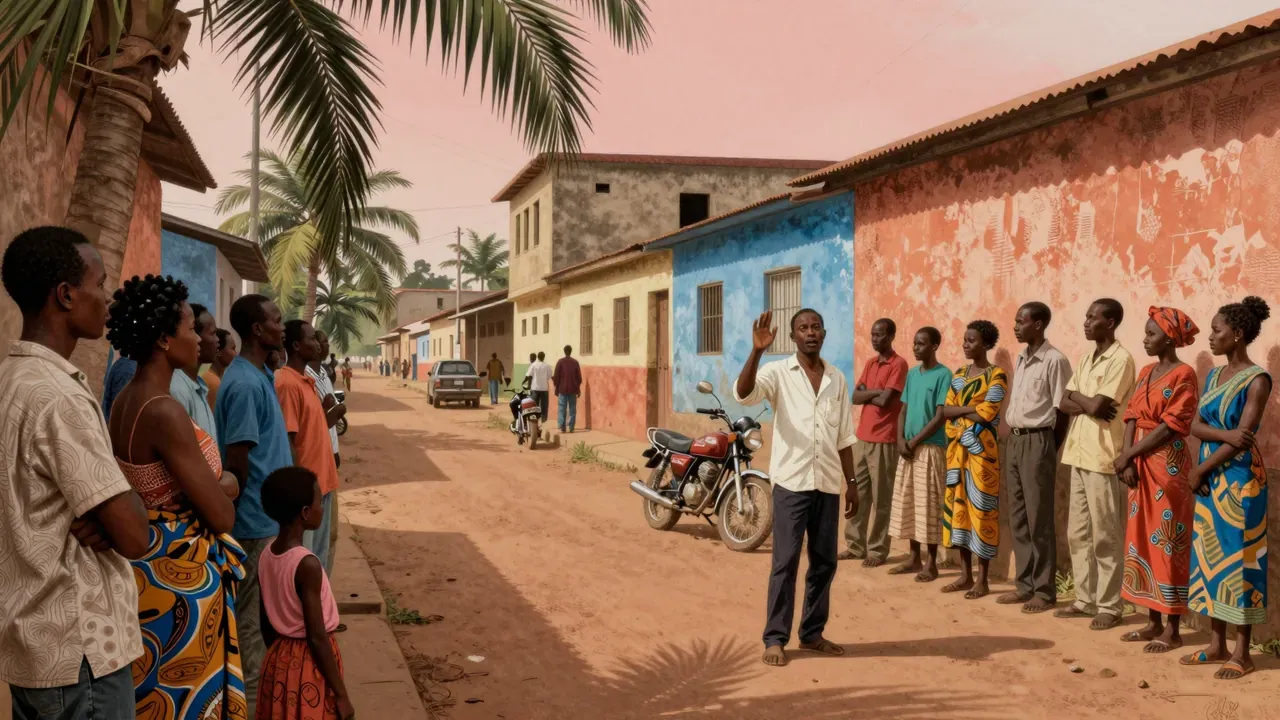
What does not land is the treatment of Zaire itself. The country appears mostly as backdrop: warm light, cheering crowds, lush foliage, Mobutu’s banners. There is no Zairian voice beyond fleeting crowd shots or untranslated chants. The film acknowledges Mobutu’s brutality only in passing, via Mailer’s offhand remark about ‘the dictator’s money’, and never explores how the people of Kinshasa experienced the event — whether as celebration, coercion, or spectacle. The Zaire 74 festival is presented as vibrant but incidental, its performers treated as colour rather than collaborators. Don King’s role is flattened into caricature: energetic, amoral, opportunistic — but we see no evidence of his negotiations, his compromises, or his relationship with local authorities. The film also sidesteps Ali’s post-fight trajectory: his declining health, his later political silences, the ways his 1974 persona would harden or soften. These omissions are structural, not accidental — the film is centred on Ali’s peak, not his arc — but they leave the context thinner than the subject deserves. (159 words)
What it claims
The themes that matter are sovereignty — bodily, national, narrative — and the conditions under which it can be claimed, performed, or revoked. Ali’s refusal of the draft, his exile, his return, his choice of Zaire as stage: each act asserts control over his own story in a world that sought to define him. The film frames the fight as a contest not only of strength but of legitimacy — whose version of Blackness, of Africa, of masculinity, of resistance, gets amplified. Colonialism lingers in the logistics: Mobutu’s sponsorship, the Western press corps, the infrastructure built for foreigners. But the film’s deeper concern is with how meaning accumulates — how a punch, a song, a speech, a photograph, a delay, a crowd’s roar, all become charged with significance when aligned in time and place. It treats sport not as escape but as condensation: of history, of identity, of risk. The rope-a-dope is both tactic and metaphor — absorbing force, waiting for fatigue, turning vulnerability into advantage. That idea echoes beyond boxing into questions of endurance, timing, and strategic withdrawal. (159 words)
Who it speaks to
This film is for viewers who want to understand how charisma operates in public life, how politics and sport intersect without collapsing into each other, and how a single event can hold multiple, competing truths. It rewards attention to tone, pacing, and silence — not just what is said, but how long it is allowed to hang. It is not for those seeking a neutral account of the fight, a technical breakdown of boxing strategy, or sustained analysis of Mobutu’s regime. Nor is it for viewers who require contemporary Zairian or Congolese perspectives as equal narrative agents — the film centres American and diasporic voices, and does so unapologetically. Some historians may object to its selective framing; others may find its reverence for Ali limiting. A different edit — one incorporating Congolese journalists, musicians, or officials — would shift the verdict. But as it stands, the film’s value lies in its focus, not its completeness. (159 words)
Why it stays
Yes, it is worth your evening — not because it is exhaustive, but because it is exact. Its 85 minutes move with deliberation, never haste, and its power comes from accumulation, not revelation. You will not learn everything about the Rumble in the Jungle, but you will feel its gravity, its irony, its heat. It works best when watched whole, without pause, allowing the rhythm of the interviews and the texture of the footage to settle. Those who expect fast cuts, explanatory graphics, or balanced geopolitical critique will find it slow or partial. But if you accept its terms — that this is Ali’s moment, filtered through Gast’s long labour and the witnesses he chose — then it delivers with quiet authority. It is not urgent, but it is enduring. Its worth lies not in novelty, but in concentration. (158 words)