A family that survives by staying unseen
Arrietty, released in Japan in July 2010, adapts Mary Norton’s 1952 novel The Borrowers, about a family of tiny people who live secretly inside a house and survive by borrowing small items from its human occupants without ever once being seen or suspected. It marks the feature directorial debut of Hiromasa Yonebayashi, an animator on Spirited Away, Ponyo and Howl’s Moving Castle, working from a screenplay Hayao Miyazaki co-wrote with Keiko Niwa after Miyazaki and fellow Ghibli founder Isao Takahata had reportedly been contemplating an adaptation of Norton’s novel for roughly forty years beforehand.
A boy who breaks the rule on purpose
Arrietty, a fourteen-year-old Borrower on her first supervised borrowing expedition, is spotted by Sho, a human boy staying at the house while recovering ahead of heart surgery. Rather than reporting what he has seen, Sho quietly tries to reach out to her, which puts Arrietty’s family, her anxious, cautious mother Homily and her steady, practical father Pod, in the difficult position of deciding whether being seen by one gentle boy is automatically as dangerous as three generations of family caution has always insisted it must be. Neighbours Spink and Forcible, two retired burlesque actresses, add their own warning about the dangers the Borrowers face once discovered.
A score written by someone who had never worked with the studio before
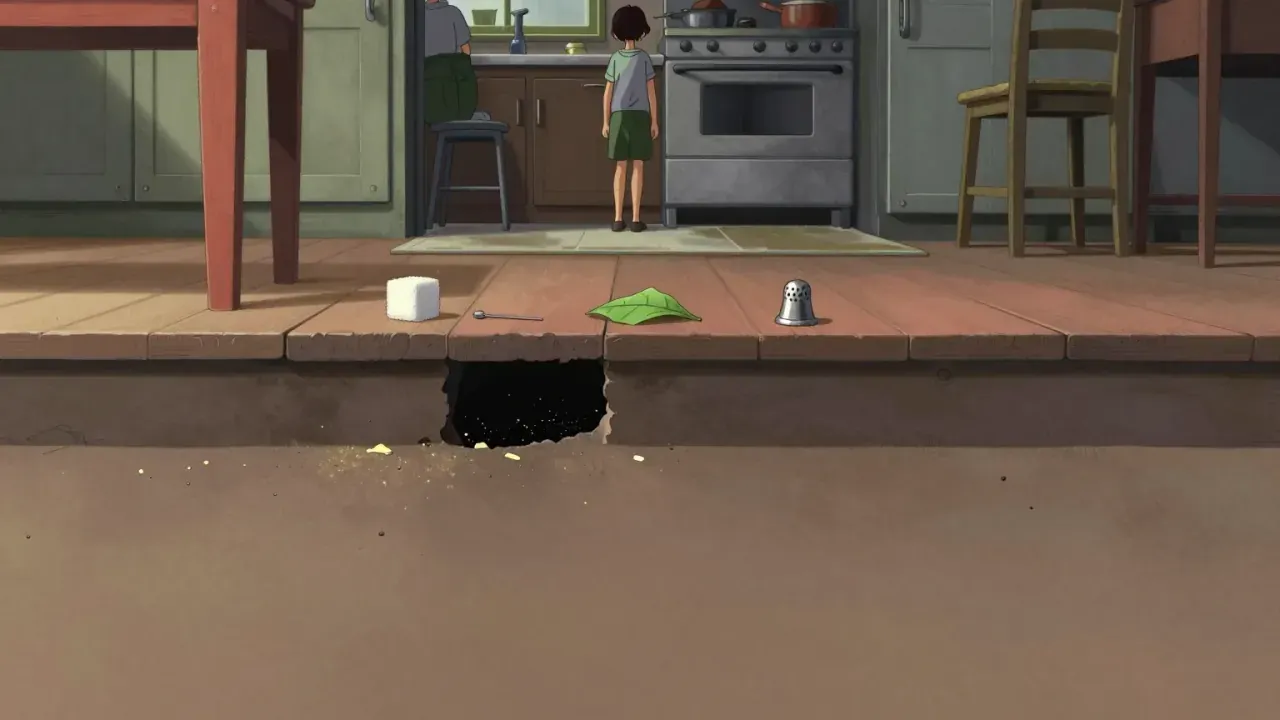
Yonebayashi and Miyazaki, who also produced and is credited as the film’s cinematographer, keep the story almost entirely contained to the one house and its overgrown garden, and the tension throughout is generated by scale itself rather than by any external villain’s scheme: a teacup becomes a genuine hazard, a gap beneath a floorboard becomes a full journey, and the film trusts these small, physical stakes to carry entire scenes without inflating them artificially. The housekeeper Haru, who does eventually try to capture the Borrowers for her own reasons, remains a comparatively minor threat next to the central, quieter relationship.
Miyazaki’s fortieth-year passion project handed to someone else
Composer Cecile Corbel, a French musician whose demo album caught producer Toshio Suzuki’s attention after she mailed a promotional copy to the studio entirely unsolicited, became the first non-Japanese composer ever to score a Ghibli feature, and her Celtic folk-influenced music, recorded in France with acoustic guitar, a string quartet, bagpipes, Irish flutes and bodhran, gives the film a musical texture distinctly different from the more orchestral scores Joe Hisaishi typically supplies for the rest of the studio’s catalogue. Corbel also performed the theme song live at the film’s Japanese release ceremony, attended by Yonebayashi and much of the cast.
Scale as the whole plot, not just the visual gimmick
The film’s real subject is proportion, both literal and emotional: it asks what a genuine relationship can look like between two people who cannot occupy the same physical scale, and whether real trust between them is possible without either side simply pretending the difference away for convenience. Sho’s own fragility, framed throughout by his heart condition and looming surgery, makes him just as vulnerable in his world as Arrietty is in hers, which keeps their brief friendship from ever feeling one-sided or purely protective in one direction. Neither of them can fully rescue the other, and the film is honest about that limit.
Who should watch it
It suits younger viewers being introduced to Studio Ghibli for the first time, readers of Norton’s original novels curious how faithfully or loosely the adaptation handles the source material, and anyone who prefers a contained, low-key domestic story to a sprawling fantasy plot with world-ending stakes. Viewers expecting the mythological scale of Miyazaki’s own directed films, such as Spirited Away or Princess Mononoke, may reasonably find this comparatively slight and modest by that particular standard, though the quieter register is very much the film’s intention rather than a shortfall in ambition.
A modest film that still delivers
At 94 minutes and made for roughly $23 million, Arrietty grossed $149.4 million worldwide and became the highest-grossing Japanese film released in 2010, a return that reflects a well-controlled, modest production rather than a spectacle-driven blockbuster chasing a wider audience. It is a solid, satisfying choice for an evening that wants Ghibli’s characteristic craft and warmth without reaching for the studio’s largest fantastical ambitions, and it also won the Animation of the Year prize at the Japan Academy Prize ceremony the following year, a fitting reward for a film that succeeds by staying small on purpose.