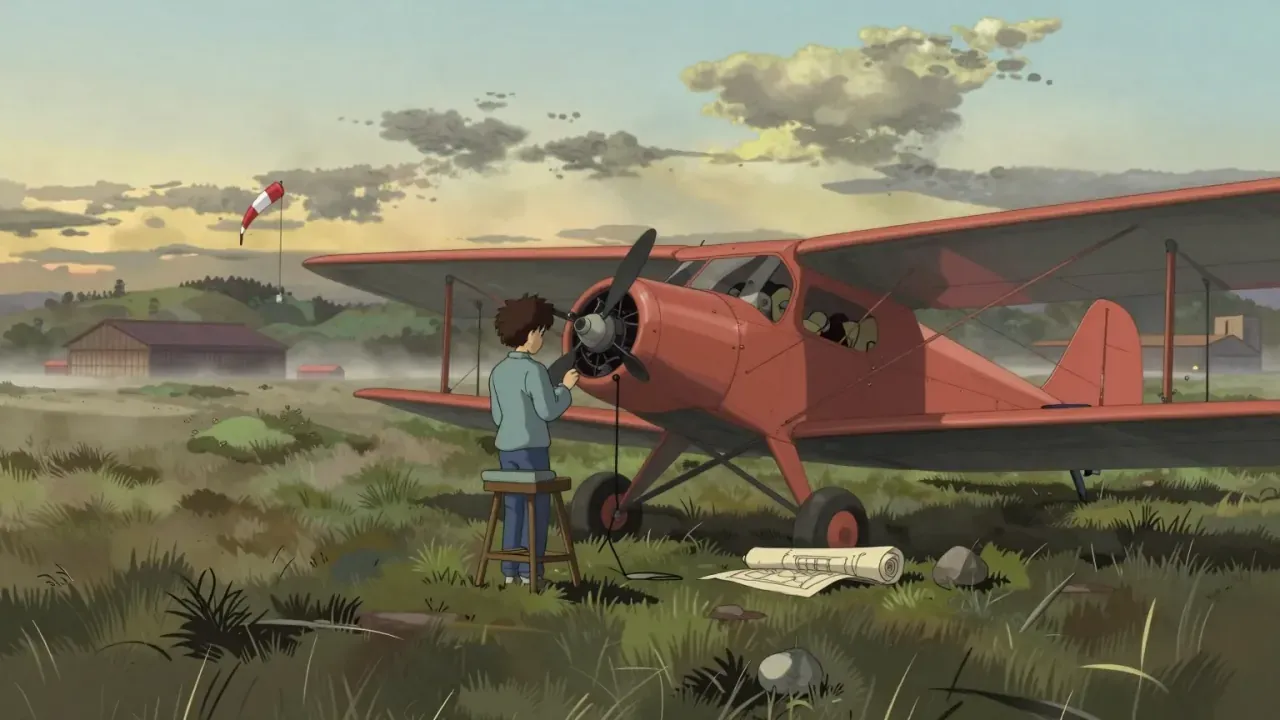
A boy who cannot fly, so he designs instead
The Wind Rises, written and directed by Hayao Miyazaki and released in Japan in July 2013, offers a fictionalised account of Jiro Horikoshi, the real engineer who designed Japanese fighter aircraft in the years leading up to and through the Second World War. Miyazaki has said this was originally intended to be his final feature film after a long career, before he later reversed that decision entirely to make The Boy and the Heron, and the finished film carries the deliberate weight of something conceived as a closing statement on his lifelong preoccupations with flight and engineering.
A romance that runs alongside the war work, not against it
Jiro’s severe nearsightedness rules out his childhood dream of becoming a pilot himself, and the film redirects that thwarted ambition into aircraft design instead, staging recurring dream sequences in which his idol, the real Italian aircraft designer Giovanni Battista Caproni, insists across the years that building planes matters more than actually flying them. Running alongside his engineering career at Mitsubishi is his relationship with Nahoko, whom he first meets during the chaos of the 1923 Great Kanto earthquake and later marries despite her steadily declining health from tuberculosis, a disease that eventually takes her from him.
Miyazaki drawing planes he built himself as the film’s cinematographer
Miyazaki is credited as the film’s own cinematographer, and the aircraft testing sequences carry an unusual degree of technical specificity, close attention to aerodynamics, wing stress and structural failure under pressure, that reflects his own long-standing personal interest in aviation history and design going back decades. These sequences function as some of the film’s most genuinely tense passages precisely because the stakes involved are mechanical and physical rather than dramatic in any conventional narrative sense. The film’s title itself borrows from a line in a 1920 Paul Valery poem, which sets the register before the story even begins.
A quote that became the film’s justification and its problem
Miyazaki has said he was specifically drawn to make the film after reading Horikoshi’s own remark that all he ever wanted was to make something beautiful, and the film largely adopts that framing as its emotional centre, treating Jiro’s devotion to elegant, efficient design as straightforwardly sympathetic without spending much comparable time on what those same designs, fighter planes eventually used in the war, actually went on to do once built. This is the film’s most debated choice by far, and it drew genuine political criticism in parts of Asia on release for that reason.
Ambition that outruns its consequences
What the film is actually sitting with, underneath its romance and its engineering drama alike, is the considerable distance between a person’s private motivations and the public consequences of their finished work, and it pointedly does not resolve that distance with a clean judgment in either direction. Jiro’s grief over Nahoko’s decline and his evident pride in his aircraft’s first successful test flight are given roughly equal emotional weight by the film, which is either its most honest structural choice or its most evasive one, depending on how much moral resolution a given viewer expects walking in.
Who should watch it
This suits adults with a genuine interest in prewar Japanese history and aviation engineering, longtime followers of Miyazaki’s wider body of work looking for his most personal statement, and viewers willing to accept a film that raises a serious moral question without ever fully answering it for them. It is not well suited to children, given both its subject matter and its slow pace, nor to viewers who specifically want a hero’s journey delivered with a clear verdict at the end. Those coming to it expecting the whimsy of Miyazaki’s more fantastical films, such as Ponyo, should recalibrate their expectations first.
A long film that asks for patience it repays
At 126 minutes, scored by longtime collaborator Joe Hisaishi and performed by the Yomiuri Nippon Symphony Orchestra, The Wind Rises was the highest-grossing Japanese film of 2013 and won the Japan Academy Prize for Animation of the Year among its several nominations. It asks for real patience rather than offering easy pleasure in the moment, but it repays that patience with a film unlike almost anything else in Miyazaki’s wider catalogue of work, and one that only grows more interesting on a second viewing once its central tension is already known.