The premise
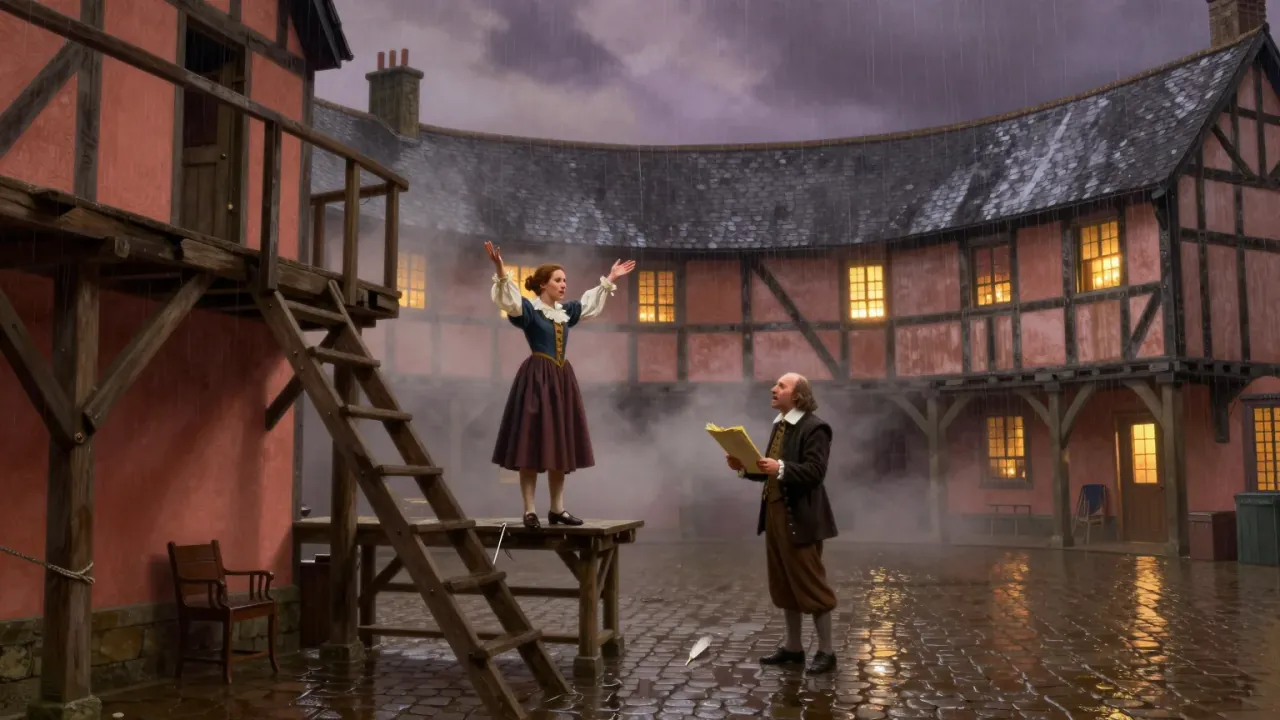
Shakespeare in Love is a romantic comedy set in Elizabethan London that constructs a fictional origin story for Romeo and Juliet, framing the play’s creation as an act of love between William Shakespeare and Viola de Lesseps. It does not aim to reconstruct history but to stage a playful, self-aware dialogue with Shakespeare’s work—borrowing structures, motifs and language while embedding them in a world where theatre is precarious, gender is policed, and art emerges from constraint. The film treats its period setting as a theatrical space rather than a documentary one: costumes are sumptuous but slightly stylised, dialogue winks at its own anachronisms, and historical figures appear less as biographical portraits than as narrative functions—Marlowe as muse, Tilney as censor, Elizabeth as arbiter of both love and law. Its ambition is structural and tonal: to sustain a dual register—earnest feeling within a knowingly artificial frame—and to make the mechanics of playmaking visible without breaking enchantment.
The rhythm
The story moves briskly through a series of tightly wound comic and romantic set-pieces: the balcony encounter, the punt scene, the church confession, the last-minute casting of Juliet. Joseph Fiennes plays Shakespeare as restless and quicksilver, Gwyneth Paltrow’s Viola as intelligent and physically assured, her disguise never quite masking her presence. Geoffrey Rush’s Henslowe is the film’s most grounded performance—tired, shrewd, perpetually out of his depth. Richard Greatrex’s cinematography favours warm interiors lit by candlelight and firelight, avoiding the bleached clarity of many period films; Stephen Warbeck’s score uses lute, viol, and harpsichord but avoids pastiche, leaning instead into melodic warmth and rhythmic pulse. David Gamble’s editing sustains momentum without rushing emotional beats—the transition from Viola’s wedding to her dash across London feels earned, not rushed. The production design and costumes (both Oscar-winning) do heavy lifting: they signal class, profession and intention without exposition.
What sticks
What lands most securely is the film’s central conceit: that great art can be born from private feeling made public through craft. The transformation of ‘Romeo and Ethel’ into Romeo and Juliet is neither mystical nor effortless—it happens in rehearsal rooms, in arguments over lines, in stolen moments backstage. The chemistry between Fiennes and Paltrow carries weight because it is rooted in shared intelligence and mutual recognition, not just attraction. Judi Dench’s single scene as Queen Elizabeth—measured, amused, quietly authoritative—is a masterclass in economy: she enters late, dominates without raising her voice, and exits having redefined the stakes. The final image of Shakespeare imagining Twelfth Night is not sentimental but structural: it closes the loop between lived experience and artistic distillation. The film’s wit lands because it is embedded in situation and character, not in quips detached from consequence.
Where it slips
What does not land is the film’s treatment of consequence itself. Shakespeare’s marriage to Anne Hathaway is mentioned only to be discarded; Viola’s arranged marriage to Wessex is resolved by royal decree rather than internal shift or negotiation. Ben Affleck’s Ned Alleyn is all swagger and no substance; Colin Firth’s Lord Wessex remains a cipher, his motivations reduced to greed and wounded pride. The subplot involving Marlowe’s murder is introduced with gravity but left unresolved—its emotional weight evaporates once Shakespeare misattributes it. The film’s reliance on coincidence—Viola happening to be at court, Webster happening to spy, Tilney happening to arrive mid-performance—begins to strain credulity in the second half. The ending offers closure but not reckoning: no character changes course because of what has happened, only because the plot requires it. This undermines the very idea of growth that the film otherwise celebrates.
What it’s really about
The themes that matter are not love versus duty, but craft versus inspiration, visibility versus disguise, and the porous boundary between life and performance. The film insists that theatre is collaborative, material, and vulnerable—built on debt, patronage, censorship and last-minute substitutions. Gender is treated not as identity but as role: Viola’s disguise works because acting is already imitation, and her success as Juliet proves that embodiment matters more than biology. The film also explores authorship—not as solitary genius but as relay race: Marlowe gives Shakespeare a line, Viola gives him motive, Henslowe gives him stage time, Tilney gives him opposition. Even the Queen participates, commissioning the next play. What endures is not the romance but the infrastructure of making: the carpenters, the prompters, the boy actors whose voices break at the wrong moment. The film’s quietest theme is endurance—the persistence of stories despite their makers’ flaws, absences and compromises.
Who it’s for
This film suits viewers who enjoy wordplay anchored in character, period settings that breathe rather than gild, and comedies where the stakes feel real even when the logic bends. It rewards attention to how scenes are built—not just what is said, but who is listening, who is hiding, who holds the candle. It will frustrate those who require psychological consistency, historical fidelity, or moral resolution: Shakespeare does not leave his wife, Viola does not refuse her marriage, and no institution is meaningfully challenged. Fans of Stoppard’s Rosencrantz and Guildenstern may find this lighter and less philosophically rigorous; admirers of Ken Russell or Derek Jarman may find it too polished, too safe. A viewer who values thematic coherence over charm, or who dislikes narrative convenience, would reasonably reject it—not as bad, but as insufficiently committed to its own implications.
Is it worth your time?
It is worth your evening if you accept its terms: a well-made, affectionate, technically accomplished confection that knows it is not profound but refuses to be shallow. Its pleasures are cumulative—textural, tonal, rhythmic—not revelatory. You would need to value craftsmanship over revelation, wit over insight, and warmth over rigour. Someone who watches for moral argument or structural innovation would find it thin; someone who watches for the pleasure of watching skilled people do skilled things—in front of and behind the camera—will find it generous. Its longevity rests not on depth but on balance: it gives enough story to satisfy, enough craft to admire, and enough heart to linger, without overreaching. That balance is rare, and it holds for 123 minutes.