The shape of the question
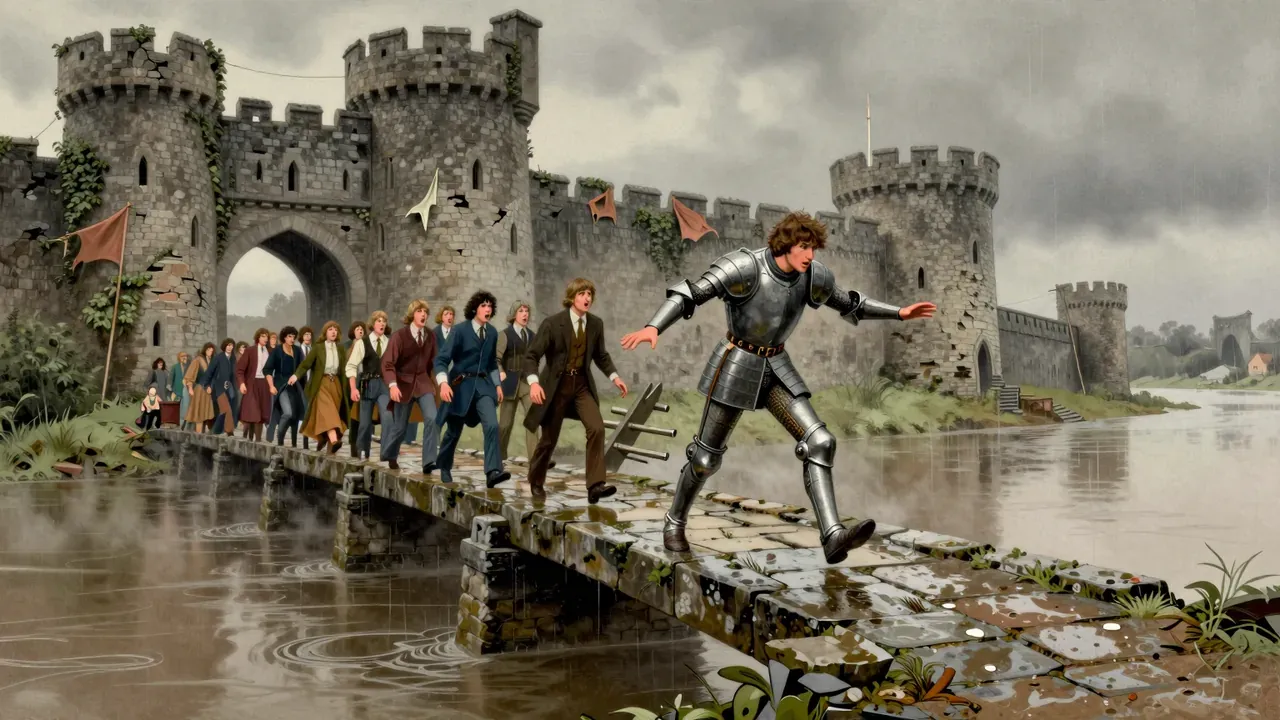
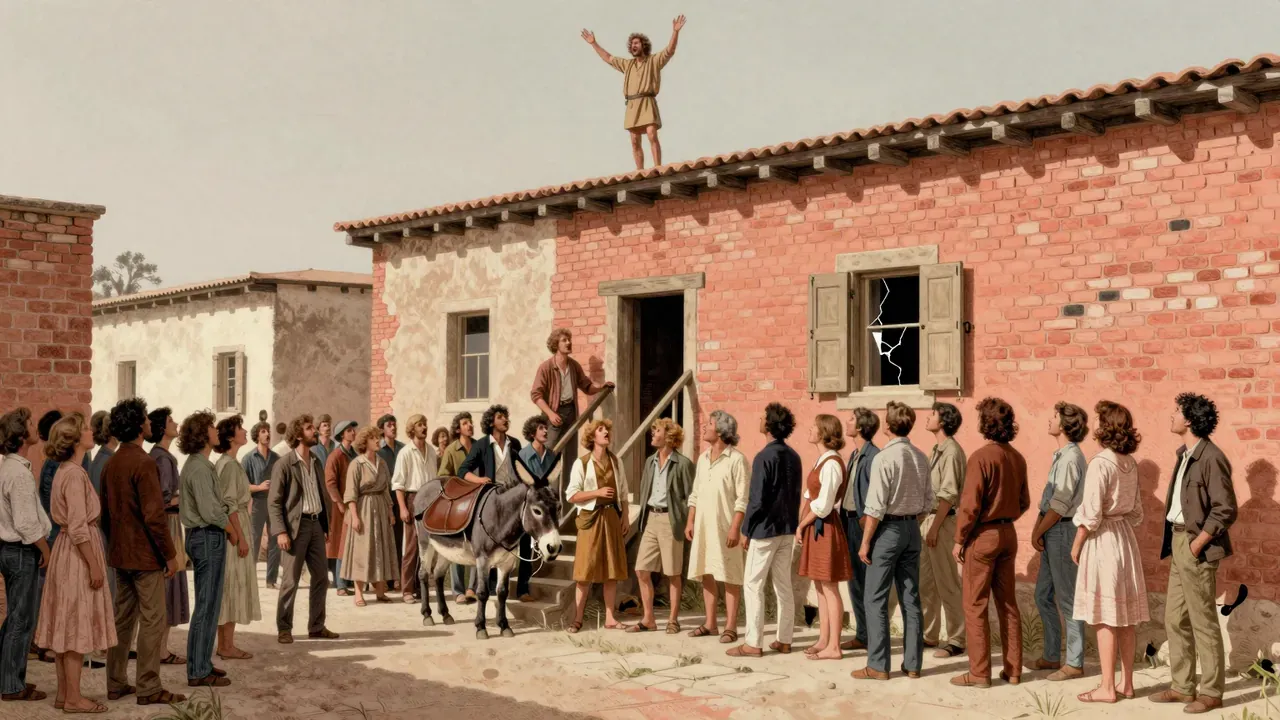
Monty Python’s Life of Brian is a satirical comedy set in Roman-occupied Judea, centred on Brian Cohen, a man born on the same day and in the same town as Jesus, who is mistaken for the Messiah despite having no interest in prophecy, leadership or theology. It is not a parody of Jesus himself — the film treats his character with quiet reverence — but of messianic fervour, religious bureaucracy, sectarian infighting, and the ease with which crowds adopt dogma without scrutiny. The Pythons aimed to lampoon institutional religion, not faith per se; their target is the apparatus of belief — priests, prophets, zealots, bureaucrats — and the absurd logic that sustains it. The film uses biblical framing not to mock scripture, but to expose how ideology calcifies into ritual, how rebellion ossifies into orthodoxy, and how liberation movements fracture under the weight of internal contradiction. It is structured like a picaresque, following Brian through escalating misidentifications and misadventures, each episode tightening the satire’s grip on groupthink and performative conviction. Its ambition is surgical: to make dogma look ridiculous by showing it from the inside, unvarnished and unflinching.
The look of it
The story unfolds episodically, anchored by Graham Chapman’s Brian — earnest, exasperated, perpetually out of his depth — and sustained by ensemble performances where every actor plays multiple roles, often swapping accents, status and species mid-scene. Terry Jones directs with deliberate flatness: wide shots, static frames, minimal close-ups, letting jokes land in rhythm rather than punctuation. Peter Biziou’s cinematography avoids flourish; lighting is even, colour palette muted, composition functional — the visual style serves the script’s deadpan delivery, not mood or metaphor. Julian Doyle’s editing tightens pace without rushing, cutting on beats of silence or misplaced certainty. Geoffrey Burgon’s score is sparse, solemn, almost liturgical — a straight-faced counterpoint to the chaos. Terry Gilliam’s animations bookend and punctuate, offering surreal relief without disrupting narrative flow. The craft is collaborative, unshowy, and calibrated to let writing and timing do the work: no gag relies on camera movement, no punchline needs music, no character requires pathos. Everything serves the central irony — that seriousness is the engine of absurdity.
Where the irony holds
What lands most reliably is the film’s structural irony: the more seriously its characters take their convictions, the more ludicrous those convictions become. The Judean People’s Front’s squabbling with the Popular Front of Judea over signage and slogans remains sharp because it mirrors real ideological fragmentation — not as caricature, but as logical extension. The stoning scene works because it follows bureaucratic procedure to its brutal conclusion: a crowd delegates moral responsibility to process, then executes it with cheerful efficiency. Brian’s final crucifixion song — ‘Always Look on the Bright Side of Life’ — lands precisely because it refuses catharsis, undercutting tragedy with chirpy resignation. The Roman centurion correcting Brian’s Latin grammar, the Pilate’s wife subplot, the ‘What have the Romans ever done for us?’ debate — all succeed by treating absurd premises with absolute sincerity. Even minor gags — the graffiti on Pilate’s fortress, the three wise men’s star map confusion — gain weight from consistency of tone: this world operates by its own rules, and those rules are comically rigid. The satire does not shout; it observes, then waits for the audience to connect the dots.
Where the rhythm slips
What does not land uniformly is the film’s reliance on repetition-as-rhythm when the underlying premise wears thin. Some sequences — particularly extended crowd scenes or prolonged bickering between splinter groups — risk monotony because they depend on variation within a narrow band of behaviour: shouting, posturing, mishearing. The ‘Otto’ sequence, cut before release, was likely excised for good reason: its escalation into nihilistic farce lacks the grounded irony of the rest. A few sight gags feel dated not in content but in execution — the starship interlude, while inventive, sits uneasily beside the otherwise earthbound aesthetic and weakens the film’s tonal discipline. The satire also assumes a baseline familiarity with New Testament structures and British class-inflected bureaucracy; viewers unfamiliar with either may miss the precision of the parody. And while the film avoids mocking Jesus, its treatment of Judaism — particularly through caricatured priests and mob logic — has aged less gracefully, lacking the same textual or theological nuance applied elsewhere. These are not flaws in intent, but limits in reach and calibration.
What it is really about
The themes that matter are secular: the mechanics of authority, the contagion of consensus, and the banality of dogma. It interrogates how institutions form not around ideas, but around the need to organise, classify and control — whether that institution is the Roman census, the Sanhedrin, or the People’s Front of Judea. It treats belief as social performance: people join movements not for doctrine, but for belonging, and sustain them through ritual repetition — chanting slogans, painting slogans, arguing about slogans. The film also dissects the illusion of agency: Brian never chooses his role, yet is held accountable for it; the crowd demands a saviour, then discards him when he fails to conform; even Pilate’s indifference is a kind of complicity. Underpinning all this is a quiet humanism — Brian’s desire for privacy, dignity and ordinary life is the film’s moral centre, and the only thing treated without irony. The satire is not anti-religious in the sense of attacking faith, but anti-institutional in its exposure of how systems, once built, begin to feed on themselves, indifferent to the people they claim to serve.
Who it is for
This film is for viewers who value linguistic precision, structural irony, and satire that trusts the audience to follow implication rather than explanation. It rewards attention to detail — the Latin corrections, the graffiti, the shifting allegiances — and patience with pacing that favours rhythm over rush. It is not for those who require emotional arcs, character development, or narrative resolution: Brian changes little, learns nothing decisive, and ends where he began — pinned, singing. It is also not for viewers who find institutional critique indistinguishable from cultural dismissal, or who expect satire to offer alternatives rather than expose contradictions. Those unsettled by irreverence toward sacred frameworks — even when directed at power, not piety — will find little comfort here. The film makes no concessions to sensitivity; its humour is dry, cumulative, and unapologetically British in its understatement. To dislike it is not to misunderstand it — some will simply prefer satire with warmer targets or clearer stakes.
Why it lasts
Yes, it is worth your evening — not as light entertainment, but as a tightly wound mechanism of comic logic that still clicks into place after forty-five years. Its ninety-four minutes pass without drag because every scene advances either plot, theme or tonal consistency; there are no detours, no filler, no self-indulgence. It repays rewatching not for hidden jokes, but for the clarity with which its architecture reveals itself: how a single line of dialogue sets up three later payoffs, how a background extra’s costume signals factional alignment, how silence after a slogan is as loaded as the slogan itself. Its endurance lies not in nostalgia but in rigour — the script was honed over two years, the shoot disciplined, the edit ruthless. Those who dismiss it as ‘just silly’ have missed the scaffolding. Those who call it ‘blasphemous’ have mistaken diagnosis for attack. It remains valuable because it asks, without raising its voice: what happens when we stop questioning the shape of the question?