The nature of the threat
Night of the Living Dead is a low-budget American horror film that sets out to depict the immediate, unmediated collapse of social order under sustained physical threat. It does not aim to explain the origin of the ghouls, nor to moralise about their existence; it treats them as a blunt, environmental fact — like floodwater or fire — against which human behaviour is tested. The film’s ambition is structural and behavioural: to confine nine people in a single location over a compressed span of time, then observe how hierarchy forms, fractures, and fails under pressure. It avoids mythic framing, supernatural exposition, or psychological interiority. There are no flashbacks, no voiceover, no establishing shots of cities falling. The crisis begins mid-sentence, with a brother and sister arriving at a cemetery, and ends before any resolution beyond survival or death. Its method is documentary-like restraint: black-and-white 35mm, natural light where possible, minimal score, no studio sets. It tries not only to frighten, but to register how fear moves through bodies, rooms, and relationships when no authority remains to contain it. (158 words)
The grammar of enclosure
The story follows a group barricaded in a Pennsylvania farmhouse as reanimated corpses surround it. Duane Jones plays Ben, a pragmatic truck driver who takes charge; Judith O’Dea plays Barbra, paralysed by shock after her brother’s death; Karl Hardman and Marilyn Eastman play Harry and Helen Cooper, whose marital tension escalates into fatal conflict in the cellar. Dialogue is sparse, often functional or contradictory, with long silences punctuated by gunfire or thudding impacts. Performances lean into realism: Jones grounds the film with physical presence and quiet command; O’Dea’s early disorientation feels unperformed, not acted. George A. Romero’s cinematography uses tight framing and shallow focus to compress space, while William Loose’s score is limited to sparse, percussive cues and library stock music. Editing by John A. Russo favours continuity over rhythm — cuts land on reactions, not action. The ghouls move slowly, lack speech, and are shot without glamour or menace beyond their numbers and persistence. Blood is Bosco syrup; flesh is butcher-shop offal. The aesthetic is not stylised but circumstantial: what could be done, with what was at hand. (159 words)
The weight of failure
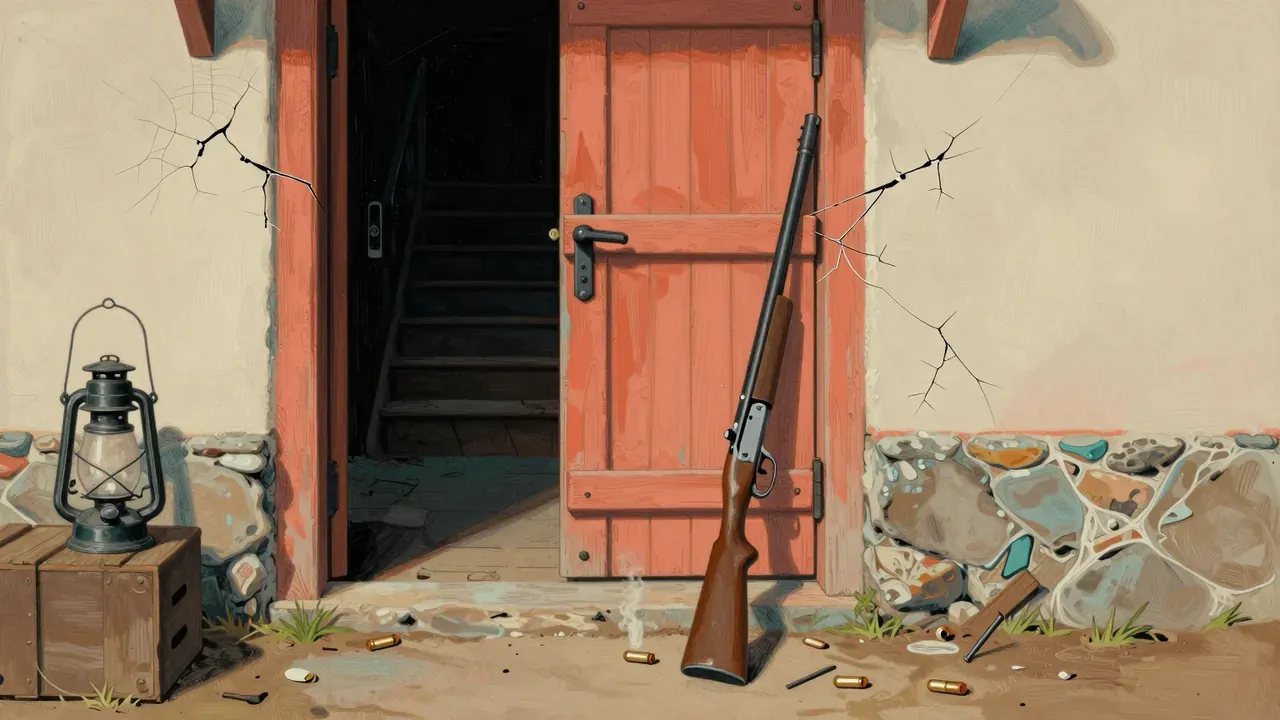
What lands is the cumulative weight of enclosure and erosion. The farmhouse ceases to feel like shelter and becomes a trap defined by its failing boundaries — doors splinter, windows shatter, the cellar door is a prop cut into drywall. The film’s power resides in its refusal to let characters speak meaningfully beyond the immediate: no speeches, no backstories, no catharsis. When Ben builds a barricade, the nails bend; when he fires a shotgun, the recoil jars his shoulder visibly. These details accumulate into a tactile sense of exhaustion and futility. The casting of Duane Jones as the de facto leader — unaltered from a script written for a white actor — lands not as symbolism but as simple fact: he is the most capable person present, and race enters the frame only when others resist his authority. The final shot — a rural posse shooting Ben in daylight — lands with documentary flatness, not irony. There is no music, no slow motion, no close-up on his face. It is just a man, mistaken for a ghoul, killed by men who have spent the night killing ghouls. That plainness is what endures. (157 words)
Where the structure gives way
What does not land is the opening sequence, which feels detached from the rest of the film in tone and pacing. The cemetery prologue — with its stilted sibling banter and abrupt violence — operates in a different register: more gothic, less grounded. Barbra’s catatonia, while consistent with trauma, becomes difficult to sustain dramatically across long stretches of silence and static framing. Some performances falter under the strain of minimal direction: Kyra Schon’s character, Karen, shifts abruptly from childlike dependence to monstrous agency without sufficient preparation. The basement scenes suffer from compromised sound and lighting, making dialogue hard to follow and motivations opaque. The film’s refusal to explain the ghouls’ origin or rules leaves some plot turns feeling arbitrary rather than inevitable — particularly the sudden breach of the cellar door, which relies on an off-screen decision with no prior setup. The black-and-white image, while effective overall, occasionally flattens spatial relationships, making it unclear where characters are relative to threats. These are not flaws in intent but limits of means: the film runs on frayed wires, and sometimes the current drops. (156 words)
The rules of the collapse
The themes that matter are not allegorical but procedural: how authority forms and dissolves in absence of institutions; how language breaks down when consensus vanishes; how racial dynamics persist even when civilisation appears to end. The film does not ‘comment on’ the civil rights movement or Vietnam — it absorbs their ambient tensions into its texture. Ben’s competence is never questioned until he asserts control over Harry Cooper; that friction is not dramatised as racism but enacted as resistance to leadership from an unexpected source. The ghouls are not metaphors for anything — they are obstacles, like rotting floorboards or jammed windows. What matters is the speed with which cooperation collapses into suspicion, then violence, then indifference. The film treats class, gender, and age not as themes to explore but as variables in a behavioural experiment: how does a teenage girl behave when her parents are dead? How does a man behave when his wife refuses his orders? These are not rhetorical questions — the film answers them with actions, not speeches. Its enduring relevance lies in this fidelity to cause and effect, not interpretation. (158 words)
Who it meets, and who it does not
It is for viewers who value precision of form over spectacle, who find tension in stillness and dread in accumulation. It rewards attention to gesture, framing, and silence. It is not for those who require narrative closure, psychological exposition, or tonal consistency. Viewers expecting modern horror pacing — quick cuts, escalating set pieces, musical punctuation — will find it slack, even inert, in places. Those who associate ‘zombie films’ with fast runners or elaborate mythology may mistake its austerity for emptiness. It assumes familiarity with mid-century American vernacular and rural infrastructure — the significance of a generator, a CB radio, a shotgun’s reload time — and does not pause to explain. It also demands tolerance for technical imperfection: muffled audio, inconsistent focus, visible crew shadows. Anyone unwilling to meet it on its own terms — as a document of limitation, not a template for genre — will leave frustrated. Its power is inseparable from its constraints. (159 words)
Why it remains
Yes, it is worth your evening — not as entertainment but as calibration. Watching it recalibrates expectations of what a horror film can do: it frightens not through surprise but through inevitability; it unsettles not with gore but with the slow leak of control. Its ninety-six minutes pass with the weight of real time, not edited time. It asks nothing of the viewer but attention, and repays that with clarity: about how groups fail, how power circulates, how endings arrive without ceremony. Those who dismiss it as ‘dated’ or ‘rough’ miss that its roughness is its grammar — every bent nail, every muddy bootprint, every line of improvised dialogue serves the same purpose. It is not for fans of polished genre fare, nor for those who need reassurance that competence will be rewarded. But if you want to see how much can be achieved with almost nothing — and how much truth can be held in a single, unblinking shot — then it is indispensable. (159 words)