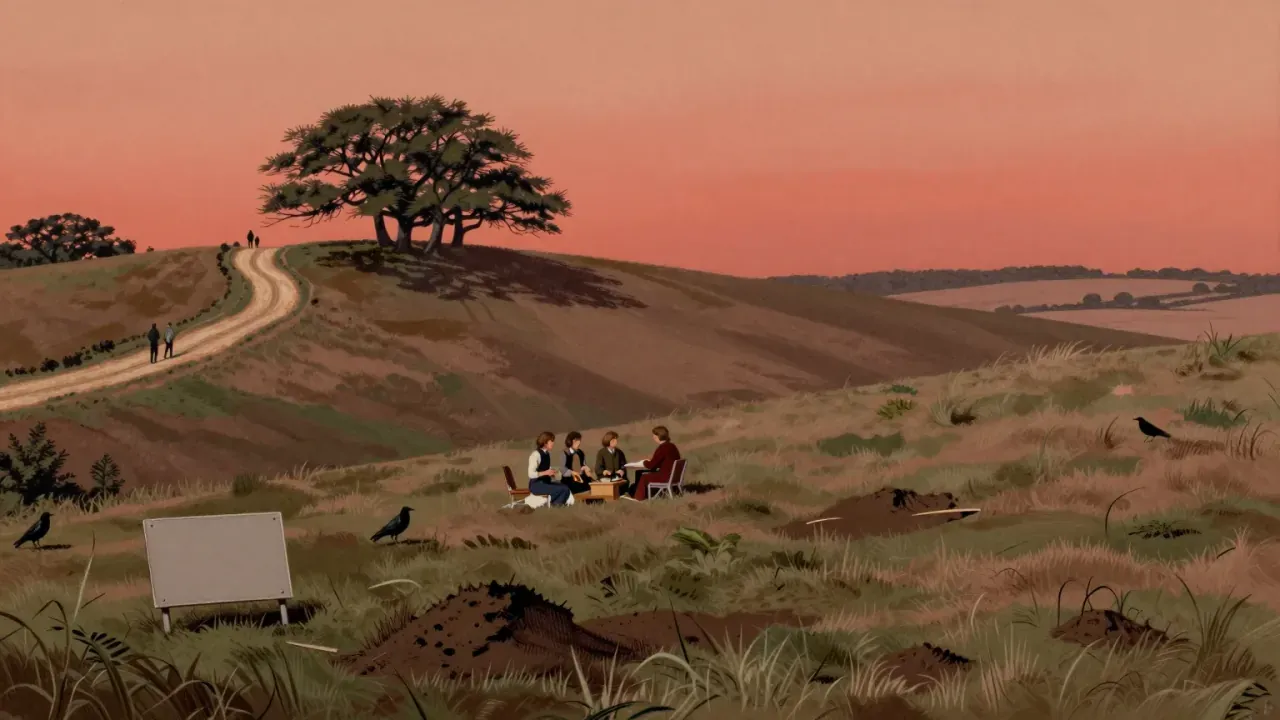
A warren fleeing before disaster strikes
Watership Down follows a small band of rabbits who abandon their home warren after one of them, Fiver, has a vision of its coming destruction, setting off across the English countryside to find a new place to live while a rival, authoritarian warren under General Woundwort threatens to crush them along the way. Producer Martin Rosen bought the film rights to Richard Adams’s 1972 novel and originally hired John Hubley to direct, only to take over the production himself, making his directorial debut, after disagreements between the two led to Hubley’s departure. Financed by a British consortium after major studios like Rank and EMI turned it down, the film set out to adapt Adams’s unusually detailed, sometimes brutal animal society without softening it for a family audience.
A production that changed directors mid-stream
Senior animator Arthur Humberstone gave the rabbit characters their distinctive look, while backgrounds were built directly from the real Hampshire locations described in Adams’s novel, including the actual down the story is named for. Angela Morley took over the score from Malcolm Williamson partway through, developing the film’s musical identity around Art Garfunkel’s rendition of Bright Eyes, written by Mike Batt, which became a number one hit in Britain independent of the film’s own reception. Vocal work from John Hurt as Hazel, Richard Briers as Fiver and Zero Mostel, in his final film role, as the gull Kehaar gave the film a cast more associated with serious drama than children’s animation, reinforcing its ambiguous target audience from the start.
Realism where cartoon shorthand usually goes
Where the film succeeds most clearly is in refusing the usual cartoon distance from violence: rabbits die on screen without the exaggerated, bloodless staging typical of animated features from the period, and predators, traps and Efrafa’s enforcers are treated as genuinely lethal threats rather than comic obstacles. That naturalism extends to the animation of the rabbits’ movement and social behaviour, which several critics singled out as unusually observant of how rabbits actually behave rather than defaulting to standard anthropomorphised cartoon gestures. The decision to keep General Woundwort’s Efrafa as a fully realised totalitarian society, with its own rules, informers and punishments, rather than a simple villain’s lair, gives the back half of the film a political weight beyond the survival plot.
Where the adaptation loses texture
Critics at the time, including Philip French, argued that the novel’s rich invented detail, particularly its constructed rabbit language Lapine and its elaborate mythology around the folk hero El-ahrairah, didn’t survive the translation to a ninety-two-minute runtime with the same texture, leaving the film’s world feeling thinner than the book’s. Some reviewers also found the background art merely competent rather than distinguished, with one describing it as resembling ordinary shopping-mall watercolour landscapes, a harsher assessment than the film’s overall reputation might suggest. The compressed runtime means several of Efrafa’s political details, compelling as they are, get less room to develop than the novel affords them.
Efrafa as a warning about total control
Multiple critics, including Jay Scott, have drawn a direct line between General Woundwort and Adolf Hitler, reading Efrafa’s rigid hierarchy and its willingness to sacrifice its own rabbits for the warren’s expansion as a specific comment on authoritarian rule rather than a generic villain archetype. That reading gives the rabbits’ migration, which starts as a simple search for safety, a second dimension: they are not just relocating but actively resisting absorption into a totalitarian system that would use them up entirely. The film’s insistence on showing what that system costs its own members, not just its enemies, is part of why it reads as more than a straightforward survival adventure.
Who this suits
This suits viewers who want animation willing to treat mortality and political control as real stakes rather than as backdrop, and fans of Adams’s novel curious how much of its darker material survived adaptation. It is a poor choice for young children, given the film’s decades-long reputation, reinforced by a controversial pre-watershed television broadcast, for genuinely distressing scenes of violence. Viewers who want the novel’s full invented mythology and language preserved intact will find the film’s compression a real loss rather than a reasonable trade-off. Anyone selecting it for a young child on the assumption that animated rabbits guarantee a gentle experience should watch it themselves first.
Worth the ninety minutes
Yes. Backed by British financiers who ultimately saw returns as high as fifty times their investment, Watership Down succeeded commercially by refusing to be the safe, sanitised animal adventure its early distributors expected, and that refusal is still what makes it worth watching decades later. Its naturalistic violence and its Woundwort-as-tyrant subplot give the migration story a seriousness closer to a war film about displacement than to typical animated family fare. At ninety-two minutes, it doesn’t fully capture the novel’s texture, but what it keeps, the danger, the politics and the cost of survival, still lands.