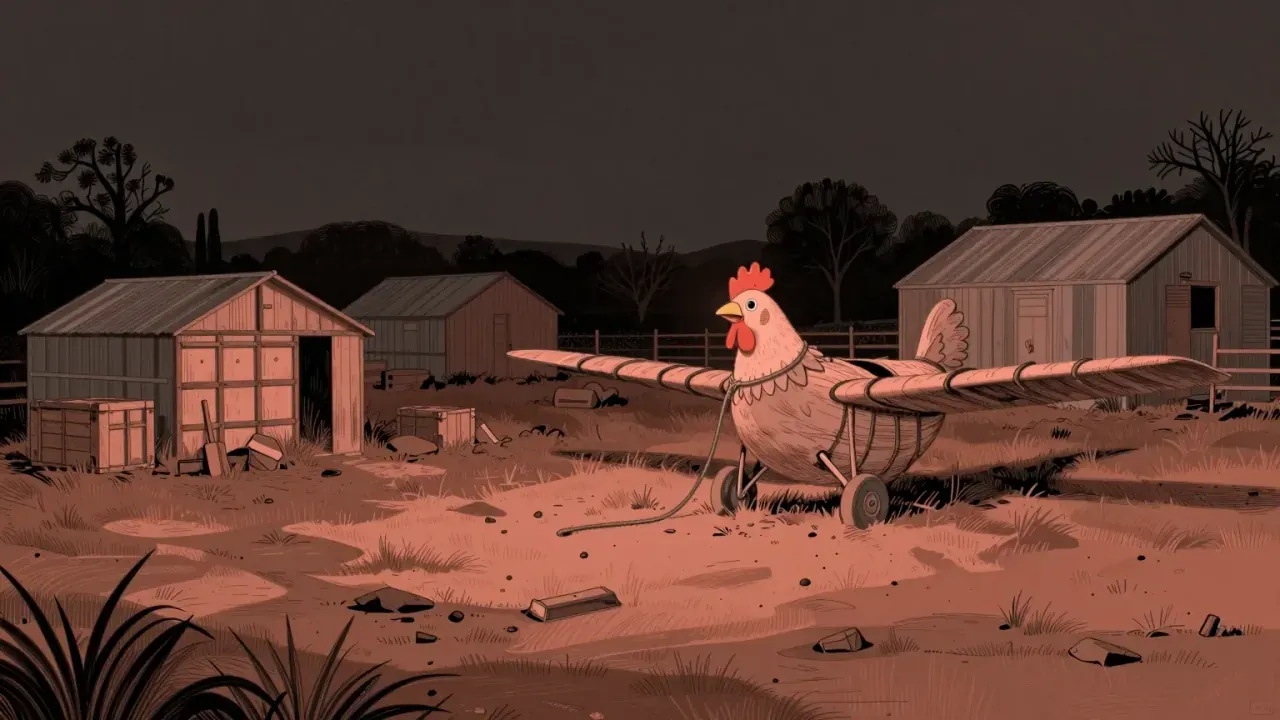
A prisoner-of-war film reset on a chicken farm
Chicken Run reworks the World War Two prisoner-of-war escape film, specifically The Great Escape, as a story about hens on a Yorkshire egg farm run like a camp, complete with searchlights, roll calls and a commandant’s wife rather than a commandant. Nick Park and Peter Lord direct Aardman’s first feature after years of shorts, with Karey Kirkpatrick scripting from their original story. When Mrs Tweedy decides to convert her failing farm into a chicken pie factory, the birds’ long string of failed escape attempts turns urgent, and an American circus rooster named Rocky, who crash-lands claiming he can fly, becomes their only apparent way out.
Eighty animators, one minute a week
Stop-motion production ran for eighteen months across thirty sets with around eighty animators, producing roughly one minute of finished film per week of shooting — a pace that shapes the film’s visual density, since every prop and expression had to be worth the time spent posing it. Julia Sawalha’s Ginger carries the film’s tension as the chickens’ de facto leader, while Miranda Richardson’s Mrs Tweedy is written with a coldness that has nothing to do with cartoon villainy; she barely raises her voice. John Powell and Harry Gregson-Williams’s score, recorded at Abbey Road, leans on kazoos and whistles that keep the tone from tipping into the genuine menace of the films it’s parodying, even as the plotting stays committed to that menace.
The moment the pie machine changes everything
The pie-machine reveal is the film’s best-constructed sequence: the birds’ fattening rations, initially read by the flock as a reward, are recontextualised in a single scene into the actual threat, which gives the second half genuine stakes rather than a vague sense of danger. Timothy Spall and Phil Daniels’s double act as the rats Nick and Fetcher supplies the film’s cynical commentary without derailing momentum, functioning the way a Great Escape film’s black-market operators would. The model work on the climactic aircraft escape, with its collapsing ramp and chase along runway lights, holds up as an action sequence regardless of the medium used to make it.
Where Rocky’s redemption comes too easily
Rocky’s reveal as a fraud who can’t actually fly, borrowed from circus cannon acts rather than genuine ability, resolves a little too neatly once he returns out of guilt, undercutting some of the tension his earlier betrayal built. A handful of gags aimed squarely at younger viewers — Babs’s running knitting joke chief among them — sit at a different register from the film’s sharper material and occasionally interrupt scenes that are otherwise building tension efficiently. Mr Tweedy’s suspicions about the chickens organising, correct at every turn but dismissed by his wife for most of the runtime, also get stretched a little further than the joke can comfortably support by the film’s end.
Farming as a prison camp
The chosen genre does real work: framing factory farming as a prison camp, with an oppressive owner tracking productivity and disposing of anyone who stops delivering, gives Chicken Run an edge a straightforward barnyard comedy wouldn’t have. The chickens’ repeated failed escapes before Rocky arrives establish that organised resistance without a workable plan is just routine, which makes Ginger’s insistence on trying again read as stubbornness rather than heroism until the plane finally gets built. Rocky’s arc, from self-interested performer to someone who returns despite having no obligation to, gives the film’s cooperation theme a harder edge than mere teamwork sentiment.
Who the straight-faced parody suits
This suits viewers who enjoy genre parody played completely straight rather than winking at the audience, and anyone with a fondness for stop-motion’s specific texture, since Chicken Run’s puppet performances carry weight that computer animation of the same period didn’t attempt. It also rewards viewers who know The Great Escape, since the film’s structure tracks it closely enough to reward that familiarity without requiring it. It’s a weaker choice for anyone wanting broad slapstick throughout, since long stretches play out with the tension of an actual prison drama rather than gags.
Why 81 minutes of puppetry still holds up
At 81 minutes, Chicken Run doesn’t waste time getting from the roll-call setup to the pie-machine threat to the runway chase, and it remains the highest-grossing stop-motion film ever made for good reason: the model work still reads as more tactile than anything computer-animated from the same year. A 5x return on its $45 million budget and a 97% critical score reflect a film that succeeded on craft rather than marketing novelty. Worth the evening, particularly for anyone who assumes a chicken-based comedy can’t sustain real tension for its full runtime.