The shape of becoming
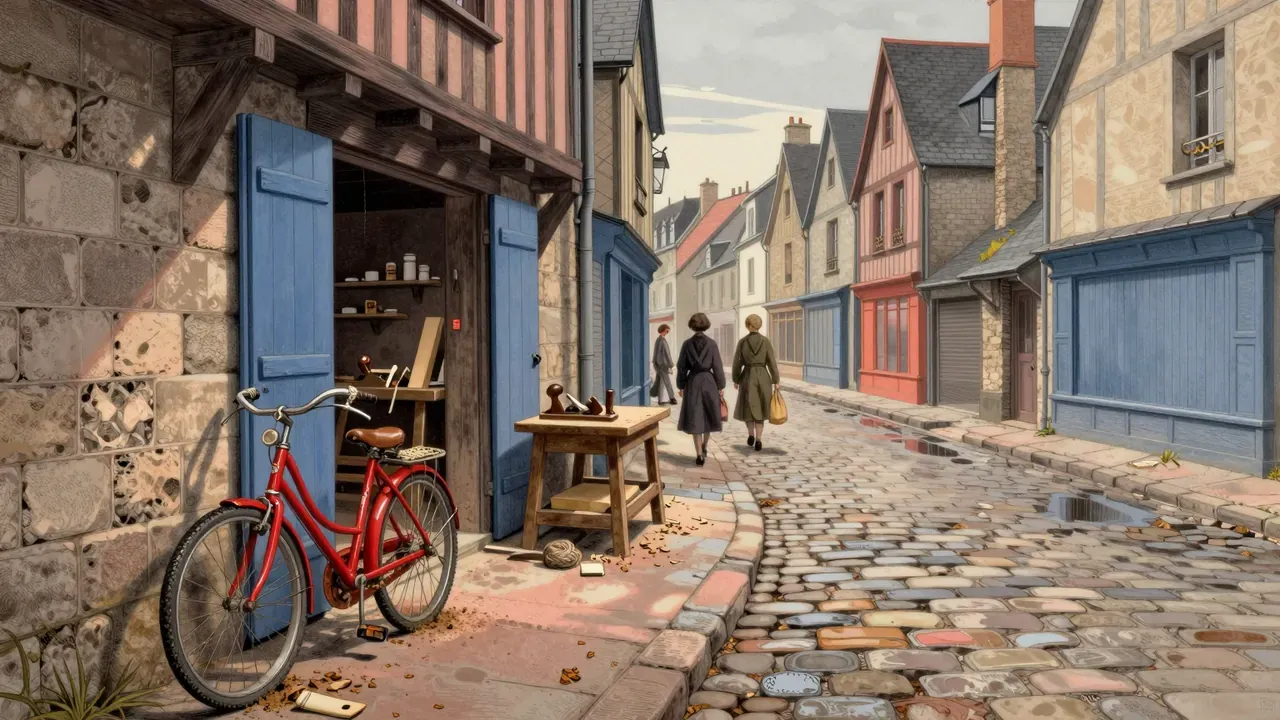
Jacquot de Nantes is a biographical portrait in hybrid form: part dramatised reconstruction, part quiet documentary, all devoted to the childhood and early artistic awakening of Jacques Demy. It does not aim to narrate his life chronologically or comprehensively, but to evoke how imagination takes root — in wartime Nantes, in a father’s workshop, in the flicker of a home projector, in the texture of painted backdrops and hand-drawn storyboards. Agnès Varda frames it as an act of love and preservation: not just of Demy’s memory, but of the tactile, unglamorous labour behind film-making itself — casting, lighting, set-building, animation. The film treats childhood not as innocence but as apprenticeship: every game is rehearsal, every scrap of paper a storyboard, every shadow on a wall a cue for composition. It avoids psychological exposition; instead, it builds its argument through accumulation — of objects, gestures, light conditions, recurring motifs like the red bicycle or the projector’s beam. This is biography as archaeology, digging not for motive but for method.
The look of it
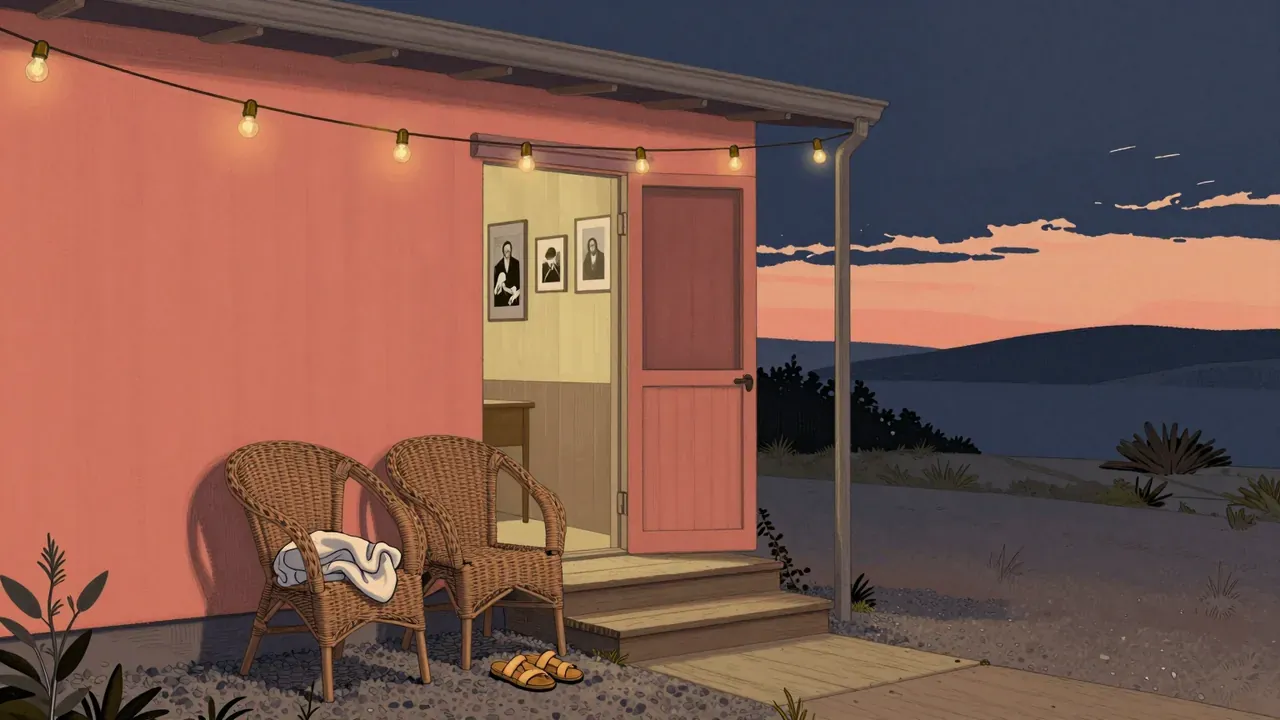
The film works by holding three registers in careful balance: fictionalised scenes with child actors, direct-to-camera interludes featuring the ailing Demy, and archival fragments — home movies, sketches, voice recordings. Patrick Blossier, Agnès Godard and Georges Strouvé shape a visual grammar that distinguishes each layer: the wartime sequences are softly lit, with shallow depth and muted palette, while Demy’s interviews are shot in crisp, frontal medium close-up against neutral backgrounds. Joanna Bruzdowicz’s score avoids sentimentality, using piano and strings with restraint, often pausing entirely during moments of manual craft — a boy tracing a cartoon, a father sanding wood. Performances are understated, especially from the young actors, who move with the unselfconscious physicality of children absorbed in play rather than acting. Varda’s script gives them precise, concrete actions — adjusting a lens, mixing paint, arranging cut-out figures — never exposition. The editing, by Marie-Josèphe Yoyotte and Claudine Merlin, favours duration over punctuation: we watch Jacquot draw for twenty seconds, not because it’s dramatic, but because drawing is how he thinks.
The weight of things
What lands is the fidelity to material experience — the weight of a camera tripod, the smell of turpentine, the grain of 16mm film when held to the light. The film’s strongest passages are those where craft becomes visible as process: Jacquot building a miniature theatre from cardboard and cellophane, Demy describing how he learned lighting by watching how light fell across his father’s face in the workshop. These moments do not argue for artistry; they show its scaffolding. The interludes with Demy himself land with quiet force: his hands, frail but steady, turning pages of old sketchbooks; his voice, thin but exact, naming the exact shade of blue he used for a sky in a 1947 animation test. There is no nostalgia here, only attention — and that attention proves contagious. When Jacquot watches a silent film and then tries to replicate its rhythm with paper cut-outs, the film makes us see cinema not as magic but as mechanics made lyrical. That shift — from wonder to method — is sustained and persuasive.
The spaces between
What does not land is the structural looseness around the adult Demy segments. Though tender, they occasionally drift into anecdote without clear connective tissue to the dramatised scenes — a story about a lost puppet feels adjacent rather than integral. The film’s refusal to clarify chronology or causality, while deliberate, can blur narrative momentum: Jacquot’s progression from copying comics to designing sets remains implied rather than charted, and some viewers may find the transitions between fiction and documentary too elliptical. The wartime setting, though evoked with care, stays deliberately vague on political context — Occupation is present as atmosphere (blackouts, ration books, muffled radio voices) but never interrogated as history. This is not negligence, but a choice that risks flattening the period into backdrop. A viewer seeking historical precision or psychological cause-and-effect will leave unsatisfied; the film offers neither diagnosis nor timeline, only recurrence — the same red bicycle, the same projector, the same way light catches dust motes — as its organising principle.
How hands learn
The themes that matter are apprenticeship, materiality, and transmission. Not inheritance, but transmission: the film shows knowledge passing not through instruction but through proximity — Jacquot learns lighting by watching his father adjust a lamp, not by being told how. Craft is treated as embodied cognition: fingers remember before the mind names. Memory is not recollection but re-enactment — Demy redraws a childhood sketch not to recover feeling, but to verify line and proportion. Time is non-linear: the adult Demy’s voiceover does not explain the child’s actions but echoes them, as if past and present are co-present in the act of making. The film also treats creativity as inherently collaborative and domestic — not solitary genius but shared space, shared tools, shared silence. Even the war appears less as catastrophe than as condition: a world of shortages that sharpens resourcefulness, of blackouts that make projected light more precious. These are not abstract ideas but textures — the feel of chalk on slate, the sound of a hand-cranked projector, the way glue dries unevenly on paper.
Who it is for
This film is for viewers who value attention over plot, process over product, and quiet observation over exposition — particularly those interested in film history, pedagogy, or the material culture of art-making. It suits people who watch documentaries about restoration labs or studio carpenters, or who linger over sketchbooks in museum displays. It is not for those who require narrative propulsion, psychological revelation, or historical framing — someone expecting a conventional biopic or a wartime drama will find it elusive. Those who dislike ellipsis, resist ambiguity in chronology, or expect thematic statements to be voiced outright will likely disengage. A viewer who values clarity of argument over accumulation of detail would find it diffuse. What would change the verdict? A tighter editorial hand in the documentary interludes — clearer anchoring of Demy’s reflections to specific dramatised moments — would sharpen its coherence without sacrificing its gentleness.
What stays
Yes, it is worth your evening — provided you arrive prepared to watch slowly, to let images settle, to notice how light changes across a room over five minutes. Its 118 minutes pass without hurry, but not without consequence: by the end, the act of looking itself feels newly calibrated. You will not leave with facts about Demy’s career, but with a heightened sense of how vision is trained, how tools become extensions of thought, how childhood curiosity hardens into discipline. It rewards patience, not endurance. Someone who prefers tightly plotted fiction or fast-cut documentaries may find it inert; but for those who trust slowness as a mode of understanding, it deepens perception. The film does not ask for your investment in outcome, but in attention — and that exchange, modest as it is, proves durable. Its value lies not in what it delivers, but in what it restores: the dignity of small, repeated acts of making.