The look of it
Town Bloody Hall is a documentary record of a live panel debate held at New York’s Town Hall on 30 April 1971, filmed by D. A. Pennebaker and released in 1979. It does not interpret, narrate or contextualise. It presents the event as it unfolded: Norman Mailer moderating a discussion with four feminist speakers — Jacqueline Ceballos, Germaine Greer, Jill Johnston and Diana Trilling — before an audience that heckles, interrupts and applauds. The film’s aim is archival fidelity: to preserve the tone, rhythm and friction of that night without editorial framing. Pennebaker’s approach avoids voiceover, cutaways or explanatory titles; the camera stays largely static, observing from mid-distance, letting argument and interruption occupy the frame unmediated. There is no attempt to balance perspectives or resolve contradictions. The film treats the event not as theatre but as evidence — a fixed point in the contested terrain of second-wave feminism, captured before consensus or canon formed. Its ambition is narrow and exact: to hold the moment steady, not to explain it. (148 words)
How it holds the room
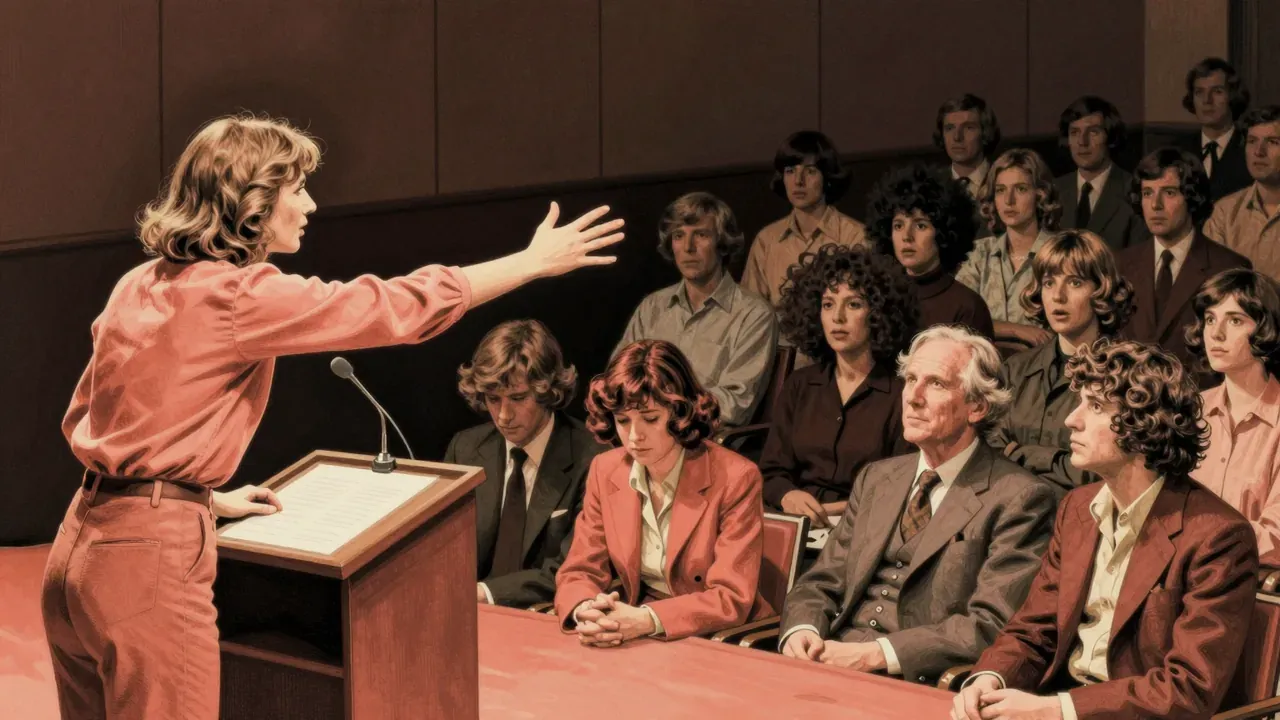
The film works through duration and proximity. Its eighty-eight minutes unfold in real time, anchored by the physical space of the auditorium — wooden seats, a modest stage, overhead lights casting long shadows. Pennebaker and Chris Hegedus edit with restraint: cuts follow speaker change or audience reaction, never to heighten drama. Gordon Willis is not involved; the cinematography is functional, grainy 16mm, with occasional focus drift and uneven exposure — the look of urgent documentation, not polished craft. Sound is raw: overlapping voices, muffled laughter, rustling programmes, microphone thumps. Performances are unscripted but charged: Greer’s clipped precision, Johnston’s theatrical provocation, Trilling’s measured gravity, Mailer’s voluble defensiveness. There are no re-enactments, no interviews shot later, no archival inserts. The only artifice is the act of filming itself — a presence acknowledged when Mailer glances at the camera or Johnston gestures toward it. The film’s coherence comes not from narrative logic but from the cumulative weight of sustained attention. (152 words)
Where the sparks fly
What lands is the sheer density of ideological collision. The film captures how political disagreement sounded before digital fragmentation — not as soundbites but as extended, stumbling, sometimes incoherent exchanges where meaning accumulates across interruptions and repetitions. Greer’s critique of male authorship lands because it emerges from her own position as a woman writer facing Mailer’s institutional authority. Johnston’s lesbian-feminist provocation lands not as dogma but as performance-as-politics, made visceral when two women kiss on stage and Mailer visibly recoils. Trilling’s rebuke — that Mailer fails to imagine women’s full humanity — lands with quiet force because it arrives after sustained listening, not as a flourish. The audience reactions land too: their laughter, groans and shouts are not background noise but part of the argument’s texture. Even Mailer’s self-aware bluster lands, not as charm but as a precise document of a certain kind of male intellectual entitlement under pressure. The film’s power lies in its refusal to smooth any of this over. (154 words)
What stays out of frame
What does not land is the illusion of neutrality. Pennebaker’s ‘fly-on-the-wall’ claim founders on basic choices: who gets the longest takes, whose interruptions are cut short, which audience reactions are foregrounded. Mailer dominates screen time early, while Ceballos’s structural critique of NOW’s narrow focus is given less visual weight. The editing privileges verbal dexterity over conceptual depth — Greer and Trilling read strongest because they speak with rhetorical discipline; Johnston’s radical simplicity suffers in comparison. The film also fails to register class beyond the opening heckle about Greer ‘betraying the poor’. No working-class women speak on stage, and the audience remains an undifferentiated mass. The absence of Black or Latina feminists — despite the era’s organising — is not neutral omission but historical erasure baked into the frame. The film cannot be faulted for what it did not film, but it is diminished by presenting this particular gathering as the feminist debate of its moment, rather than one contested node among many. (156 words)
The weight of the unsaid
The themes that matter are not abstraction but friction: the tension between movement and institution, visibility and voice, theory and embodiment. Class recurs not as analysis but as accusation — outside the hall, inside the hall, in Mailer’s discomfort with Johnston’s bodily politics. Sexuality is treated as inseparable from epistemology: Trilling links female orgasm denial to the erasure of women’s subjectivity; Johnston ties lesbianism to self-determination, not identity. Authority is staged physically — Mailer at the lectern, the women seated slightly lower, the audience looking up at all of them. The film exposes how liberation debates were fought over language itself: who names, who defines, who gets to be incomprehensible and still heard. It also reveals feminism’s internal fault lines — Ceballos’s organisational pragmatism versus Johnston’s separatist rupture, Greer’s cultural revisionism versus Trilling’s psychoanalytic rigour. These are not resolved, nor meant to be. What matters is that the film holds them in simultaneous, unresolved tension — a portrait of ideology in motion, not doctrine in place. (152 words)
Who it meets halfway
It is for viewers who want to hear how ideas sound when they are still unsettled — students of gender history, practitioners of political theatre, anyone curious about the texture of pre-digital public argument. It is not for those seeking synthesis, clarity or resolution; the film offers none. Nor is it for viewers who expect representation to be proportional or intersectional — its exclusions are structural, not incidental. Some feminists will find its framing reductive, others will value its unvarnished record. Historians may object to its lack of context; activists may bristle at its passive stance. But its value lies precisely in its limitations: it is a time capsule, not a textbook. To watch it expecting balance or completeness is to misunderstand its purpose. It rewards patience, not passive consumption. Those who come prepared to listen closely, to sit with discomfort and contradiction, will find it indispensable. Those who need guidance, summary or moral certainty should look elsewhere. (150 words)
Why it lasts
Yes, it is worth your evening — but only if you treat it as primary source material, not entertainment. Its eighty-eight minutes demand attention, not distraction. It repays slow viewing: noticing how lighting shifts as the debate wears on, how voices grow hoarse, how Mailer’s posture changes when Johnston speaks. It is not ‘enjoyable’ in the conventional sense, but it is absorbing in its specificity. Anyone who has ever sat through a live debate knows its mixture of tedium and revelation — this film honours both. Detractors might say it feels dated, but its tensions — over who speaks, how bodies are policed, whether anger counts as argument — remain live. A viewer who expects polish or perspective will be frustrated. But one who accepts its narrow, stubborn fidelity will leave with a sharper ear for how power sounds when it is being contested, not conferred. That makes it worth more than one evening. (149 words)