The shape of it
Traffic is a multi-strand American crime film that maps the drug trade across national and social borders: from a newly appointed US drug czar’s domestic crisis, through DEA operations on the Mexico–US border, to a wealthy teenager’s descent into addiction, and a Tijuana trafficker’s daily calculus of risk and loyalty. It adapts the 1989 British television series Traffik but relocates its Pakistani thread to Mexico and compresses its agricultural subplot. Its aim is structural rather than psychological — to show how policy, enforcement, consumption and supply form interlocking systems, not isolated moral failures. The film refuses a single protagonist or narrative arc; instead, it treats each storyline as a parallel current in the same polluted river. It does not argue for a solution but insists on the impossibility of treating any one node — user, cop, politician, smuggler — without acknowledging the others. Its political orientation is embedded in this refusal to isolate cause or blame, and in its insistence on linguistic and cultural specificity, particularly in the Mexican sequences where Spanish dialogue remains unsubstituted and unexplained.
The look of it
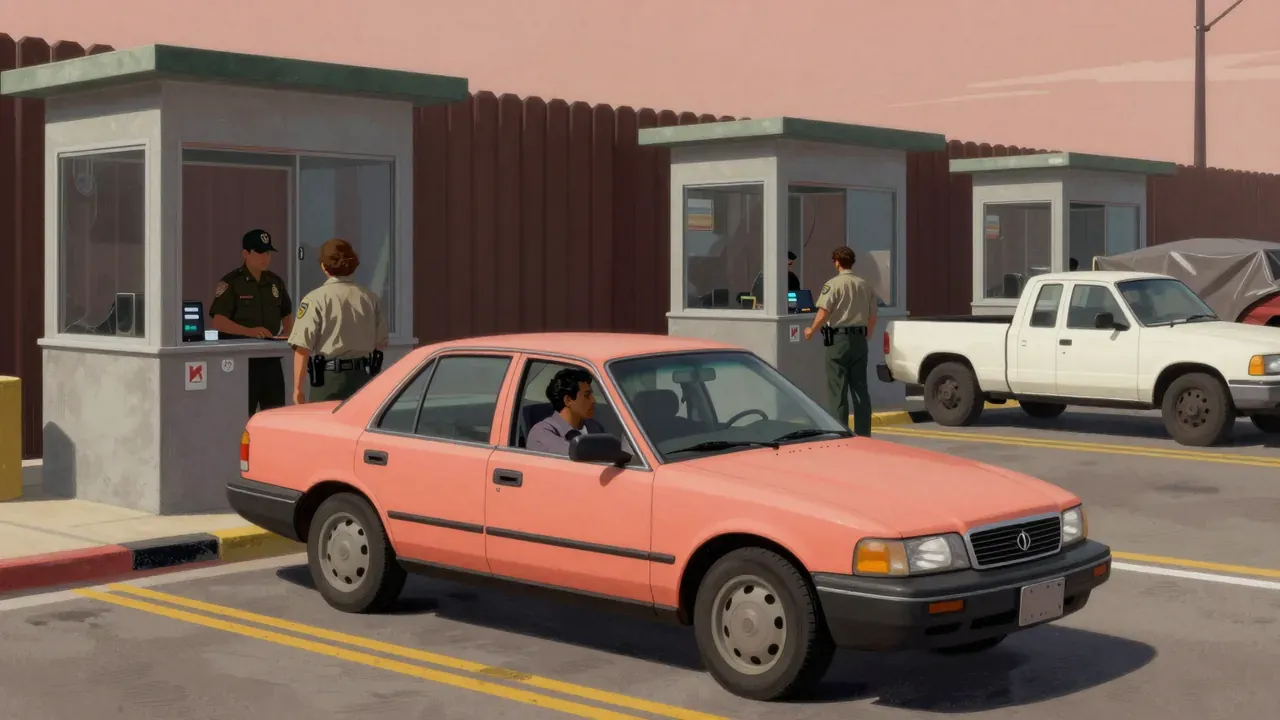
The film works through disciplined formal choices: Steven Soderbergh operates the camera himself under the pseudonym Peter Andrews, using three distinct colour grades — cool blue for Washington DC, warm amber for Ohio, and desaturated green for Tijuana — to separate storylines without exposition. Stephen Mirrione’s editing stitches them together with rhythmic precision, avoiding cross-cutting for dramatic tension and instead building cumulative pressure through repetition of motif and image: surveillance footage, border checkpoints, pill bottles, intercepted calls. Performances are restrained, even muted: Michael Douglas plays Robert Wakefield with bureaucratic stiffness that hardens into grief; Catherine Zeta-Jones conveys escalating desperation through posture and silence more than speech; Benicio del Toro’s Javier Rodriguez speaks almost entirely in Spanish, his authority rooted in stillness and gaze rather than volume. Cliff Martinez’s score avoids melody in favour of low-frequency pulses and fragmented electronic textures, reinforcing the sense of systemic unease. The script by Stephen Gaghan tightens the original series’ sprawl while preserving its procedural fidelity — dialogue sounds like briefing notes or intercepted radio chatter, not monologue.
What holds
What lands is the film’s structural integrity and its refusal to flatter the viewer’s assumptions. The Washington storyline avoids easy caricature: politicians speak in clichés not because they are foolish but because clichés are the operating language of power. The Mexican sequences gain weight from their linguistic authenticity — the studio’s insistence on subtitles, and del Toro’s insistence on speaking only Spanish, gives those scenes an impenetrability that mirrors the real-world asymmetry of understanding between north and south. The teenage addiction plot avoids melodrama by anchoring Erika Christensen’s character in banal privilege — her spiral begins not with trauma but with boredom and access. Even minor roles land: Tomas Milian’s ageing cartel boss exudes weary calculation; Don Cheadle and Dennis Quaid’s DEA agents move through their assignments with procedural exhaustion, not heroism. The film’s pacing, often described as deliberate, functions as a feature: it forces attention on bureaucratic inertia, on the time it takes for a seizure to become intelligence, for a policy to become law, for a relapse to become visible.
What slips
What does not land is the film’s occasional drift into schematic abstraction. Some characters remain functional rather than felt — Luis Gómez’s Tijuana police officer, for example, serves primarily as a counterpoint to del Toro’s Javier, but his inner life is withheld beyond duty and doubt. The Ohio storyline, centring on Douglas’s daughter, risks flattening adolescent self-destruction into a cautionary footnote about suburban affluence, its emotional texture thinner than the political or operational strands. A few scenes — notably the improvised cameos by real US senators — feel like gestures toward verisimilitude that do not deepen the narrative. The film’s commitment to procedural accuracy occasionally sacrifices psychological momentum: long stretches of surveillance footage or inter-agency negotiation accumulate data but not urgency. And while the colour-coding aids clarity, it also reinforces a kind of visual determinism — each world is sealed off, its palette unchanging, which subtly undermines the film’s stated aim of showing interconnection. The system is shown, but its friction points sometimes feel smoothed over.
The weight of it
The themes that matter are not addiction or corruption in isolation, but the architecture of impunity — how laws are written to protect some bodies while exposing others, how enforcement budgets swell while treatment funding stagnates, how language itself becomes a barrier to accountability. The film treats translation as both literal and political: English-speaking officials misread Spanish-language evidence; Mexican officers translate for US agents but withhold context; subtitles force the Anglophone viewer into the position of the outsider. It also treats time as a theme: the difference between the slow burn of policy implementation and the sudden rupture of overdose or arrest. Class is rendered not through dialogue but through spatial grammar — the wide shots of gated communities versus the tight, handheld frames inside Tijuana safe houses. The film’s quietest theme is complicity by omission: no character is evil, yet all participate in sustaining the system — the senator who votes for tougher penalties, the dealer who rationalises his work, the parent who looks away. It refuses redemption arcs not out of cynicism, but because redemption implies individual resolution in a problem that is collective and structural.
Who it’s for
It is for viewers who value formal coherence over emotional catharsis, who follow narrative through pattern rather than plot, and who accept that a film about systems may leave individuals unresolved. It rewards patience with density: repeated viewings reveal how a line spoken in Washington echoes in Tijuana, how a budget line item recurs as a seized shipment. It is not for those who require clear moral binaries, strong central protagonists, or narrative closure — the film ends not with a verdict but with a continuation, its final shot lingering on a border fence under indifferent sunlight. Those who expect character-driven drama or thriller pacing will find its rhythms alienating. Its value lies in its refusal to simplify, so anyone seeking a primer on drug policy or a polemic against prohibition will be disappointed. What changes the verdict is not better acting or tighter editing, but willingness to sit with ambiguity — to treat the film not as a story to be followed, but as a diagram to be read.
The time it takes
Yes, it is worth your evening — not as entertainment but as calibration. Its 141 minutes recalibrate expectations of what a mainstream American film can hold: multiple languages, unmediated bureaucracy, moral grey zones that never resolve into clarity. It assumes attention, not empathy, and repays attention with structural rigour. Its box office success — $207.5 million against a $46 million budget — suggests it found an audience willing to meet those terms. Anyone who has watched a procedural and wondered why the system never breaks, only bends, will recognise its logic. It is not relaxing, nor is it designed to be; it is methodical, like reading a government white paper with the emotional weight of a family album. Its endurance comes not from spectacle but from consistency: every frame serves the architecture. To dismiss it as cold is to mistake discipline for detachment. Its worth lies in how precisely it measures the distance between intention and outcome — in policy, in parenting, in smuggling — and refuses to bridge it with fiction.