A Romantic Fairy Tale
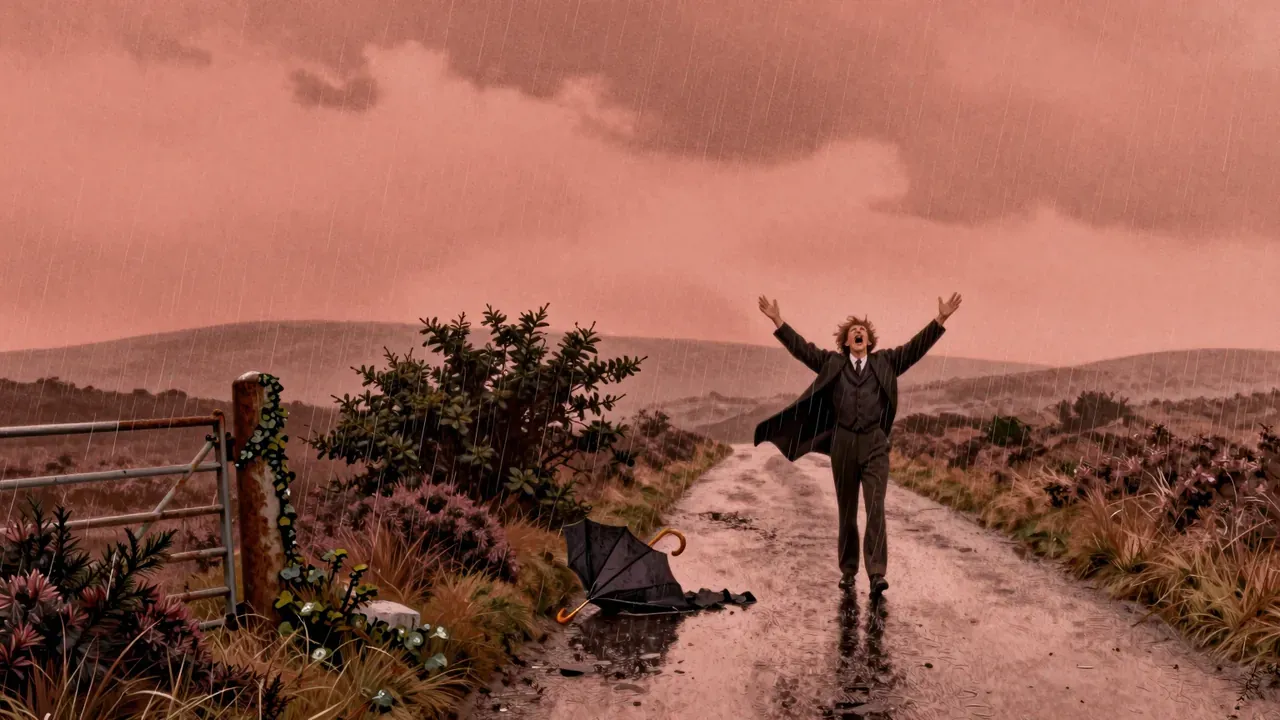
Tie Me Up! Tie Me Down! is a Spanish black comedy from 1989 that sets out to recast romantic mythmaking as an act of willful, almost pedantic construction — love not as fate or feeling but as project, discipline, and self-invention. Pedro Almodóvar co-writes and directs a story in which a recently discharged psychiatric patient, Ricky, abducts an actress, Marina, with the stated aim of becoming her husband and father of her children. The film frames this violent premise not as psychological realism nor as satire of coercion, but as a heightened, stylised fairy tale — one that cites Doris Day comedies, Calderón de la Barca, and Euro-horror simultaneously. Its ambition is tonal: to hold together tenderness and threat, absurdity and sincerity, without collapsing either into irony. It treats romance as ritual, bondage as grammar, and recovery — Marina’s from addiction, Ricky’s from institutionalisation — as parallel, uneven processes. The film does not ask whether love can be forced, but how stubbornly it can be rehearsed until it takes root.
The Look of It
The plot unfolds in tight, brightly lit domestic and studio spaces, shot by José Luis Alcaine Escaño with flat, saturated colour and minimal shadow — no chiaroscuro, no ambiguity in the light. Victoria Abril plays Marina with watchful restraint: her resistance is physical, vocal, then gradually procedural — she negotiates, observes, tests boundaries. Antonio Banderas’s Ricky is all nervous energy and unblinking conviction, his performance calibrated between feral and studious. Ennio Morricone’s score leans into thriller tropes but feels deliberately generic, as if Almodóvar wanted music that signals genre without deepening mood. Editing by José Salcedo keeps pace brisk, cutting away from discomfort just before it settles. The film-within-the-film, The Midnight Phantom, is shot in grainy monochrome and functions less as parody than as structural echo: Marina defeats a monster on screen, then slowly rewrites the terms of her captivity off it. Supporting turns — Loles León’s sharp-tongued Lola, Francisco Rabal’s weary director Máximo — ground the absurdity without puncturing it. There are no false notes in casting; each actor occupies their register precisely.
How She Holds On
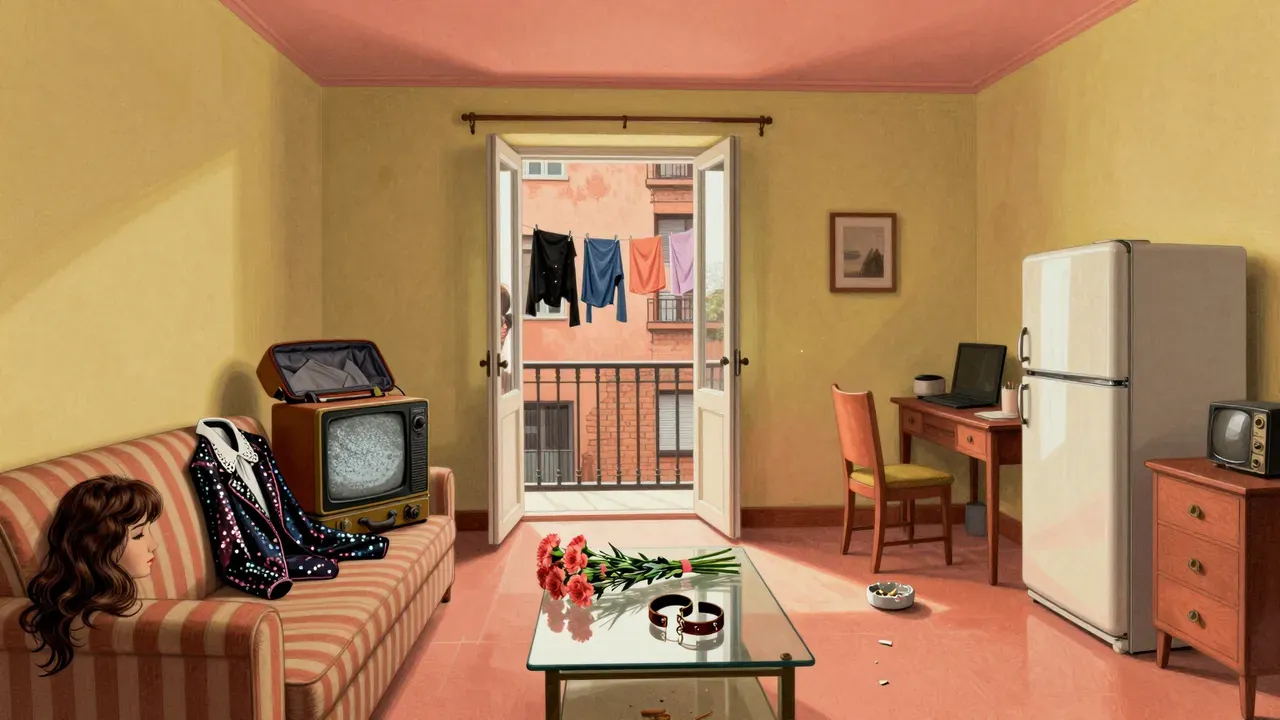
What lands is the film’s unwavering tone: its refusal to apologise for Ricky’s actions while also refusing to treat them as normal. The rope is literal, never eroticised, and the film sustains that distinction without winking. Marina’s gradual shift — from terror to vigilance to something like collaboration — feels earned because it is slow, unromanticised, and anchored in small decisions: accepting food, asking for toothpaste, letting Ricky shave. The domestic scenes in her apartment gain weight through repetition and texture: the clutter of film props, the hum of a fridge, the way light falls across a discarded wig. Almodóvar’s use of pop music — especially Dúo Dinámico’s ‘Resistiré’ over the final shot — lands with quiet force: it names endurance without triumph, resistance without rejection. The film’s visual confidence — its bold colour blocking, its theatrical framing, its affection for female craft (costume, make-up, script supervision) — never falters. Even when the premise strains credulity, the world remains internally consistent, persuasive in its own logic.
The Midnight Phantom
What does not land is the film’s attempt to fully reconcile its genres. The horror scaffolding — posters, references, Marina’s role in The Midnight Phantom — remains decorative rather than functional; it gestures at thematic depth but adds little to the central dynamic. Morricone’s score, though technically competent, feels like borrowed atmosphere: it evokes Psycho but lacks Hitchcock’s precision of dread, and Almodóvar’s own later scores would show how much more expressive silence or diegetic sound could be. Ricky’s backstory — orphaned, institutionalised, sexually inexperienced — is sketched but not inhabited with enough specificity to make his belief system legible beyond metaphor. The film’s insistence that this is ‘not sadomasochism’ becomes defensive when the imagery repeatedly invites that reading. Some supporting characters dissolve into type: Rossy de Palma’s drug dealer, for instance, is vivid but narratively inert. And while the NC-17 controversy was real, the film’s American reception does not translate into sustained dramatic tension on screen — the stakes feel cultural, not emotional.
The Labour of Love
The themes that matter are those of self-determination under constraint, and the labour of love as rehearsal. Marina’s recovery from addiction and Ricky’s from psychiatry are parallel arcs, both requiring daily practice, relapse, and recalibration. The film treats marriage not as destination but as discipline — Ricky studies parenting manuals, rehearses proposals, cleans obsessively. His violence is never excused, but it is contextualised as the only language he has been taught for claiming connection. The film also interrogates female agency within genres that routinely erase it: Marina is both star and subject of horror, both captive and critic of her captor, both recovering addict and working professional. Her sister Lola offers a counterpoint — sardonic, embodied, politically aware — reminding us that resistance need not be solemn to be serious. The recurring motif of film-making — scripts, dailies, retakes — reinforces the idea that identity, relationship, even sanity, are performances that can be rewritten, reshooted, edited.
Who It Is For
This film is for viewers who trust Almodóvar’s formal control and are willing to sit with moral unease without demanding resolution. It rewards attention to gesture, costume, and spatial rhythm — people who notice how a character holds a cigarette or arranges a shelf. It is not for those who require psychological plausibility as a condition of engagement, or who find the premise inherently unforgivable regardless of framing. Those who expect clear ethical signposting — condemnation, redemption, or catharsis — will leave unsettled, not because the film is ambiguous, but because it refuses to judge on terms outside its own logic. A viewer who values narrative closure over tonal consistency, or who reads all captivity narratives through contemporary frameworks of consent, may find the film’s stance alienating. The verdict shifts if the viewer accepts that some stories are about the architecture of feeling, not its authenticity.
Is It Worth Your Evening?
Yes, it is worth your evening — provided you approach it as a crafted object, not a moral document. At 111 minutes, it moves with purpose and never drags; its colours, textures, and pacing sustain attention without demanding emotional surrender. It repays rewatching: the second time, you see how carefully Marina’s resistance is staged — not as defiance but as calibration, a series of micro-adjustments to an impossible situation. Those who dislike it tend to do so on principle, not execution: they reject the premise outright, or find the tonal tightrope too precarious. But the film’s success lies precisely in holding that line — not in making Ricky sympathetic, but in making his conviction legible, and Marina’s response intelligible. It is not comfortable, but it is coherent, precise, and formally exhilarating. That coherence is rare, and worth the time.