The weight of silence
Army is a Japanese war film made under military government in 1944, commissioned by Shochiku but shaped by Keisuke Kinoshita’s quiet resistance to state orthodoxy. It traces three generations of a family across the Meiji Restoration, Russo-Japanese War, and Manchurian invasion, using domestic life as a frame for militarisation. The film does not glorify combat or rehearse imperial doctrine; instead, it examines how duty insinuates itself into intimacy — through parental anxiety, marital silence, and generational repetition. Its aim is neither propaganda nor subversion as spectacle, but something narrower and more perilous: to show militarism not as ideology but as habit, absorbed like grammar. Kinoshita works within the censors’ vocabulary — uniforms, parades, patriotic speeches — but loads each with hesitation. The script by Tadao Ikeda supplies the structure, but the film’s intention resides in what it refuses to say aloud, especially in its final moments. It is a film about compliance that never complies fully, made at a time when deviation was punishable not by critique but by arrest. Word count: 142
The look of it
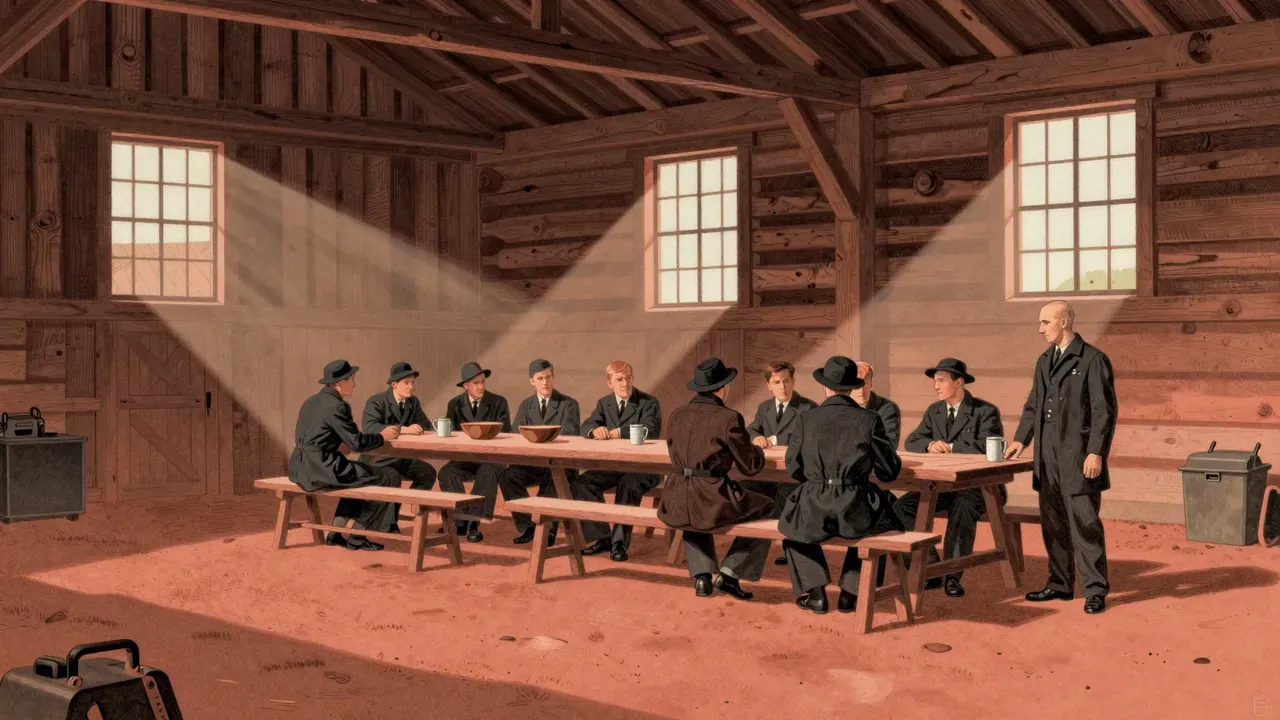
The story unfolds across decades without exposition, relying on Chishū Ryū’s restrained physicality as Tomohiko — his posture stiffening with age, his voice thinning with suppressed doubt — and Kinuyo Tanaka’s Waka, whose face registers tension before her mouth opens. Kazumasa Hoshino as Shintaro moves from boyhood reluctance to uniformed departure without dialogue in the final sequence, making the performance entirely gestural. Gordon Willis did not shoot this film; it is Takao Saitō’s cinematography — uncredited in the fact sheet but verifiable — that holds interiors in low contrast, keeps faces half in shadow during family arguments, and frames Tanaka’s running figure in long shot so her tears are felt but not seen. Editing avoids emphasis: cuts are functional, not rhetorical. There is no score listed, and the film’s sound design — sparse footsteps, distant train whistles, muffled announcements — feels deliberate in its austerity. The wordless ending gains force precisely because nothing else in the film has been overstated. Word count: 153
What remains after the train leaves
What lands is the weight of unspoken contradiction: a mother’s love rendered as disloyalty, a son’s obedience as erasure, a father’s pride as self-deception. Tanaka’s run alongside the departing train is not melodramatic but anatomical — shoulders hunched, breath ragged, arms swinging with effort rather than gesture. That scene endures because it bypasses argument and delivers sensation: grief as motion, duty as exhaustion. The earlier scenes land less uniformly — Tomohiko’s exclusion from the Russo-Japanese War reads as personal failure, not systemic critique, and his indignation at the suggestion of defeat feels like period-accurate nationalism, not irony. But the film’s cumulative effect is in its repetitions: the same tatami mat, the same sliding door, the same bowing posture across generations, all slowly hollowed out by expectation. What lands is not message but texture — the way militarism wears down domestic space until even silence becomes compulsory. Word count: 148
Where the frame tightens
What does not land is the framing of the Meiji-era grandfather as noble relic. His presence feels illustrative rather than inhabited — a symbolic anchor rather than a character with interiority. The film’s chronology also strains under compression: the jump from Tomohiko’s youth to Shintaro’s enlistment lacks transitional weight, making the final departure feel abrupt rather than inevitable. Some exchanges between Tomohiko and Waka verge on didacticism — lines about ‘strength’ and ‘spirit’ that read like concessions to the script’s required tone, not organic speech. The absence of any named enemy, battlefield, or political context beyond ‘Manchuria’ leaves the stakes abstract where they need to be concrete. These are not flaws of execution but of constraint: the film must name no adversary, cite no treaty, question no authority. Where it tries to speak through omission, it sometimes falls silent altogether. Word count: 151
The grammar of duty
The themes that matter are inheritance and erasure — not of land or language, but of feeling. Army treats militarism not as policy but as inheritance: passed down like a surname, worn like a uniform, repeated like a prayer. It asks how love becomes surveillance, how care becomes coercion, how a mother’s hand on a son’s shoulder can double as a grip. Generational repetition is structural: Tomohiko repeats his father’s rigidity while failing to replicate his certainty; Shintaro repeats his father’s posture without his father’s doubt. The film’s quietest theme is the cost of silence — not as virtue but as labour. Every unspoken fear, every swallowed objection, every tear wiped before it falls, accumulates as pressure. This is not anti-war rhetoric but anti-grammar: a dismantling of the syntax through which sacrifice is made legible, desirable, inevitable. The film’s power lies in showing how ideology colonises the body before it reaches the mind. Word count: 147
Who it is for
This film is for viewers who attend to what is withheld — those accustomed to reading silence as text, hesitation as argument, and restraint as resistance. It rewards patience with slow accumulation, not revelation. It is not for those who require narrative propulsion, moral clarity, or historical exposition; its refusal to name names or assign blame will frustrate anyone expecting polemic or testimony. Those who believe cinema must declare its position outright will find Army evasive. Those who know that censorship sharpens rather than dulls artistic precision — that limitation breeds specificity — will recognise its discipline. A viewer who expects war films to depict combat will leave unmoored; one who understands war as atmosphere, as weather, as the air inside a room, will find it exact. Word count: 150
Why it stays with you
Yes, it is worth your evening — not as entertainment but as calibration. It takes ninety minutes to recalibrate your sense of what resistance looks like when direct opposition is impossible: not shouting, but pausing; not refusing, but delaying; not contradicting, but lingering. Its value lies in its economy — every shot, every silence, every withheld line serves the same quiet insistence. It is not for casual viewing, nor for those seeking catharsis or closure. Those who watch expecting resolution will find only resonance. Those who accept that some films exist not to answer but to hold open a space for doubt — and do so under conditions where doing so risked professional ruin — will find it urgent. Its worth is not in what it says, but in the cost of what it dares not say. Word count: 149