The look of it
Westfront 1918 is a German sound film made in 1930, directed by Georg Wilhelm Pabst, adapting Ernst Johannsen’s novel Four Infantrymen on the Western Front 1918. It sets out to depict trench warfare not as heroism or strategy but as sustained physical and psychological attrition — a systematic wearing-down of men by mud, miscommunication, artillery error and institutional indifference. Its ambition is documentary realism filtered through New Objectivity: no grand speeches, no flags, no enemy faces beyond blurred silhouettes or distant shouts. The film avoids moralising in favour of accumulation — of fatigue, of arbitrary death, of bodies stacked like timber in a church-turned-hospital. It treats war not as event but as environment: one that reshapes perception, erodes language, and collapses distinctions between front and rear, sanity and breakdown, German and French. This is not a film about causes or outcomes, but about duration — the nine months between spring and armistice as lived by four infantrymen whose names are secondary to their uniforms, wounds and exhaustion. Word count: 142
How it moves
The story follows four soldiers — the Bavarian, Karl, the Student and the Lieutenant — across rest periods and rotations, with minimal exposition and no flashbacks. Performances avoid theatricality: Fritz Kampers’ Bavarian speaks in grunts and pauses; Gustav Diessl’s Karl carries resentment like a weight in his shoulders; Hans-Joachim Moebis’ Student moves with quiet urgency, his face often half-obscured by helmet or rain. Fritz Arno Wagner’s cinematography uses deep focus and long takes, especially in the trench sequences, where camera movement feels less choreographed than tracked — following men through muck, ducking under beams, rising over parapets. Sound design is functional rather than expressive: clanging metal, muffled explosions, overlapping German commands, the wet thud of a body hitting mud. Editing by Jean Oser and others avoids rhythm for its own sake; cuts land where breath runs out or light fails. Alexander László’s score is sparse, mostly absent during battle, returning only in hospital scenes as a thin, dissonant hum beneath groans and silence. Word count: 154
What sticks
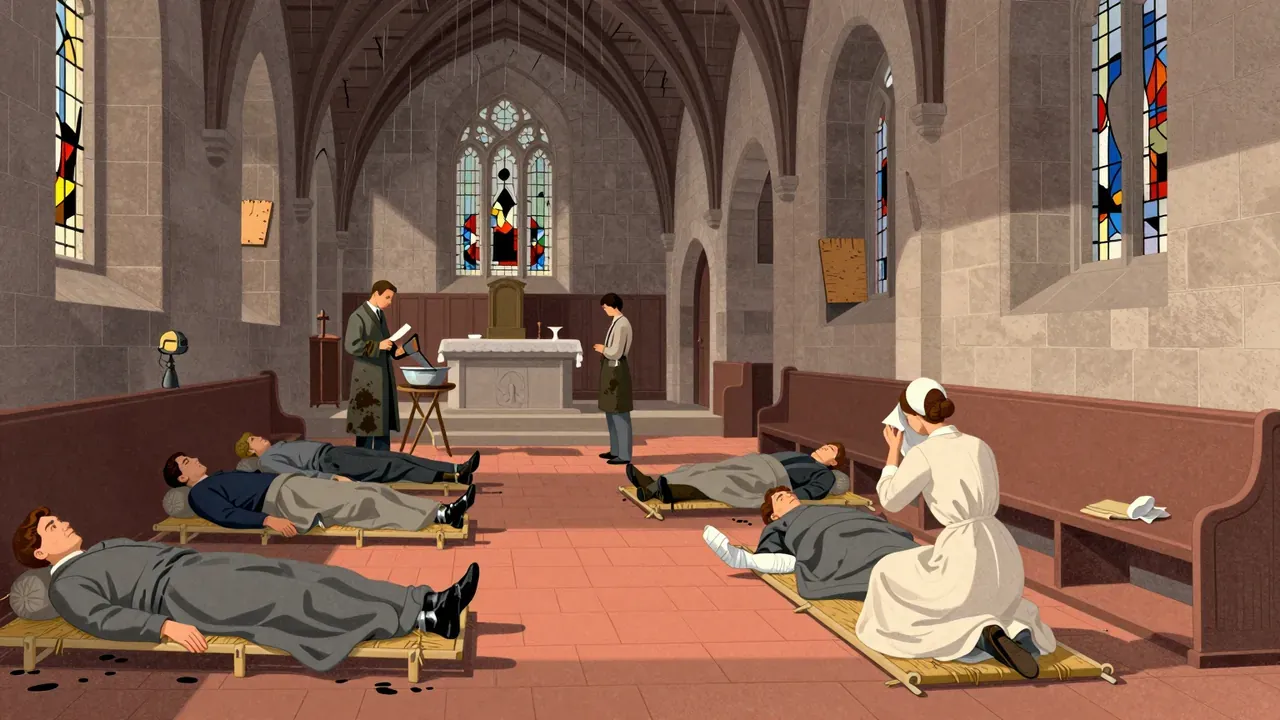
What lands most firmly is the film’s refusal to separate horror from routine. The trench collapse, the friendly-fire incident, the drowning soldier — none are framed for shock value alone, but as consequences of proximity, poor visibility and exhausted command. The hospital sequence inside a gutted church works because it shows injury without commentary: limbs wrapped in stained gauze, nurses wiping brows with the same cloth used on three men, doctors performing amputations while standing. The final image — Karl’s hand protruding from his shroud, grasped by a French soldier — lands not as sentiment but as quiet, physical fact: two bodies in identical positions, identical wounds, identical stillness. Even the title card ‘The End?!’ avoids irony; it reads as punctuation, not question — a full stop followed by ellipsis. These moments gain force from restraint: no music swells, no close-up lingers, no voiceover interprets. The film trusts the viewer to register what is shown, not what is told. Word count: 147
Where it slips
What does not land is the domestic interlude with Karl’s wife and the butcher’s son. Shot in softer light and tighter framing than the trenches, it feels narratively isolated — a subplot inserted to supply motive rather than deepen character. Karl’s return to the front carries little emotional weight because his home life is sketched, not inhabited: we see his mother’s face once, his wife’s betrayal in a single glance, the butcher’s son’s smirk in profile. Similarly, Yvette exists only as a brief counterpoint to mud — her scenes lack texture, her presence serving thematic contrast rather than dramatic function. The Lieutenant’s descent into madness, though visually stark, relies on repetition — shouting ‘Hurrah’ — without prior psychological groundwork. His breakdown reads less as consequence than convention, a shorthand for shell shock that other characters do not share. These passages do not fail because they are poorly made, but because they operate on a different register: symbolic where the rest is observational, illustrative where the rest is accumulative. Word count: 149
What it says
The themes that matter are not patriotism or sacrifice but erosion — of language, of hierarchy, of self. Rank dissolves in the mud: the Lieutenant salutes corpses; the Student, lowest in status, saves the group twice. Time distorts: rest days blur into frontline hours; fever dreams merge with memory. The film treats identity as provisional — a name on a dog tag, a uniform patched with different cloth, a hand emerging from mud indistinguishable from any other. It is also a film about listening: not to orders, but to what sound reveals — the hollow echo in a collapsed trench, the uneven breathing of a wounded man, the silence after an artillery barrage ends and no one moves. This is not anti-war as argument, but anti-war as sensory record: the way cold seeps into boots, how mud sucks at boots, how a man’s last words are swallowed by rain. These are not metaphors. They are conditions. Word count: 146
Who it’s for
This film is for viewers who tolerate extended discomfort without narrative reward, who value precision over catharsis, and who accept that some films document rather than persuade. It suits those familiar with Weimar cinema’s visual grammar or with First World War history as lived experience, not myth. It is not for viewers seeking character arcs, emotional resolution or even clear cause-and-effect — Karl’s wife’s infidelity is presented as fact, not drama; the Student’s death is off-screen, unremarked. Those who expect pacing shaped by modern editing conventions will find its long takes and static hospital shots testing. Some historians may object to its compression of 1918’s final months into episodic vignettes, though the film makes no claim to chronicle. A viewer wanting clarity on tactics, politics or national context will leave unsatisfied — this is a film about being inside a body under fire, not about why the fire began. Word count: 149
Is it worth your evening
Yes, it is worth your evening — but only if you approach it as a historical artefact first, a drama second. Its power lies in its material specificity: the grain of 1930 film stock, the timbre of early German sound recording, the weight of wool uniforms soaked through. It repays attention not because it entertains, but because it insists on duration — ninety-seven minutes of accumulated weariness that cannot be skimmed. Those who watch it expecting All Quiet’s narrative sweep or Milestone’s pacing will feel short-changed. But anyone willing to sit with its rhythms, to notice how Wagner lights a trench wall not for beauty but for depth of shadow, or how Pabst holds on a nurse’s hands washing blood from a stump — that viewer will find it singular. It is not enjoyable. It is necessary. Word count: 148