The premise
The Hurt Locker is a war film set in Iraq during the 2004 insurgency, centred on a U.S. Army Explosive Ordnance Disposal (EOD) team. It does not seek to explain the war’s politics, justify its conduct or trace its origins. Instead, it narrows its focus to the physiological and psychological immediacy of defusing roadside bombs — the seconds-long decisions, the weight of the suit, the heat, the silence before detonation, the way stress reshapes perception and erodes trust between men who must rely on each other absolutely. The screenplay, written by Mark Boal after embedded time with an EOD unit, treats the conflict as environment rather than subject: the war is the air the characters breathe, not the argument they make. Kathryn Bigelow directs with a commitment to procedural fidelity and sensory immersion, avoiding exposition, voiceover or flashbacks. The film’s ambition is singular: to render the embodied experience of high-stakes, repetitive danger — not as spectacle, but as rhythm, repetition, fatigue and compulsion. It is less about why the soldiers are there than how they remain functional, minute by minute, under conditions that systematically degrade attention and judgment.
The look of it
It works through accumulation: three tightly framed characters, each defined by a distinct response to threat — James’s hyperfocus bordering on addiction, Sanborn’s vigilance hardening into suspicion, Eldridge’s fraying composure. Anthony Mackie and Brian Geraghty ground their roles in physical restraint and micro-tension; Jeremy Renner’s performance is calibrated to feel both unnervingly calm and quietly unmoored. Barry Ackroyd’s handheld camerawork stays close, often inside helmets or behind shoulders, refusing distance or editorial framing. Sound design dominates — the hiss of radio static, the thud of boots on tarmac, the low thrum of distant gunfire — while Marco Beltrami’s score remains sparse, entering only when silence would be louder. Chris Innis’s editing sustains unease through asymmetrical cuts and withheld resolutions: a bomb disposal sequence may end not with relief but with a new alert, a new location, a new face in the crowd. The Jordan shoot — 44 days at 49°C, using real military equipment from the Royal Jordanian Army after U.S. DoD cooperation collapsed — feeds directly into the texture: sweat, dust, grit, and exhaustion are not simulated but documented.
The rhythm
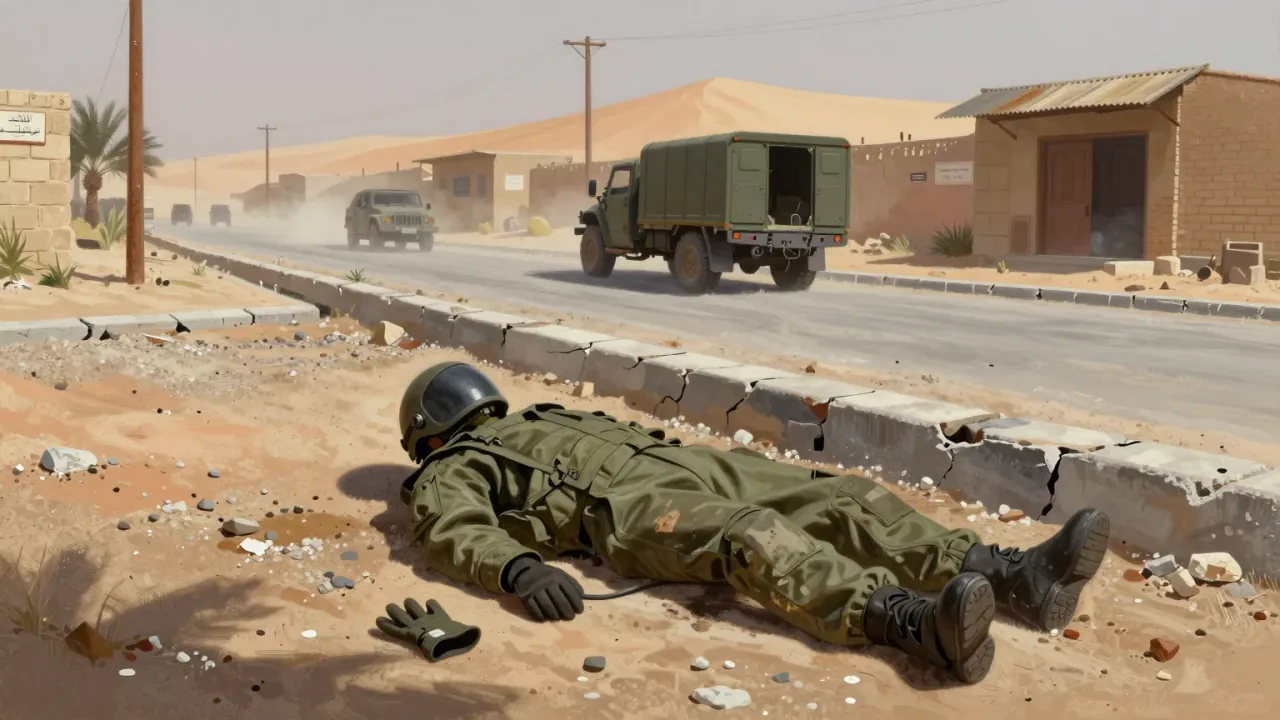
What lands is the relentlessness of proximity. The film makes the viewer feel the weight of the bomb suit, the delay between command and action, the way a single misjudged step can collapse a ten-minute sequence into catastrophe. Its most effective scenes — the market sniper standoff, the convoy ambush, the final foot patrol — do not hinge on plot twists but on escalating uncertainty, where every civilian could be armed, every glance could signal intent, and every decision carries irreversible consequence. The performances land because they avoid heroism or breakdown in favour of granular, habituated responses: Sanborn checking his watch mid-crisis, Eldridge’s hands shaking just once before he steadies them, James removing his helmet not in triumph but in slow, ritualistic exhaustion. The authenticity of the setting — the cracked concrete, the heat-haze distortion, the Arabic signage blurred by lens flare — does not serve realism as an end but as pressure: it compresses the frame, limits escape, and forces attention inward, onto the men and their choices. This is not a film about victory or meaning, but about endurance as a nervous system response.
The gap
What does not land is the film’s attempt to treat its central character’s psychology as enigmatic rather than explained. Staff Sergeant William James’s compulsive risk-taking is presented as innate, almost biological, but the script offers no grounding in trauma, training, or prior history — only repeated assertion of his ‘addiction’ to danger. This flattens him into archetype rather than person, making his final solo mission feel less like culmination and more like narrative convenience. The film also avoids any sustained engagement with Iraqi civilians beyond functional roles: bystanders, suspects, victims. Suhail Dabbach’s character — the man strapped with explosives — is powerfully rendered in the moment, but the film does not extend that empathy to context, motive or consequence. Some veterans have called this omission not just dramatic shorthand but ethical evasion: the war appears as a series of hostile environments, not as a human landscape with political, social and historical dimensions. The film’s refusal to name or interrogate the occupation leaves its moral architecture incomplete — compelling as tension, thin as reckoning.
The weight
The themes that matter are compulsion, containment, and the erosion of self under sustained threat. The bomb suit is both literal and metaphorical: it isolates, insulates, distorts perception, and becomes a second skin — so much so that removing it feels like exposure, not relief. The film traces how repeated exposure to extremity recalibrates normalcy: silence becomes alarming, stillness feels dangerous, routine feels hollow. It is less about courage than about calibration — how the nervous system resets its baseline when adrenaline is the default state. Another theme is the fragility of unit cohesion: trust is earned in seconds, broken in glances, and reassembled only through shared, unspoken labour. There is no grand statement about war’s futility or necessity; instead, the film suggests that for some, the battlefield becomes the only place where attention, purpose and consequence align with absolute clarity — and that this alignment may be incompatible with civilian life. That ambiguity — whether this clarity is pathology or precision — is the film’s quiet, unresolved centre.
The audience
It is for viewers who value procedural rigour over exposition, who respond to physical storytelling and sustained atmospheric pressure, and who accept that a war film need not offer moral resolution to be ethically engaged. It is not for those who require clear character arcs, contextual grounding, or narrative closure — particularly those seeking historical explanation, political critique or cultural portraiture of Iraq. Veterans who have criticised the film as ‘absurd’ or ‘nonsensical’ do so not because of technical inaccuracy but because its narrow focus omits the logistical, bureaucratic and communal realities of deployment — the boredom, the paperwork, the long-term relationships with interpreters and local units. A viewer who values those dimensions may find the film reductive. But for those willing to sit within its tightly circumscribed frame — to feel the heat, hear the static, wait for the click — it delivers an experience few other films replicate with such consistency and control.
The duration
Yes, it is worth your evening — not as entertainment but as immersion. Its 131 minutes pass without lull because the film refuses to release attention: every shot serves proximity, every edit tightens the frame, every sound pushes the viewer closer to the threshold of panic. It rewards patience with cumulative effect — the tension does not spike and drop but accumulates, plateaus, then surges again. Those who dislike it tend to do so on grounds of emotional austerity or thematic narrowness, not craft failure. Its power lies in what it withholds: no backstory, no epilogue, no verdict. What remains is the body in extremis — breathing, sweating, deciding, surviving. To dismiss it as ‘just a thriller’ misunderstands its method: it uses thriller grammar to conduct a study in human adaptation. If you want a film that asks you to inhabit a state rather than follow a story, this one earns its duration. It does not ask for agreement — only presence.