The look of it
Rome, Open City is a war drama made in Rome within six months of the Nazi withdrawal, using scavenged film stock, damaged studio facilities, and mostly non-professional actors. It attempts to render the moral texture of daily life under occupation—not as spectacle or allegory, but as immediate, unvarnished pressure: fear of betrayal, the weight of silence, the exhaustion of resistance, the collision of faith and ideology in cramped apartments and rain-slicked streets. Its aim is not historical documentation nor political argument, but ethical witness: to show how ordinary people hold themselves upright when institutions collapse, when law is replaced by arbitrary force, and when survival demands choices that leave no clean conscience. It does not reconstruct 1944 Rome for accuracy’s sake; it re-occupies it, with the rawness of lived memory still in the actors’ voices and the grain of the emulsion. The film’s urgency comes from its making—no budget, no permits, no safety net—and its subject: the moment just before liberation, when hope is indistinguishable from dread. It treats Catholicism, communism, motherhood, addiction and collaboration not as positions on a board, but as conditions endured in real time, under real threat.
The shape of the story
The story moves through intersecting lives bound by proximity and peril: a Resistance leader hiding in plain sight, a priest who administers sacraments and smuggles messages, a pregnant woman whose scream halts a convoy, a nightclub singer undone by dependency and coercion. Performances are uneven by design—Aldo Fabrizi’s Francesco carries the quiet gravity of a man used to command; Anna Magnani’s Pina erupts with a physicality that feels less acted than summoned. Ubaldo Arata’s cinematography uses three distinct film stocks—Ferrania C6 outdoors, Agfa Super Pan and Ultra Rapid indoors—resulting in shifts of contrast, grain and tonal consistency that were once mistaken for error but now read as documentary texture. Eraldo Da Roma and Jolanda Benvenuti’s editing favours long takes and abrupt cuts alike, often holding on faces after dialogue ends. Renzo Rossellini’s score is sparse, functional: strings and piano used only where silence would feel like evasion. There is no establishing shot of St Peter’s until the final frame; the city is felt through doorways, stairwells, and the sound of boots on cobblestones.
What stays with you
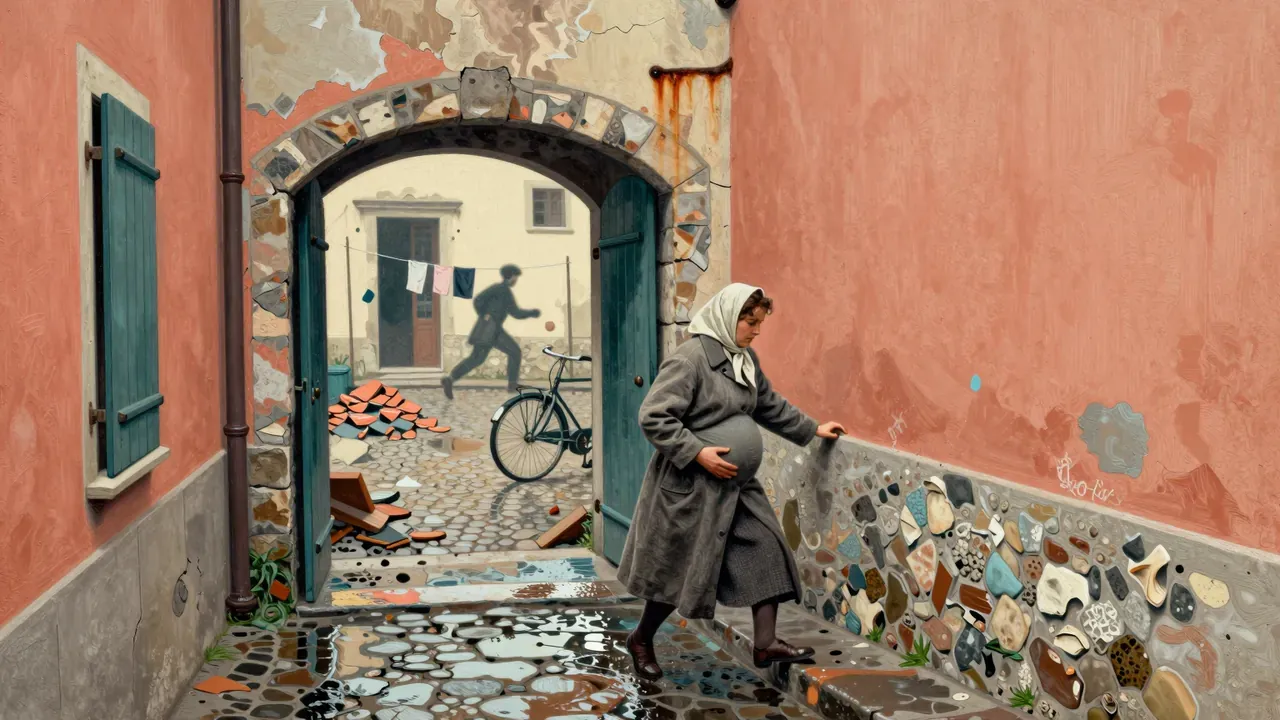
What lands is the cumulative weight of small, irreversible decisions: Pina breaking through the cordon, Don Pietro staying behind to erase weapons while pretending to administer last rites, Marina accepting the fur coat knowing what it costs. These moments land because they are not dramatised for effect—they are filmed at eye level, without music, often without close-ups, and almost always without explanation. The execution scene works not because of its staging but because of its duration: the delay in the firing squad’s compliance, the boy whistling, the slow walk to the wall, the dome in the distance. The film’s moral clarity does not come from simplification—it comes from refusing to let characters off the hook, including the priest, whose faith is tested not by doubt but by complicity in a system he serves while undermining it. Even the Nazis are not caricatured: Bergmann speaks Italian fluently, cites scripture, offers Don Pietro a cigarette. The film lands where it trusts the audience to sit with discomfort, to register grief without catharsis, to understand courage as continuity—not heroism, but showing up again after you’ve been broken.
Where it stumbles
What does not land is the structural reliance on melodramatic binaries—good communist versus corrupt fascist, pure believer versus compromised sinner—when the film’s own texture undermines them. Marina’s descent into addiction and betrayal is sketched in shorthand: her nightclub past, Ingrid’s coercion, the sudden switch to treachery. It reads less as psychological inevitability and more as narrative necessity, a device to accelerate the plot rather than deepen it. Similarly, Luigi Ferraris remains abstract: we see his resolve, but not his thought, his doubts, or even his face for long stretches. The script gives him speeches about duty, but no private hesitation. The film’s improvisational method—shooting without full script, adapting to shortages—leaves some relationships underdeveloped: the bond between Don Pietro and Luigi feels theological rather than personal, their conversations more catechism than conversation. A viewer attuned to interiority may find the film’s moral architecture persuasive but its emotional architecture incomplete. It shows suffering clearly, but not always its inner weather.
What it is really about
The themes that matter are fear as a shared condition, not a flaw; faith as practice, not doctrine; and resistance as collective habit, not individual virtue. The film treats Catholicism not as dogma but as ritual scaffolding—the rosary beads passed hand to hand, the whispered Latin over a dying man, the altar boys whistling a partisan tune. Communism appears not as theory but as solidarity: shared bread, hidden radios, names written on scraps of paper. Class is rendered materially: the difference between Marina’s smudged lipstick and Pina’s threadbare coat, between Bergmann’s leather gloves and Don Pietro’s worn cassock. The film’s central tension is not between fascism and freedom, but between two forms of endurance: one enforced by terror, the other sustained by mutual obligation. Even the title—‘open city’—is bitterly ironic: Rome was declared open to avoid bombing, yet its citizens remained closed in, watched, starved, silenced. The film’s lasting concern is not victory, but what survives defeat: dignity in small gestures, continuity in ritual, memory in whistle tunes.
Who it is for
This film is for viewers who accept that moral seriousness need not require polished performances or seamless structure—that history’s weight can be carried in a single unbroken take of a woman running down stairs, or in the way light falls across a cracked plaster wall. It is for those who value craft born of constraint: editing shaped by shortage, sound design limited to ambient street noise, acting drawn from lived experience rather than rehearsal. It is not for viewers who require psychological exposition, narrative symmetry or resolution that feels earned rather than imposed. Those who expect character arcs or thematic closure will find the ending abrupt, the motivations opaque, the pacing uneven. A viewer trained on classical Hollywood continuity or contemporary streaming pacing may misread its hesitations as flaws, not features. To change that verdict, the film would need either a fuller script—or a different audience, one accustomed to reading meaning in silence, grain, and gesture rather than exposition and score.
Why it lasts
Yes, it is worth your evening—not because it entertains, but because it recalibrates attention. Its 100 minutes do not pass lightly; they accumulate like sediment, layering image, sound and silence until the final shot of St Peter’s dome feels less like a symbol than a fact: something enduring, indifferent, visible. It asks for patience with its roughness, its repetitions, its unresolved tensions—and repays that patience with a rare kind of honesty about collective endurance. Anyone who has ever waited for news, held their breath in a room full of strangers, or made a choice knowing it would cost them something, will recognise the film’s terrain. It is not easy viewing, but it is necessary viewing—not as history lesson, but as calibration: a reminder that cinema can be a vessel for moral gravity without rhetoric, and that some films earn their place not by pleasing, but by persisting.