The look of it
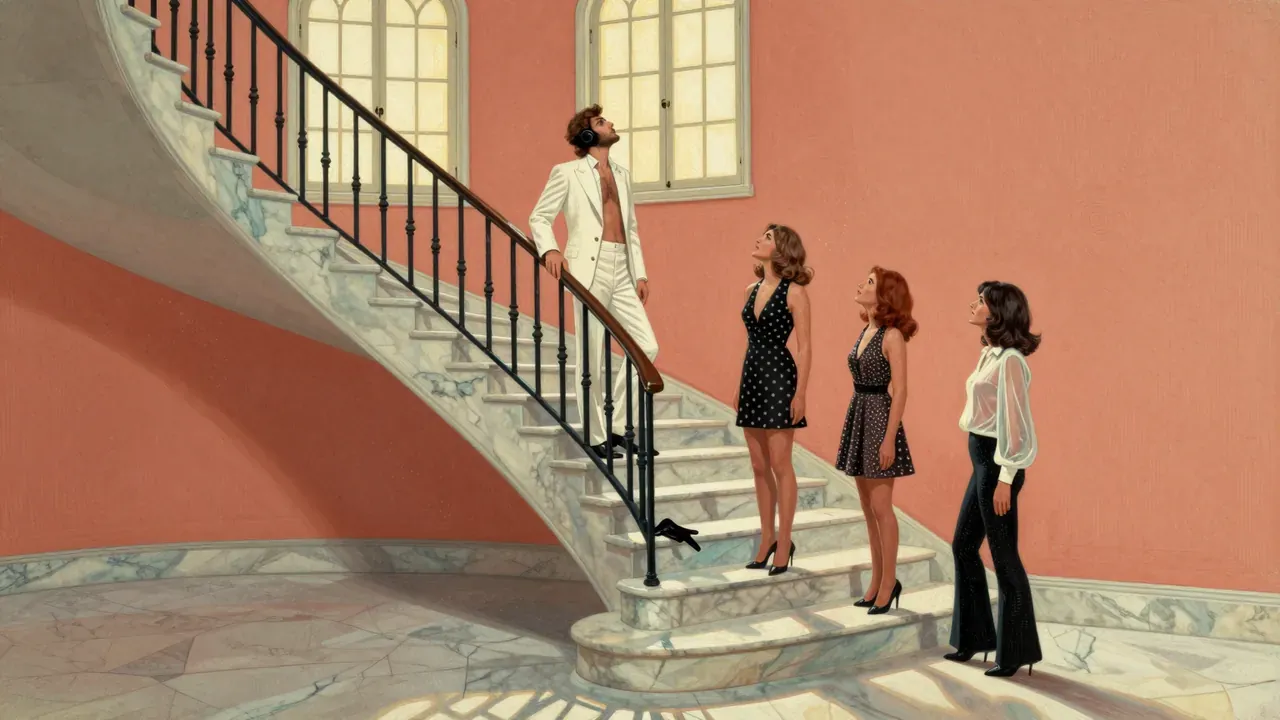
The Girl Can’t Help It is a studio-made musical comedy designed to exploit the commercial rise of rock ’n’ roll while packaging it inside a satirical Hollywood farce. It does not attempt realism, nor does it aim for character depth or social critique in the manner of later musicals; instead, it treats rock as spectacle, advertising as absurdity, and stardom as a series of visual gags. Frank Tashlin — a former animator — directs with a cartoonist’s sense of timing and spatial exaggeration: characters freeze mid-gesture, sets tilt, lighting shifts abruptly, and dialogue is often secondary to movement or costume. The film was conceived as a vehicle for Jayne Mansfield, then newly signed to 20th Century Studios, but Tashlin retooled Garson Kanin’s original story to foreground music acts over narrative coherence. Its ambition is not to explain rock ’n’ roll but to stage it — repeatedly, urgently, and in full colour — as both commodity and contagion. It assumes its audience knows the difference between a jukebox and a slot machine, and that they’ll recognise the joke in casting a mobster who composes prison ballads. Word count: 148
The rhythm of it
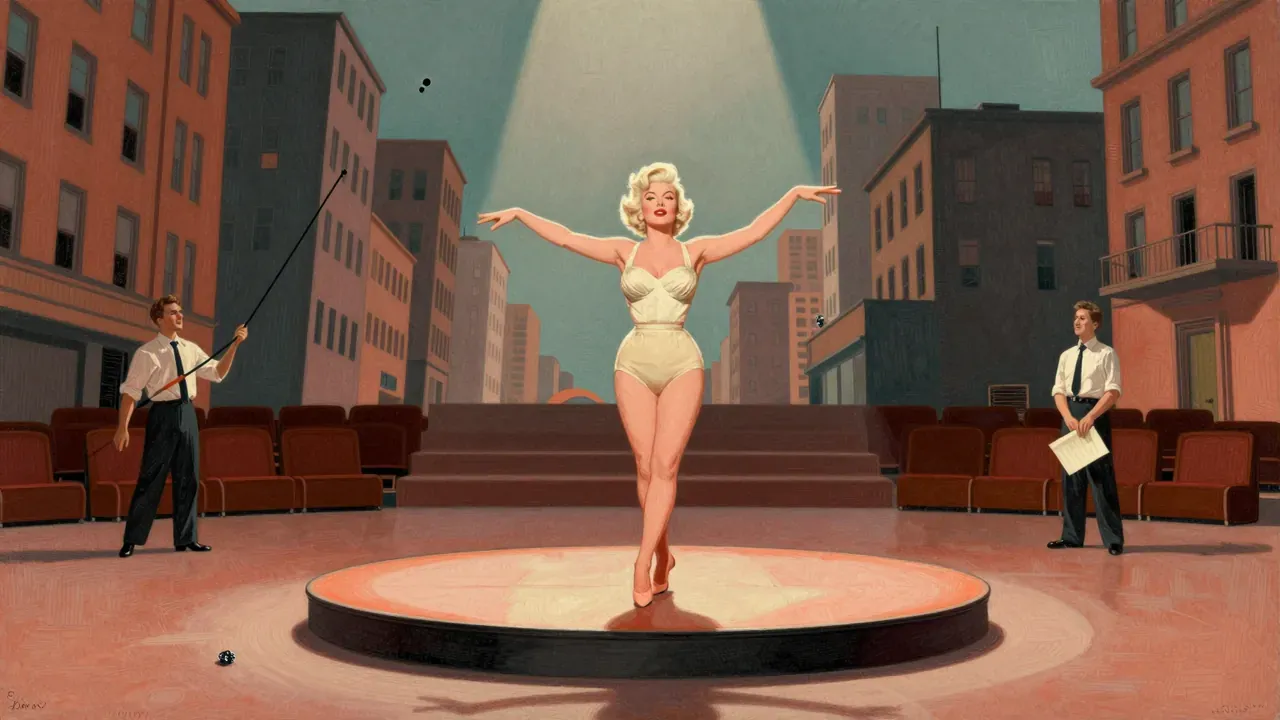
The plot follows Tom Ewell as a cynical press agent hired to launch Jayne Mansfield’s character as a singer despite her lack of talent — a premise that allows the script to pivot constantly between deadpan irony and slapstick. Ewell delivers his lines with hangdog timing, Mansfield plays Jerri Jordan with deliberate vacancy and physical precision, and Edmond O’Brien’s mobster Marty Murdock moves through scenes like a live-action Looney Tunes villain. Leon Shamroy’s DeLuxe Color cinematography keeps saturation high and contrast sharp, favouring bold blocks of red, gold and turquoise; costumes are loud, sets are stylised, and every musical number is framed like a poster. Bobby Troup’s score is functional rather than inventive, though the title song — performed by Little Richard — lands with unvarnished force. Editing by James B. Clark maintains brisk pacing, cutting away from exposition to performance without transition. The film’s craft is unified: all departments serve the same logic — that image, rhythm and repetition matter more than motivation or consequence. Word count: 152
The sound of it
What lands is the sheer density of musical performance. Little Richard’s ‘The Girl Can’t Help It’, Gene Vincent’s ‘Be-Bop-A-Lula’, Fats Domino’s ‘Blue Monday’, and The Platters’ ‘Only You’ are not background filler but structural anchors — each appears as a self-contained set piece, shot with clarity and energy, and placed at moments where narrative momentum would otherwise stall. These sequences do not advance the plot, but they do define the film’s pulse. Mansfield’s physical presence also lands consistently: her walk, her pauses, her way of holding a microphone — all calibrated to register on screen before she speaks. The satire of publicity machinery works because it is literal: press agents really did invent personas, studios really did dub voices, and mobsters really did dabble in entertainment. Tashlin’s animation instincts show in how he treats objects — a jukebox becomes a character, a light bulb shatters on cue, a telephone wire is coiled like a spring. These are not metaphors but gags built into the grammar of the film. Word count: 149
The shape of it
What does not land is the romantic subplot between Ewell and Mansfield. Their chemistry is muted, their dialogue stiff in places, and the emotional pivot — when Mansfield reveals she can sing — arrives without buildup or psychological plausibility. The film avoids developing her character beyond surface contradiction (blonde bombshell who wants domesticity), and the resolution depends on Murdock’s sudden, unmotivated benevolence rather than earned change. Henry Jones’s supporting turn as a rival agent feels underwritten, and Julie London’s cameo lacks context or function beyond name recognition. The satire of rock ’n’ roll itself remains shallow: it mocks industry mechanics but never questions the music’s cultural weight or teenage identification with it. The film’s cartoon logic starts to fray in the final act, where assassination attempts, last-minute rescues and televised reconciliations pile up without tonal consistency. It is not that the film fails to be funny — it is that some jokes rely on assumptions no longer shared, and others depend on timing that modern pacing erodes. Word count: 157
The business of it
The themes that matter are commodification, performance, and the gap between image and agency. The film treats fame as a system of manufactured consent: Murdock buys attention, Miller sells illusion, and Jerri Jordan negotiates her own visibility by pretending incompetence. Rock ’n’ roll is not portrayed as rebellion but as product — licensed, packaged, and inserted into nightclubs and jukeboxes like any other consumer good. Advertising is the film’s true subject: every scene is a pitch, every costume a logo, every song a jingle waiting for its brand. Even the mob operates like a proto-media conglomerate, swapping violence for market share. Mansfield’s body is the central site of this transaction — displayed, measured, lit, and sold — yet the film gives her no interior life beyond that function. There is no nostalgia here, only calculation; no innocence, only positioning. The film’s enduring interest lies in how early it recognised celebrity as infrastructure rather than personality — a network of cameras, contracts, and playback devices, all humming in the same key. Word count: 151
The audience for it
It is for viewers who value stylistic cohesion over psychological realism, who enjoy mid-century American design and want to see rock ’n’ roll performers in unmediated, pre-TV variety-show contexts, and who respond to visual wit over verbal dexterity. It is not for those who require narrative causality, character development, or thematic subtlety — the film’s satire is broad, its emotions schematic, and its politics implicit rather than argued. Anyone expecting a biographical portrait of Mansfield or a documentary account of rock’s emergence will find it thin. Those put off by studio-era artifice or uncomfortable with the film’s treatment of female agency may find its pleasures inaccessible. Its appeal narrows further for viewers unfamiliar with the performers: Little Richard’s charisma reads differently without knowledge of his contemporaneous chart dominance. A viewer who values authenticity over exuberance, or sincerity over staging, would likely leave unmoved. Word count: 150
The time for it
Yes, it is worth your evening — provided you watch it as a time capsule of aesthetic intention rather than as a narrative whole. Its ninety-three minutes pass briskly, its colours hold up, and its musical interludes retain visceral impact. It rewards attention to framing, costume, and editing rhythm more than to dialogue or motivation. Those who dislike it tend to judge it by standards it never claims — dramatic credibility, moral complexity, or historical accuracy — and would prefer something like Rock Around the Clock or Blackboard Jungle instead. What would change the verdict is if the film were approached as a choreographed exhibition of 1950s media logic: not a story about fame, but a working model of it. Seen that way, its repetitions, its flatness, its refusal of depth become features, not flaws. Word count: 150