The shape of the conflict
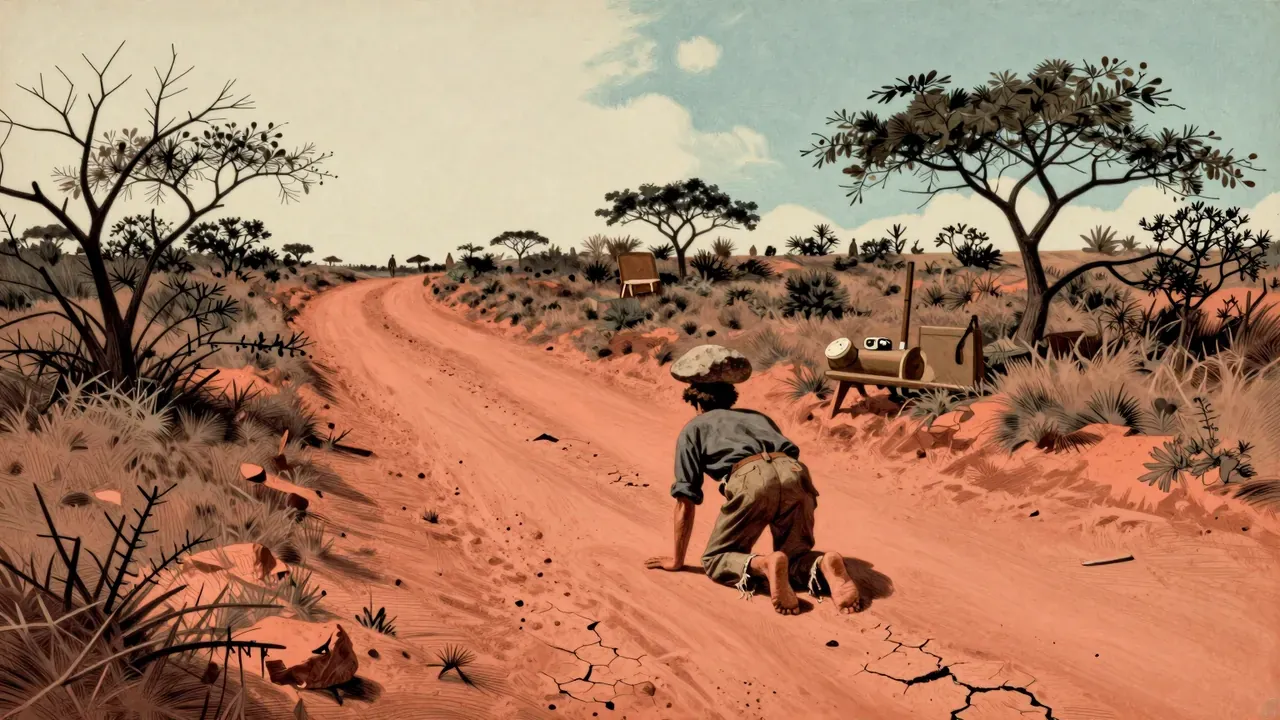
The Furies is a Western that treats the genre as a vessel for psychological and familial conflict rather than frontier action. Set in 1870s New Mexico Territory, it adapts Niven Busch’s 1948 novel to trace the mutual destruction of a cattle baron and his daughter, both defined by inherited ruthlessness and emotional austerity. Anthony Mann directs not for spectacle but for pressure: every scene tightens the coil between Vance Jeffords and her father T. C., their antagonism structured like a legal contract written in blood and land deeds. The film aims to reframe the Western’s moral binaries — law versus outlaw, settler versus native — as internal divisions within a single dynastic psyche. It does not seek realism in dress or dialect, nor authenticity in ranch management or territorial governance; instead, it builds a mythic architecture where property functions as identity, currency as character, and inheritance as curse. Its ambition lies in sustaining that architecture across 109 minutes without collapsing into melodrama or abstraction — a balance it pursues with deliberate, unblinking severity. Word count: 132
The weight of a signature
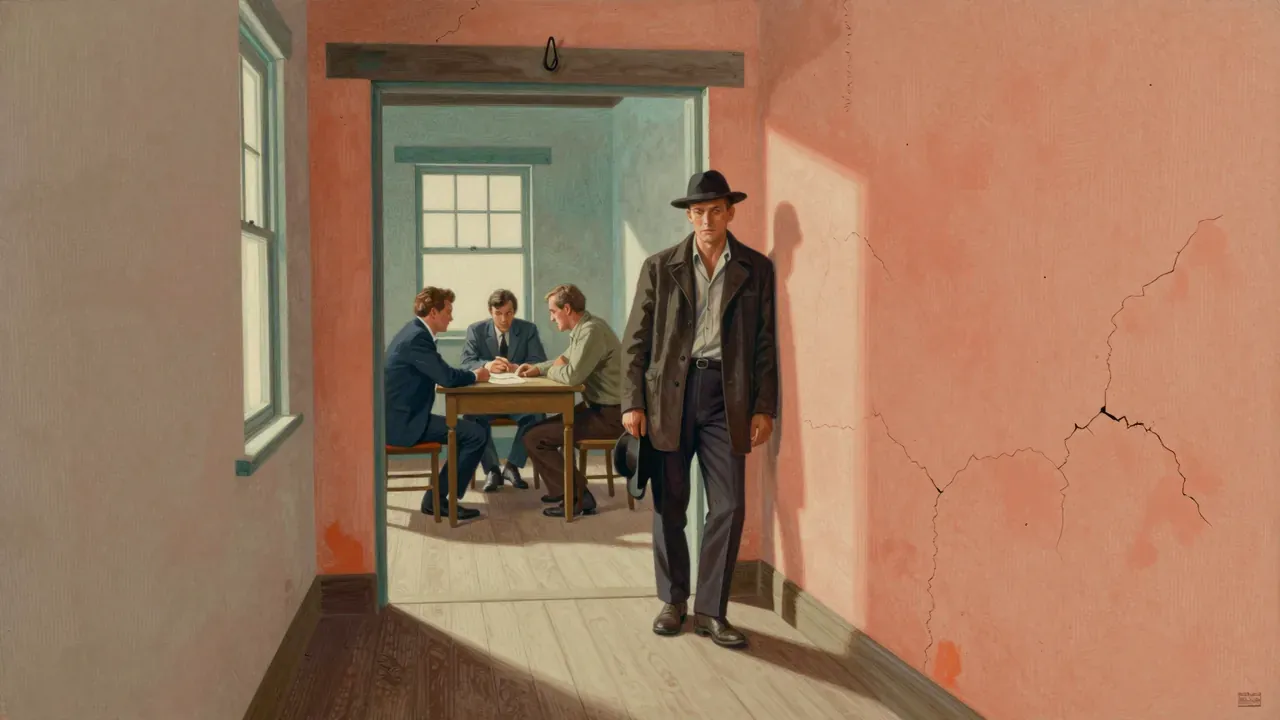
The story unfolds in three acts of escalating symmetry: domination, rupture, and inversion. Vance begins as T. C.’s heir in temperament and authority; after Flo Burnett’s arrival and the violent expulsion of the Herreras, she becomes his adversary in method and motive; finally, she outmanoeuvres him using his own instruments — paper money, legal pretence, public humiliation. Barbara Stanwyck holds the film with physical precision: her posture, gaze, and stillness convey control long before dialogue confirms it. Walter Huston, in his final role, gives T. C. a weary, almost ceremonial arrogance — less villain than force of nature, measured in acres and autographs. Victor Milner’s cinematography avoids the sun-bleached grandeur typical of Westerns; interiors are dense and shadowed, exteriors deliberately flat and unromantic. Franz Waxman’s score leans into dissonance and brass-led tension, avoiding folk motifs. Archie Marshek’s editing sustains a slow, judicial rhythm — no cross-cutting urgency, no montage flourish. Word count: 147
The crate of worthless notes
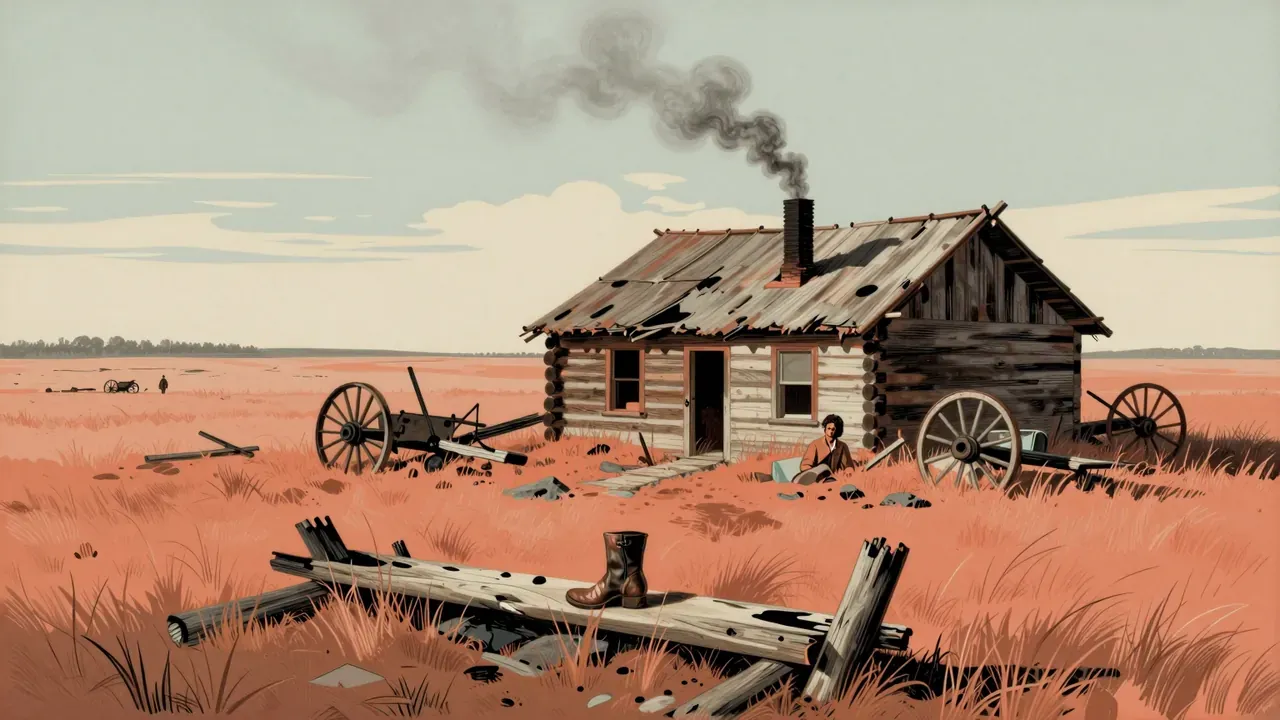
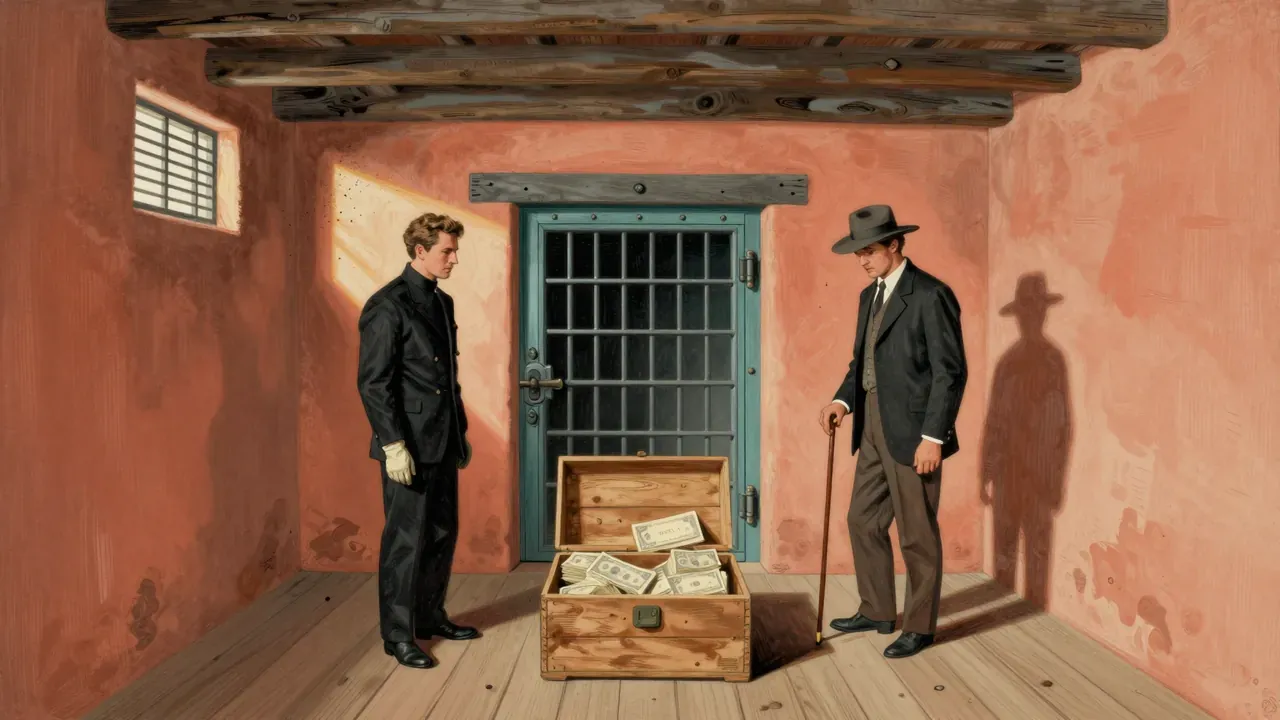
What lands is the film’s central inversion: that vengeance is not cathartic but recursive, and that winning a war against one’s father leaves no territory to inhabit. The bank sequence — where Vance presents T. C. with a crate of his own devalued notes — works because it is both literal and symbolic, grounded in the film’s established logic of value-as-performance. The earlier confrontation with Flo Burnett lands not for its violence but for its refusal of moral framing: Vance throws the scissors not in passion but calculation, and the disfigurement is treated as consequence, not punishment. The final image — T. C. burning his currency while walking arm-in-arm with Vance and Rip — lands because it refuses resolution: there is no reconciliation, only shared exhaustion and the quiet inevitability of death. Even the Herrera mother’s killing shot feels less like justice than punctuation — an act that closes the sentence but does not answer the question. These moments succeed because they follow the film’s own grammar, never straining for emphasis or explanation. Word count: 142
The man who walks beside her
What does not land is the film’s attempt to position Rip Darrow as a moral counterweight. Wendell Corey’s performance lacks the volatility or ambiguity the script requires; he reads as passive rather than pragmatic, and his pivot from bribe-taker to co-conspirator feels unearned. The subplot involving the Herreras’ resistance — particularly the Pinnacles fight — is visually coherent but emotionally detached: the stakes remain abstract because the film invests little time in Juan Herrera beyond his function as Vance’s childhood anchor and political foil. Judith Anderson’s Flo Burnett is sharply drawn but under-served by the script’s refusal to explore her motives beyond transactional greed. The film’s Freudian label sticks only if one accepts that repression needs no subtext — here, desire and resentment are spoken plainly, leaving little room for unconscious tension to breathe. The Western setting, meanwhile, remains largely ornamental: the landscape serves as backdrop, not participant, and the territorial politics of New Mexico in the 1870s are elided entirely. Word count: 148
What burns outside the bank
The themes that matter are inheritance as compulsion, wealth as self-portraiture, and power as a language passed down like a dialect. The film treats land not as resource but as extension — the Furies ranch is less property than bodily organ, and its transfer is less succession than amputation. Vance’s campaign to buy up T. C.’s ‘T. C.’ notes is not economic sabotage but linguistic erasure: she replaces his signature with her own agency, turning his symbol of control into evidence of collapse. The film also treats marriage as annexation — Flo Burnett seeks it as title deed, Rip negotiates it as lease agreement, and Vance rejects it until it can be rewritten as partnership. There is no redemption arc, no moral recalibration: the characters do not change, they escalate. Even grief is transactional — Vance buries her father not as daughter but as executor. The film’s preoccupation is not with righting wrongs but with tracing how wrongs replicate themselves across generations, through gesture, syntax, and the quiet ritual of signing one’s name on paper. Word count: 146
Who watches this film
This film is for viewers who treat genre as scaffolding, not costume — those who watch Westerns for their architecture of power, not their dust storms. It rewards patience with structural rigour, and rewards attention to composition over plot turns. It is not for viewers who require narrative momentum, emotional release, or moral orientation; those seeking clarity of motive or closure will find the film withholding. Anyone expecting the mythic sweep of Shane or the kinetic drive of Red River will feel stranded in its stillness. Nor is it for those who need historical texture: the New Mexico setting is generic, the period details functional. A viewer who values psychological precision over action, or thematic density over exposition, will find it rich. Someone who finds Stanley Kubrick’s Barry Lyndon too slow may still find The Furies intolerably austere. Word count: 142
Is it worth your evening
Yes, it is worth your evening — but only if you accept its terms: no relief, no diversion, no reassurance. It demands sustained attention to tone and gesture, and repays that attention with a portrait of familial entanglement that feels neither dated nor allegorical. Its 109 minutes pass without hurry, yet nothing is wasted: every line, glance, and cut serves the central equation of power and blood. Those who dislike it tend to cite its coldness — Niven Busch called Stanwyck ‘poorly directed’, and modern critics sometimes mistake its restraint for emptiness. What would change the verdict? A stronger Rip Darrow, or deeper integration of the Herrera storyline, might open the film’s emotional register without compromising its discipline. But as it stands, its austerity is its argument — and that argument holds. Word count: 140