The look of it
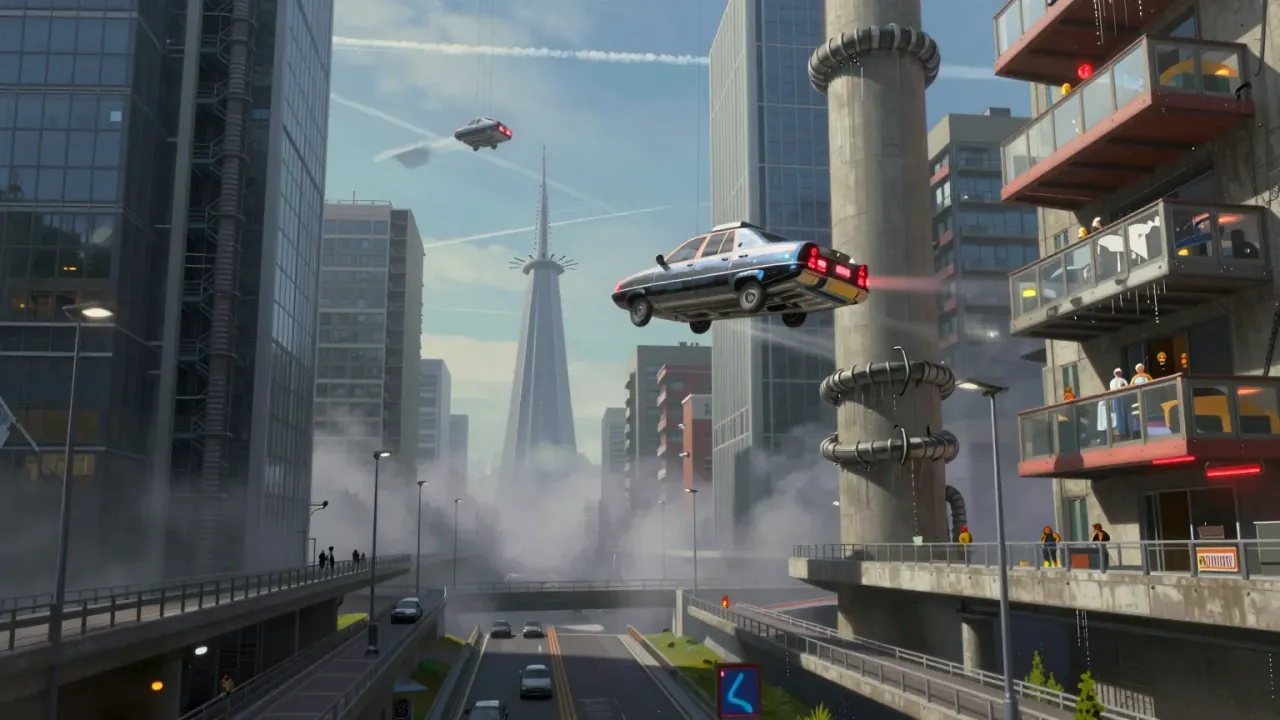
The Fifth Element is a French science-fiction film conceived by Luc Besson over two decades and released in 1997 as an English-language production. It attempts a maximalist, cartoon-logic reimagining of the genre: not a speculative extrapolation of technology or society, but a densely layered visual and tonal pastiche — part pulp serial, part opera, part fashion show, part Saturday-morning cartoon — built around a mythic structure of elemental guardianship and cosmic threat. Its ambition is stylistic sovereignty: to replace sci-fi’s habitual gloom with saturated daylight, cluttered verticality, and rhythmic absurdity; to treat worldbuilding as costume design, architecture as illustration, and dialogue as rhythmic punctuation rather than exposition. It seeks no realism, psychological depth, or thematic subtlety — only coherence within its own self-declared logic, where physics bends to choreography and narrative urgency serves spectacle. The film’s central proposition is that futurism need not be austere or anxious; it can be loud, tactile, gender-fluid, and unapologetically decorative. That proposition is embedded in every frame, every costume sketch, every flying cab trajectory — not argued, but enacted.
The way people move in it
The story follows Korben Dallas, a New York taxi driver and ex-soldier, who becomes entangled with Leeloo, a genetically perfected being revived from ancient stasis, and must help her recover four stones to repel a cosmic entity. Bruce Willis plays Dallas with deadpan minimalism, anchoring the chaos with physical stillness; Milla Jovovich gives Leeloo a feral, pre-verbal intensity, speaking a constructed language of 400 words. Gary Oldman’s Zorg is all clipped menace and bureaucratic evil, though he shares no scenes with Willis — a deliberate separation of poles. Chris Tucker’s Ruby Rhod is pure vocal performance, a gender-bending media oracle whose flamboyance clashes deliberately with the film’s otherwise grounded action. Thierry Arbogast’s cinematography favours wide lenses, high-key lighting, and fluid tracking shots across layered sets — notably the 007 Stage at Pinewood, where seven soundstages housed modular cityscapes inspired by Antonio Sant’Elia and metabolist architecture. Jean Paul Gaultier’s 900+ costumes — including Leeloo’s bandage-wrapped revival outfit and Rhod’s iridescent jumpsuits — are not background detail but structural elements, defining character before dialogue does. Éric Serra’s score alternates between synth pulses and operatic interpolation, refusing ambient mood in favour of rhythmic insistence.
What holds your eye
What lands is the film’s sheer, unrelenting visual confidence. The opening sequence — a silent, airborne chase through Manhattan’s stacked highways — establishes tone, scale, and kinetic grammar in under three minutes: no exposition, just motion, colour, and spatial logic made legible through repetition and contrast. The Fhloston Paradise opera scene works precisely because it refuses to explain itself: Diva Plavalaguna’s aria is treated as diegetic spectacle, not metaphor — the camera holds on faces reacting, not on the singer, making awe a shared, bodily response. Leeloo’s combat sequences land because they are choreographed like ballet, each movement weighted and visible, unbroken by rapid cutting. Even minor touches — the tactile grit of the Egypt-set ruins in Mauritania, the way light bounces off chrome taxicab roofs, the precise timing of Zorg’s cigarette-lighting ritual — accrue into a world that feels inhabited, not assembled. The film’s humour lands when it commits fully to its own ridiculousness: Rhod’s vanity, the Mondoshawan elders’ bureaucratic solemnity, the way a sacred stone is delivered via pneumatic tube. These are not gags; they are world-rules stated plainly, then followed without irony.
What stays just out of reach
What does not land is the emotional scaffolding beneath the spectacle. Korben and Leeloo’s relationship develops through proximity and gesture, not dialogue or revelation — which works only if the viewer accepts silence as intimacy, not absence. For many, it reads as vacancy. The script’s reliance on archetypes — the weary hero, the pure saviour, the flamboyant trickster, the corporate villain — leaves little room for contradiction or growth; characters serve functions, not psychology. The Divine Language, while linguistically coherent, remains opaque as expression — its emotional weight depends entirely on Jovovich’s physical delivery, which some find compelling, others alienating. The film’s refusal to clarify its cosmology (why four stones? why this entity? what is the ‘fifth element’ beyond Leeloo’s biology?) frustrates viewers expecting mythic logic to cohere like theology rather than folktale. And though Besson insisted on daylight, the resulting brightness occasionally flattens texture — some sets lose depth in the glare, and the colour grading, while bold, sometimes sacrifices shadow detail needed for spatial orientation. The pacing also sags in the middle act, where exposition about the Mondoshawans and the Great Evil relies on static exposition rather than integrated action.
What it believes in
The themes that matter are not those of salvation or sacrifice in the abstract, but of embodiment, translation, and cultural collision. Leeloo is not just a weapon or messiah — she is a body remade, a voice reconstructed, a consciousness reinstalled into flesh that remembers nothing but reacts to everything. Her arc is one of sensory reintegration: touch, sound, gravity, pain — all registered before language. The film treats language itself as material: the Divine Language is spoken, written, and sung as physical gesture, not semantic tool. Ruby Rhod embodies mediation — a broadcaster whose identity is performative, whose truth is audience-dependent. Zorg represents systematisation of evil: not ideology, but efficiency, contract law, and outsourcing. Even the stones are not magical artefacts but resonant frequencies — objects that work only when held in correct relation. The film’s deepest concern is how meaning is carried: in costume, in cadence, in architecture, in the angle of a glance. It asks what survives translation — across millennia, species, languages, media — and suggests the answer is rhythm, repetition, and resistance to erasure. That resistance is aesthetic first, ethical second.
Who it speaks to
It is for viewers who value worldbuilding as craft rather than allegory, who respond to costume and set design as narrative carriers, and who tolerate — even prefer — emotional restraint in service of tonal consistency. It rewards attention to texture: the weave of a jacket, the hum of a flying cab engine, the way light catches on chrome. It is not for viewers who require psychological realism, causal clarity, or thematic resolution — those will find its mythic shorthand evasive, its character arcs underdeveloped, its stakes arbitrary. Those who dislike stylisation as substance, or who expect science fiction to interrogate technology’s social consequences rather than celebrate its visual potential, will reject its priorities. A viewer who values narrative economy over spectacle, or who finds Tucker’s performance grating rather than generative, will struggle to engage. The film assumes goodwill toward its excess; without that, the density becomes clutter, not richness.
Why it endures
Yes, it is worth your evening — provided you watch it as designed: large, loud, and without expectation of naturalism. Its 121 minutes pass briskly when approached as a sustained visual and sonic argument about how futures might feel, not how they might function. It repays rewatching not for hidden plot details, but for shifts in emphasis: noticing how Gaultier’s costumes map social hierarchy, how Arbogast’s framing isolates characters within their own rhythms, how Serra’s score mirrors the pulse of traffic or breath. Those who dismiss it as shallow miss that its shallowness is structural — a refusal of subtext in favour of surface as meaning. Critics who found it emotionally vacant were not wrong; they simply prioritised a different axis of evaluation. To judge it solely on character depth or thematic rigour is to misread its contract. Its value lies in its uncompromising execution of a singular, tactile vision — one that has aged not as nostalgia, but as a benchmark for what stylised sci-fi can be.