What it is
Nikita is a French action thriller that sets out to rework the assassin-as-protagonist trope through a tightly controlled, stylistically precise lens. It does not aim for realism in its depiction of state-sponsored killing, nor does it treat its central character’s transformation as psychological realism. Instead, it constructs a fable about identity, discipline and erasure — one where a convicted criminal is unmade and remade as a weapon, then tested by the persistence of feeling. Luc Besson wrote the film with Anne Parillaud in mind, but deliberately against her known persona: shy, intellectual, untrained in violence. The project leans into artifice — from the Centre’s clinical interiors to the theatricality of Nikita’s missions — treating genre conventions not as scaffolding for plausibility but as grammar for moral ambiguity. Its ambition lies not in expanding the action film’s scope, but in tightening its syntax: every shot, edit and musical cue serves the rhythm of control and rupture. It is a film about surfaces that do not conceal but constitute meaning — a woman’s body, her name, her apartment, her lover’s ignorance, all calibrated as functional elements in a system she both serves and subverts. (159 words)
How it works
The story follows a linear, almost ritualistic arc: arrest, erasure, training, deployment, entanglement, breach, exit. Parillaud’s performance anchors it with physical precision — her stillness in repose, her sudden velocity in motion, her eyes registering fatigue before resolve. Tchéky Karyo’s Bob is all contained authority, Jeanne Moreau’s Amande a glacial mentor whose presence implies decades of similar transactions. Thierry Arbogast’s cinematography favours shallow focus and cool, even lighting; interiors are clean but never warm, exteriors crisp but drained of seasonal texture. Éric Serra’s score uses synthesised pulses and sparse piano motifs to underline tension without swelling it. Olivier Mauffroy’s editing sustains momentum without hurry — cuts land on breaths, on door handles, on rifle bolts. There is no improvisatory looseness; every scene is composed like a diagram. Even the Venice sequence — where intimacy and duty collide — avoids melodrama by holding Marco off-centre, his voice muffled behind bathroom tile, his presence felt as interruption rather than counterpoint. The craft is unified, deliberate, unshowy in its technical fluency. (158 words)
What lands
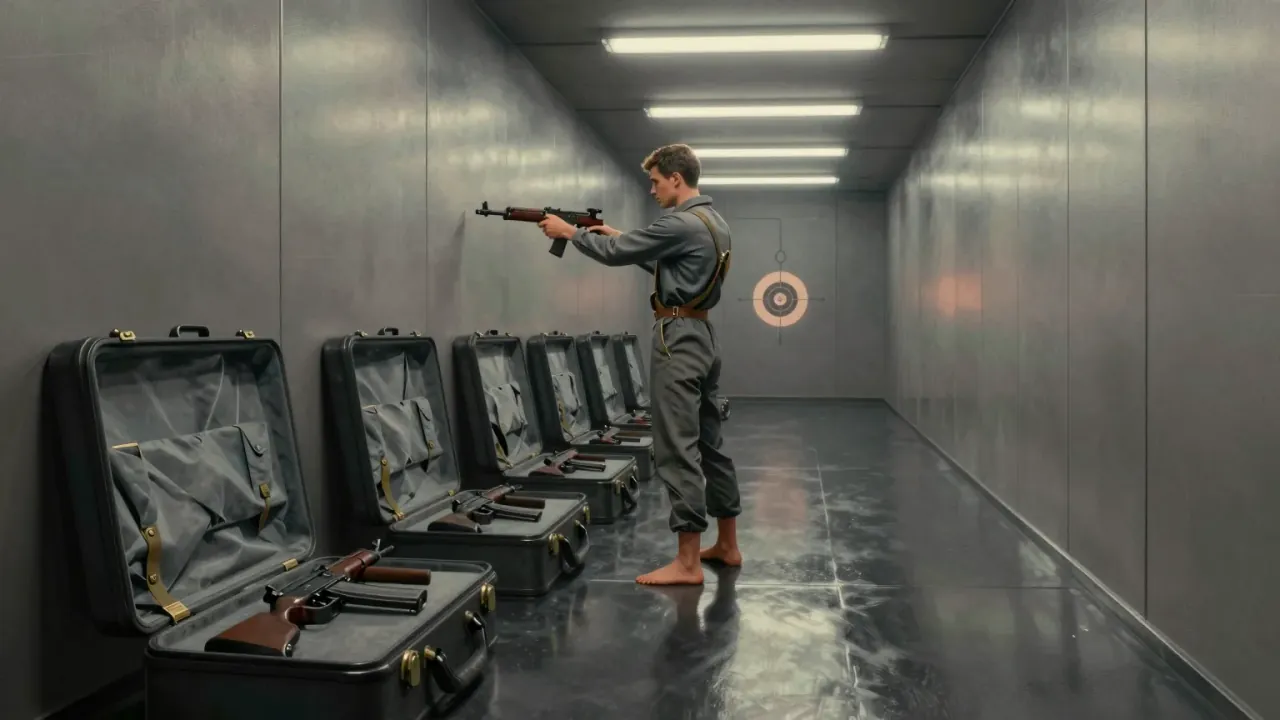
What lands is the film’s unwavering tonal discipline. Its vision of institutional control feels credible not because it mimics bureaucracy, but because it treats procedure as aesthetic: the Centre’s uniforms, the timed debriefings, the way Nikita’s hair is cut and restyled as part of her induction. Parillaud’s physical transformation — from twitching addict to poised operative — reads as earned, not magical, because the film shows repetition, not revelation: target practice, language drills, posture correction. The supermarket meeting with Marco works because it is banal, not romantic — he notices her lack of ID, not her beauty. The film’s most effective moments are procedural: Nikita assembling a rifle in a bathtub, checking angles in a mirror, adjusting her grip while water runs. These are not set-pieces but demonstrations of competence, and competence is the film’s quiet subject. Even the ending — which offers no catharsis, only departure — lands because it refuses to resolve the contradiction at the film’s core: that a person trained to erase herself cannot be reintegrated, only removed. The film trusts its own logic, and that consistency carries weight. (157 words)
What does not
What does not land is the emotional architecture between Nikita and Marco. Their relationship is sketched in gestures — shared groceries, a glance across a checkout counter — but never deepened beyond function: he exists to expose her fracture, not to complicate it. His discovery of her secret feels abrupt, his persuasion to flee under-motivated, his final handover of the embassy documents unearned. The film gives him no interior life, no history, no contradiction — he is a narrative hinge, not a character. Similarly, the Centre remains abstract: we see no hierarchy beyond Bob, no political context for its operations, no sense of why Nikita is chosen over others. The DGSE reference is ornamental, not explanatory. The film’s refusal to locate itself in a real world extends to its violence, which is bloodless and consequence-free — bodies fall silently, missions conclude without fallout. This stylisation works for mood but undermines stakes. When Victor dies, his sacrifice registers as choreography, not loss. The film’s austerity becomes a limitation when it denies its characters the friction of doubt, memory or consequence — things that would test, rather than confirm, its central thesis. (156 words)
The themes that matter
The themes that matter are erasure, performance and the cost of competence. Nikita does not become an assassin; she learns to inhabit the role so thoroughly that the distinction between self and function collapses. Her training is less about skill acquisition than about unlearning instinct — flinching, hesitation, attachment — until her body obeys before her mind consents. The film treats identity as costume, memory as liability, loyalty as protocol. Even love is rendered as misdirection: Marco’s affection is useful only insofar as it makes Nikita vulnerable enough to be tracked, then discarded. The Centre does not seek obedience but ontological compliance — a person who no longer asks why, only how. That this process is gendered is implicit but not interrogated: Nikita’s femininity is weaponised, polished, deployed, but never examined as a site of resistance or contradiction. The film’s coldness is thematic, not incidental — it insists that systems of control do not care about motive, only output. What lingers is not the violence, but the silence after it: the empty apartment, the unused passport, the grave that holds no body. These are the film’s true subjects — absences made visible. (159 words)
Who should watch it
This film is for viewers who value formal rigour over emotional exposition, who find tension in restraint rather than release, and who accept genre not as escapism but as a language for examining power. It rewards attention to composition, pacing and the weight of silence. It is not for those who require psychological plausibility, moral anchoring or relational depth — viewers who expect Marco to have a backstory, or Bob to face consequences, will find the film withholding. Those drawn to French New Wave spontaneity or 1990s American indie naturalism will find its precision alienating. The film assumes its audience understands that a thriller can be about structure, not suspense — that the real threat is not the mission, but the ease with which a person can be rewritten. Anyone expecting a feminist parable or a critique of state violence will leave unsatisfied; Nikita offers neither indictment nor justification, only demonstration. Its appeal is narrow but exact: it is for people who watch films as systems, not stories. (159 words)
Is it worth your evening
Yes, it is worth your evening — provided you approach it as a study in controlled execution, not emotional engagement. Its 117 minutes pass without drag because every frame serves its logic: no digression, no filler, no false notes. The performances are calibrated, the design consistent, the music purposeful. It does not ask for empathy but for observation — and it repays that attention with clarity. Those who dislike it tend to cite its emotional distance or political vagueness; they would prefer a film that argues, not arranges. A different verdict would follow if the film attempted more — if it gave Marco agency, or located the Centre in a real institution, or let Nikita speak her doubt aloud. But it does not. Its worth lies precisely in what it refuses: explanation, expansion, indulgence. It is a complete statement, not a draft. To dismiss it as cold is to miss that its temperature is its subject. It earns its duration by sustaining a single, unwavering pitch — and that is rare. (159 words)