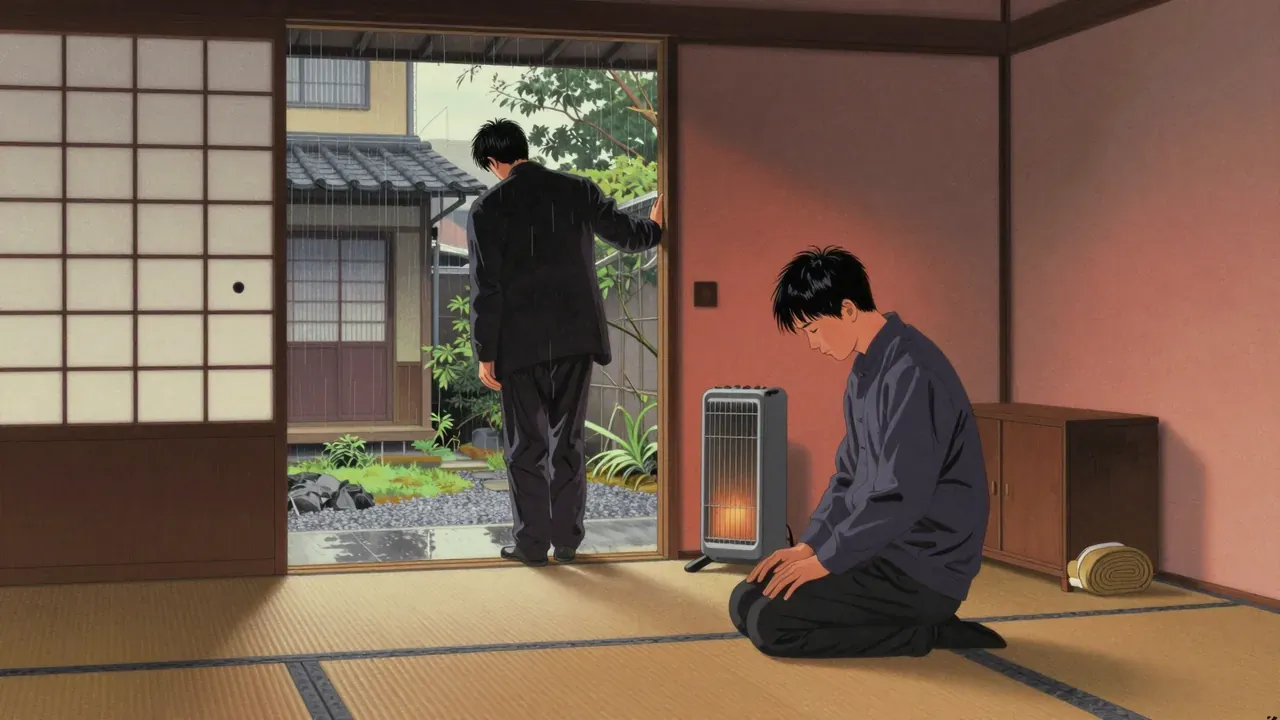
The walk begins
The Emperor’s Naked Army Marches On is a Japanese documentary that follows Kenzō Okuzaki, a 62-year-old Second World War veteran, as he investigates the deaths of two privates in his former New Guinea unit. It does not reconstruct events with archive footage or narration; instead, it observes Okuzaki’s confrontational, often coercive interviews with surviving officers and soldiers. The film makes no claim to resolve historical ambiguity—it records how memory fractures under time, shame, and trauma. Kazuo Hara and producer Sachiko Kobayashi position the camera at close range, rarely intervening, letting Okuzaki’s rage and persistence drive the inquiry. There is no voiceover, no timeline overlay, no explanatory text beyond a single title card about confiscated New Guinea footage and an epilogue summarising Okuzaki’s later attempted murder of a former captain. The film’s purpose is not forensic closure but sustained, uncomfortable witness: to show how war’s moral collapse persists in the bodies and speech of those who lived it. It treats history not as settled record but as contested terrain, still yielding violence decades later. (158 words)
The look of it
The film works through unmediated duration and proximity. Hara’s crew films Okuzaki in real time—walking city streets, entering homes unannounced, pressing questions until voices break or fists rise. Okuzaki’s performance is neither staged nor moderated: he shouts, slaps, invades personal space, and declares violence his ‘forte’. His physicality—his age, his limp, his relentless pacing—anchors every scene. The sound recording by Toyohiko Kuribayashi captures breath, silence, muffled sobs, and the abrupt thud of a shove without embellishment. Editing avoids rhythm or emphasis; sequences run long, resisting catharsis. When Okuzaki corners a sergeant in a cramped room and forces a confession about cannibalism, the camera holds steady, refusing cutaways or reaction shots. There are no re-enactments, no maps, no subtitles beyond translation—just Japanese speech, its tonal shifts and hesitations left audible. The absence of music, of archival inserts, of contextual framing, means the viewer must sit with contradiction: competing testimonies about desertion, execution orders, racial euphemisms, and survival logic all land with equal weight because the film grants them equal space. (159 words)
The shape of memory
What lands is the unbearable weight of unresolved accountability. Okuzaki’s fixation on the Shōwa Emperor—not as symbolic figurehead but as living, breathing man who evaded trial—gives the film its moral spine. His accusation that Hirohito was ‘the most cowardly man in Japan’ lands not as rhetoric but as the culmination of decades of suppressed grief and institutional betrayal. The film’s power resides in the cumulative effect of small, brutal admissions: a former officer admitting he fired the coup de grâce; a sister stating her belief that her brothers were killed so officers could eat; the sergeant’s matter-of-fact recollection of marking men for death based on perceived moral failure. These moments do not build to revelation but to repetition—the same phrases recur across interviews, slightly altered, never resolved. The viewer feels the exhaustion of truth-seeking when evidence is oral, contradictory, and soaked in guilt. The epilogue’s dry summary of Okuzaki’s prison sentence lands with quiet force: the state punishes the investigator, not the investigated. This asymmetry—between official impunity and individual reckoning—is what endures. (157 words)
The weight of the hand
What does not land is any sense of resolution, and the film does not intend to offer one—yet its refusal to editorialise can read as abdication where moral clarity is needed. Okuzaki’s physical aggression, while documented without judgment, risks normalising coercion as investigative method; the film offers no counterpoint from ethics, law, or even fellow veterans who might dissent. The absence of Indigenous New Guinean voices—despite their centrality to the cannibalism accounts and the film’s own title referencing ‘black pigs’—is a structural silence the film neither acknowledges nor mitigates. Likewise, the Indonesian government’s confiscation of New Guinea footage is noted only in a title card, with no exploration of why or what was lost. The film’s rigour becomes a limitation when context is withheld: we hear ‘white pigs’ and ‘black pigs’ but no analysis of wartime dehumanisation as systemic policy, no reference to Japanese military codes or colonial hierarchies in the South Pacific. Some viewers may find the unrelenting focus on Okuzaki’s methods exhausting without sufficient grounding in the broader history of Japan’s New Guinea campaign or postwar justice mechanisms. (159 words)
The emperor’s silence
The themes that matter are responsibility without recourse, memory as injury, and the slow violence of impunity. The film interrogates how institutions dissolve accountability: the Emperor escapes trial, officers evade prosecution, and Okuzaki—though he names names—receives twelve years for attempting murder while those he accuses face no legal consequence. It treats trauma not as interior psychology but as social fact: embodied in Okuzaki’s limp, voiced in stammered confessions, enacted in the repeated physical intrusions into private homes. Colonialism surfaces obliquely—not as historical backdrop but as lived hierarchy: the designation of Indigenous people as ‘black pigs’ reveals how racialised dehumanisation enabled survival cannibalism, yet the film never pauses to examine that language’s roots in imperial ideology. Ageing is another quiet theme: Okuzaki’s frailty contrasts with his ferocity, suggesting rage as the last functional muscle left after decades of silence. The film also insists on the materiality of war’s aftermath—starvation, decay, the body as both weapon and food—refusing abstraction. These are not philosophical questions posed in voiceover but truths forced out of mouths under duress, then left hanging. (158 words)
The sentence
This film is for viewers who can hold sustained discomfort without demanding resolution—those accustomed to essay films, direct cinema, or politically charged non-fiction that refuses catharsis. It suits historians, students of postwar Japan, or anyone attentive to how power operates through omission. It is not for those who require narrative symmetry, emotional safety, or clear moral signposting; its ethical stance is implicit, not declared. People who expect documentaries to explain, contextualise, or offer expert commentary will find it withholding. Those sensitive to unmediated verbal aggression or depictions of physical coercion—including scenes where Okuzaki injures an interviewee—should approach with caution. A viewer expecting insight into New Guinean perspectives or Indonesian sovereignty over the territory will be disappointed. The film’s rigour assumes prior knowledge of Japan’s wartime conduct and postwar politics; without it, Okuzaki’s fury may seem unmoored. Others may argue the film’s neutrality toward Okuzaki’s methods undermines its moral weight—but that neutrality is precisely its provocation. (159 words)
The echo
Yes, it is worth your evening—if you accept that some films exist not to entertain or inform but to unsettle and persist. Its 122 minutes do not pass easily; they accumulate, like testimony in a courtroom with no judge. It rewards attention not with answers but with sharper questions about who gets to speak, who is silenced, and what violence looks like when it wears the face of a pensioner knocking on doors. Those who prefer documentaries with narration, graphics, or a guiding thesis will find it alienating—but that is the point. It asks more of the viewer than most films dare: to sit with contradiction, to bear witness without resolution, to feel the weight of history as physical pressure. It is not for casual viewing, nor for those seeking uplift. But for anyone willing to confront how war’s rot lingers in language, gesture, and silence, it remains singular. Its endurance lies not in what it shows, but in what it refuses to soften. (159 words)