The look of it
The Bridge is a West German war drama released in October 1959, directed by Bernhard Wicki and adapted from Gregor Dorfmeister’s 1958 novel. It sets out to depict the final days of World War II not through generals or strategy, but through seven teenage boys drafted into the Volkssturm and assigned to defend a useless bridge near their hometown. Its purpose is not historical reconstruction but moral compression: to show how ideology, adult abdication, and adolescent idealism converge in a single, futile act of violence. The film avoids grand pronouncements; its anti-war stance emerges from accumulation — from the boys’ unformed personalities, their half-understood loyalties, and the sheer physicality of their deaths. It does not ask whether war is wrong, but forces the viewer to witness what happens when war is handed to children who have never been taught how to refuse it. The closing line — that the event was so minor it never appeared in any war communique — is not irony but quiet indictment: this kind of waste requires no justification, only silence.
The boys in the barracks
The story follows a tight, chronological arc: recruitment, deployment, isolation, engagement, and collapse. Performances are restrained and unvarnished — Fritz Wepper as Karl, Michael Hinz as Walter, Folker Bohnet as Klaus — all avoid theatricality, leaning instead on gesture and hesitation. Gerd von Bonin’s cinematography keeps the palette muted and the framing tight, favouring medium shots that hold the boys within their environment rather than isolating them as heroes or victims. Hans-Martin Majewski’s score is sparse, using strings and percussion only at moments of rupture. Carl Otto Bartning’s editing sustains rhythm without emphasis: cuts land where breath would catch, not where music swells. The script by Wicki and Michael Mansfeld gives each boy a private friction — with family, desire, shame — but never resolves them. Their inner lives remain sketches, which makes their collective end more unsettling: they die not as characters fully known, but as types made real by duration and consequence.
The bridge at dawn
What lands is the cumulative weight of small, unremarkable choices adding up to irreversible consequence. The scene where the Unteroffizier is shot by Feldgendarmerie for no clear reason — not cowardice, not betrayal, just misrecognition — lands with chilling banality. So does Sigi’s death: he refuses cover not out of courage but because he has been mocked, and his stillness under fire becomes unbearable precisely because it is unmotivated by anything larger than pride. Walter’s two tank kills feel less like triumph than mechanical inevitability — the Panzerfaust is heavy, loud, and effective, and he uses it twice before being cut down. The final sequence, where Albert kills the Feldwebel and then dies alone, lands not as catharsis but as exhaustion: the machinery of command continues even after meaning has evaporated. These moments work because they are presented without commentary, without flashback, without music to cue response. The film trusts the viewer to sit with cause and effect as they unfold in real time.
The first shot
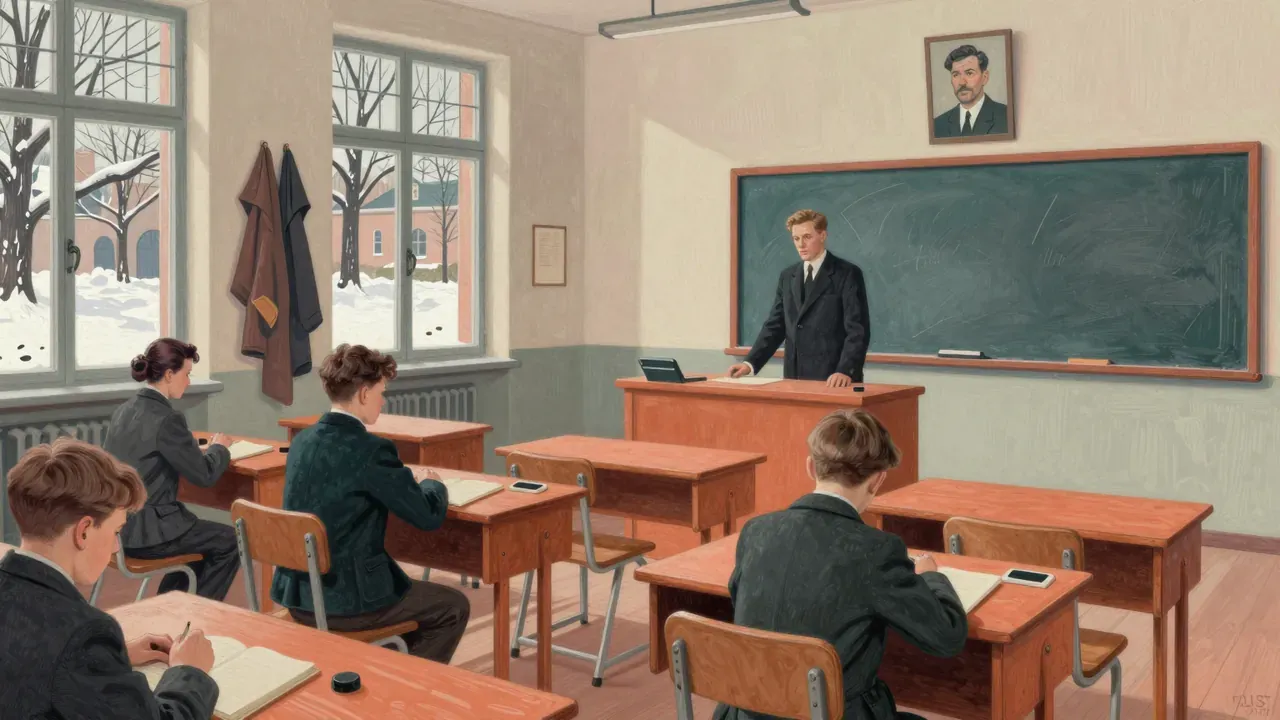
What does not land is the framing device implied by the opening school scenes — the sense that these boys were ‘normal’ before being swept up. Their domestic tensions are sketched too thinly to carry emotional freight: Karl’s crush, Klaus’s obliviousness, Walter’s resentment — none are developed beyond exposition. The teacher’s brief intervention, meant to underscore adult complicity, feels perfunctory rather than damning. The American soldiers remain functionally anonymous; their dialogue is minimal, their motives opaque, their humanity flattened by narrative necessity. This is not a failure of intent — the film is not about the enemy — but it leaves a gap where moral symmetry might have deepened the horror. Some viewers may also find the pacing uneven: long stretches of waiting on the bridge risk monotony if the viewer does not already accept the stakes. The film assumes attention, not empathy, and that assumption excludes those unwilling to meet it halfway.
The code they kept
The themes that matter are not war itself but the infrastructure that delivers boys to it: conscription as routine, authority as delegation without responsibility, duty as repetition of phrase without understanding. Adolescence is treated not as a stage of growth but as a condition of suspension — between childhood certainty and adult accountability, neither of which these boys are allowed to inhabit. The bridge is literal and symbolic: a structure built to connect, now repurposed as a threshold to death, guarded by those who do not know why it matters. Nationalism appears not as belief but as habit — repeated slogans, inherited uniforms, the reflexive use of ‘Führer und Vaterland’ without reference to either. Trauma is shown not in aftermath but in real time: Klaus begging Karl to kill a dying man, then running into gunfire upon learning Karl is already dead. There is no recovery here, only interruption — of life, of thought, of language. The film’s moral centre is not pacifism but precision: it asks what happens when institutions stop asking questions and start assigning square metres to defend.
The engineer’s arrival
This film is for viewers who can sit with unrelieved gravity, who value craft over comfort, and who understand that restraint in performance and editing is not absence but discipline. It is for students of postwar German cinema, of adaptation as distillation, and of war films that reject spectacle. It is not for those who require narrative resolution, psychological exposition, or moral clarity — the film offers none. Parents of teenagers may find it useful, but only if prepared to discuss its implications directly; its power lies in what it withholds, not what it explains. Those who expect historical context or geopolitical framing will leave unsatisfied: the film names no battles, cites no dates beyond its closing line, and locates itself entirely in the provincial. A viewer who values character arcs over collective fate, or who needs catharsis as release, will likely find the ending intolerably bleak — not because it is unjustified, but because it refuses consolation.
The line before the credits
Yes, it is worth your evening — provided you set aside the expectation of entertainment and accept it as a durational reckoning. Its 103 minutes pass slowly not from slackness but from insistence: every shot holds its ground, every silence is weighted, every death arrives without flourish. It rewards attention, not passive viewing. Those who dismiss it as ‘depressing’ or ‘dated’ misunderstand its method — it is not trying to move you emotionally so much as recalibrate your sense of scale: one bridge, seven boys, one morning, no record. A viewer who prefers irony, ambiguity, or aesthetic distance will find it too direct. A viewer who values historical accuracy over moral concentration may prefer something more annotated. But for anyone willing to sit with what the film presents — not as allegory, not as memory, but as forensic account — it remains singular in its economy and force. Its value is not in what it says, but in how little it needs to say to make its point stick.