What it is
Singin’ in the Rain is a studio musical built around a conceit: to repurpose pre-existing songs — mostly by Nacio Herb Brown and Arthur Freed — into a coherent, self-aware narrative about Hollywood’s chaotic shift from silent films to sound. It does not aim for realism or historical fidelity but for structural wit: the plot mirrors the formal constraints of its own genre, using the talkie transition as both setting and metaphor for artistic reinvention. The film treats song-and-dance not as ornament but as narrative engine and emotional logic — characters sing when dialogue fails, dance when language collapses, and re-stage reality when technology distorts it. Its ambition is modest on paper — a romantic comedy with set pieces — but precise in execution: to demonstrate how craft, timing, and collaborative ingenuity can convert commercial obligation into durable art. It assumes familiarity with vaudeville rhythm, studio-era hierarchy, and the physical grammar of musical performance. It presumes no irony toward its own artifice; its sincerity is methodical, not naive.
How it holds together
The story follows Don Lockwood’s navigation of professional obsolescence and romantic misalignment during the 1927–28 shift to sound, with Kathy Selden as his grounded counterpoint and Lina Lamont as the brittle symbol of silent-era artifice. Betty Comden and Adolph Green’s script balances farce with structural discipline: every subplot serves the central question of what survives technological disruption — voice, talent, partnership, or image. Gene Kelly and Donald O’Connor deliver performances rooted in physical specificity — O’Connor’s ‘Make ’Em Laugh’ is calibrated exhaustion, Kelly’s title number a controlled surrender to weather and gravity. Harold Rosson’s cinematography avoids flourish; he keeps frames stable, lets choreography dictate movement, and uses deep focus to preserve spatial clarity during ensemble numbers. Adrienne Fazan’s editing sustains momentum without cutting away from effort — we see breath, sweat, weight. The score functions diegetically and non-diegetically, with Freed and Brown’s melodies repurposed as both character expression and industrial commentary.
Where it lifts
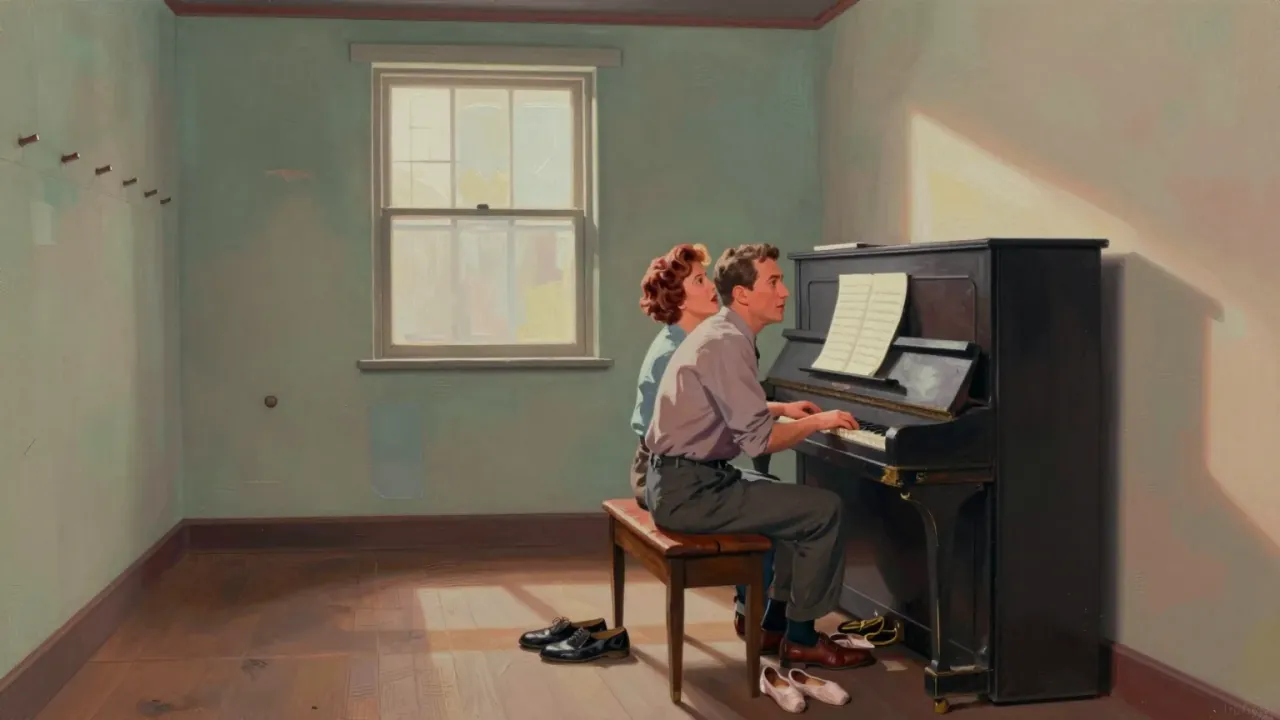
What lands most decisively is the film’s refusal to separate technique from feeling. The ‘Broadway Melody Ballet’ works not because it is lavish but because its internal logic — a dream sequence where Kelly’s character resolves his romantic and professional conflicts through choreographed allegory — is sustained without exposition. ‘Good Morning’ lands because its lightness is earned: three performers exhausted from filming, sharing a single piano bench, their voices overlapping in unpractised harmony. The rain sequence lands because Kelly’s soaked shirt clings, his umbrella spins off-centre, and his grin never falters despite fever — the physical cost is visible, the joy uncompromised. Even Jean Hagen’s Lina Lamont succeeds not as caricature but as consequence: her shrill voice and brittle vanity are symptoms of a system that rewards surface over substance. The film’s warmth comes from its respect for labour — for dubbing artists, stunt dancers, prop men, and editors — all of whom appear, unnamed but present, in the margins of the frame.
Where it leans
What does not land is the framing device of the Hollywood premiere, which opens and closes the film with perfunctory fanfare and no thematic return. The R.F. Simpson character remains functionally inert — a producer who exists only to deliver exposition and approve rewrites. Debbie Reynolds’s Kathy, though well-acted, is underwritten in motivation: her decision to remain anonymous as Lina’s voice lacks interiority beyond loyalty, and her arc hinges on Don’s recognition rather than her own assertion. The ‘Beautiful Girl Montage’ feels detached from narrative progression — a showcase for Cyd Charisse and Rita Moreno that serves studio branding more than character development. Some transitions rely on musical cue alone, skipping psychological bridges: Don’s shift from dismissing Kathy to pursuing her occurs off-screen, leaving emotional causality thin. The film’s faith in charm occasionally substitutes for depth — particularly in its treatment of class, where studio executives move freely between penthouses and soundstages while extras vanish after a single take.
What it’s really about
The themes that matter are continuity amid rupture, the labour behind illusion, and the ethics of authorship in collaborative media. The film treats dubbing not as deception but as redistribution of skill — Kathy’s voice replaces Lina’s not to erase but to complete. It interrogates value: why is Lina paid more than Kathy? Why does Don’s dancing retain prestige while Cosmo’s comic timing is framed as support? The transition to sound becomes a lens for asking what endures when tools change — not just voices, but partnerships, hierarchies, and definitions of talent. There is quiet critique in how the studio absorbs crisis: R.F. Simpson doesn’t fix the system, he rebrands it, turning technical failure into marketable novelty. The film’s nostalgia is procedural, not sentimental — it mourns neither silents nor talkies, but the moment before consensus, when rules were unwritten and anyone with rhythm and nerve could rewrite them.
Who it’s for
It is for viewers who value precision of craft over psychological exposition, who find pleasure in watching people solve problems with their bodies and voices, and who accept musical logic as narrative grammar. It is not for those who require interior monologue, moral ambiguity, or social critique delivered without levity. A viewer expecting satire may find its tone too affectionate; one seeking realism will reject its studio-bound geography and compressed chronology. Those put off by mid-century American diction, unironic romance, or the physical demands of tap choreography will disengage early. But its accessibility is structural, not diluted: children grasp its slapstick and rhythm before parsing its meta-commentary, while film scholars return to its editing rhythms and production design. Its endurance rests on this dual register — immediate in sensation, cumulative in meaning — and that duality holds only if the viewer accepts its terms: that singing in the rain is both absurd and necessary.
Is it worth your time
Yes, it is worth your evening — not as period curiosity or textbook example, but as a working model of how form and function cohere. Its 103 minutes sustain a single, unwavering proposition: that art made under constraint, with clear purpose and shared competence, can outlive its context. You need not love musicals to feel the lift of ‘Good Morning’, nor be familiar with 1920s Hollywood to recognise the panic of obsolete skill. Its pleasures are kinetic and auditory first, intellectual second — and that order matters. Someone who finds its cheerfulness cloying, or its gender dynamics outdated without interrogation, would reasonably decline. But that objection changes only the viewer’s stance, not the film’s coherence: it was never designed to provoke discomfort, but to demonstrate resilience through rehearsal, revision, and repetition. Its worth lies in that demonstration — intact, unapologetic, and still technically flawless.