The weight of the dead
The Burmese Harp is a Japanese war drama from 1956 that adapts Michio Takeyama’s novel into a meditation on grief, duty and spiritual rupture. It does not recount battlefield tactics or political causation; instead, it follows a group of Japanese soldiers in Burma at the war’s end, then narrows to one man’s refusal to return home after surviving a massacre. Kon Ichikawa and screenwriter Natto Wada strip the source’s children’s-book tone to expose the physical and moral weight of unburied dead. The film’s aim is neither indictment nor exoneration but quiet insistence: that mourning must precede memory, and that peace cannot be declared over corpses left exposed. It treats surrender not as capitulation but as a threshold — one crossed by singing, then silence, then solitary labour. Its perspective is Japanese, but its gaze is fixed on the ground, not the flag: on mud, bone, monsoon light, and the slow accumulation of mounds where bodies are laid. It asks how a soldier becomes a monk not through doctrine, but through repetition — digging, washing, naming, saluting — until ritual overtakes identity. Word count: 148
The look of it
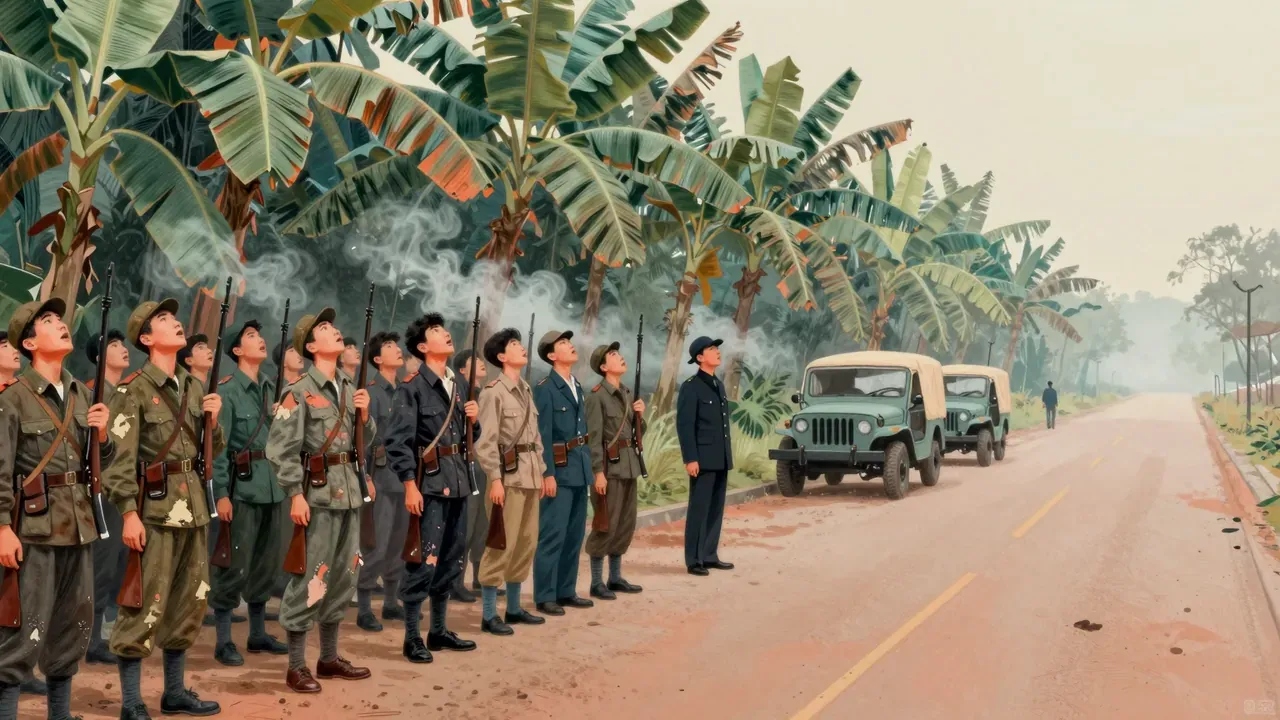
The story unfolds in two movements: collective surrender, then individual pilgrimage. Jun Hamamura, Rentarō Mikuni and Shōji Yasui anchor the ensemble with restrained physicality — Mikuni’s Captain Inouye carries authority without volume, Yasui’s Mizushima grows quieter with each scene until speech ceases altogether. Natto Wada’s script avoids exposition; motivations emerge through gesture — a hand tightening on a harp string, a pause before kneeling, the way a parrot’s mimicry echoes human longing without understanding it. Akira Ifukube’s score uses sparse harmonies and recurring motifs, notably the adaptation of ‘Home! Sweet Home!’ as ‘Hanyo no yado’, which functions less as melody than as cultural resonance — heard first in barracks, then across enemy lines, then as a ghost in Mizushima’s memory. Gordon Willis is not involved; cinematographer Kazuo Miyagawa works in high-contrast monochrome, holding shots long enough for landscape to settle into character: mist over hills, rain on bamboo, the flat glare of a sun-baked plain. Ichikawa’s storyboards are followed precisely, yielding compositions that feel inevitable rather than composed. Word count: 152
What stays with you
What lands is the cumulative weight of small, repeated acts: Mizushima’s daily burial of corpses, the soldiers’ shared song before surrender, the captain’s decision to send a parrot instead of a search party. These are not symbolic gestures but practical ones — the only tools available when language fails and institutions collapse. The film’s restraint makes its emotional impact durable: there is no swelling music at the graves, no close-up on a tear, no voiceover explaining enlightenment. Instead, we see Mizushima’s hands, cracked and stained, smoothing earth over a skull; we see the British captain’s stillness as he watches the Japanese men sing; we see the monk’s robe, borrowed and worn, becoming indistinguishable from devotion through use. The final ocean shot does not signify closure but continuity — water as both boundary and passage, horizon as neither destination nor endpoint. The film earns its solemnity not through grandeur but through fidelity to scale: one body, one mound, one day’s walk. Its power lies in what it refuses to dramatise — vengeance, guilt, triumph — and what it insists on showing instead: time spent, ground covered, silence held. Word count: 154
Where it holds back
What does not land is the film’s occasional reliance on narrative convenience to sustain its spiritual arc. Mizushima’s transition from conscript to monk occurs off-screen, with no visible crisis of faith — only injury, recovery, and theft of robes. The logic of his choice rests on implication rather than dramatisation, leaving his final letter to feel more like a thesis statement than earned revelation. The British soldiers’ immediate, harmonious response to ‘Home! Sweet Home!’ strains plausibility without irony or commentary, flattening the asymmetry of power between occupier and occupied. Likewise, the film’s visual reverence for Burmese Buddhist iconography sits uneasily beside its near-total absence of Burmese characters — no villagers speak beyond background murmur, no local voice interprets the landscape or its sacred geography. This omission risks turning Burma into a stage set for Japanese introspection, especially given the historical reality of Japanese occupation atrocities there. The film’s pacifism is sincere, but its moral framework remains inward-facing, anchored to national loss rather than regional consequence. Word count: 156
What it believes in
The themes that matter are not Buddhism as doctrine but as practice — bowing, burying, chanting, walking — and the tension between collective memory and individual conscience. Mizushima’s pilgrimage is less about conversion than about displacement: he sheds uniform, name, nationality, and finally speech, not to erase himself but to inhabit a role older than empire. The harp is not an instrument of art but of translation — its strings vibrating across language, rank and allegiance. The film treats landscape as liturgy: full moons hang like suspended sutras; mist veils statues as if they breathe; the ocean at the end is not escape but dissolution of the self into something wider than nation or creed. Nationalism persists, but as residue — in the Japanese-style wooden boxes used for remains, in the soldiers’ instinct to salute even when no officer is present. The film’s deepest concern is not war’s horror but its aftermath: how societies dispose of the dead, and what happens when one man decides disposal is also devotion. Word count: 150
Who it is for
This film is for viewers who accept stillness as intensity, who find gravity in duration rather than escalation, and who do not require explanation to feel conviction. It rewards attention to texture — the grain of film stock, the rasp of a throat after singing, the sound of rain on thatch — and patience with ambiguity. It is not for those who need narrative propulsion, psychological exposition or moral clarity. Some will find its pace glacial, its ending unresolved, its politics insufficiently interrogated — particularly scholars of colonial violence or Southeast Asian history, for whom the film’s erasure of Burmese agency may feel like complicity. A viewer who expects anti-war cinema to name perpetrators or assign responsibility will leave unsatisfied. The verdict changes only if the film were re-cut to include Burmese perspectives, or if its soundtrack incorporated indigenous Burmese music alongside the adapted Western hymn — but it is not. Word count: 150
Is it worth your evening
Yes, it is worth your evening — not as diversion but as calibration. Its 116 minutes move slowly, but never waste time; every frame serves the central question of how to live after mass death. It does not offer answers, but it models attention: to soil, to silence, to the weight of a single body. You will not laugh, jump or gasp, but you may find yourself holding your breath longer than usual, or noticing how light falls on a wall the next morning. It is not universally accessible — its form assumes a willingness to sit with absence — but for those prepared, it lingers like incense smoke: faint, persistent, impossible to ignore. Those who dismiss it as dated or sentimental have likely missed its rigour: this is not nostalgia, but archaeology — of feeling, of duty, of what remains when flags are lowered and songs stop. Word count: 150